Laravel Performance Optimization: CTO Guide 2026


By 2026, over 1.7 million websites rely on Laravel, yet many CTOs still treat performance as a series of reactive patches rather than a foundational architectural discipline. You likely recognize the frustration of watching infrastructure costs climb while page load speeds stagnate during peak traffic. It's a common challenge when legacy codebases struggle to keep pace with modern user expectations and the demands of PHP 8.3 environments. Maintaining a competitive edge requires more than just adding servers; it demands a systematic refinement of your software's core structure.
This guide provides a definitive roadmap to master laravel performance optimization, moving beyond surface-level fixes to build a leaner, more resilient system. We'll explore how to leverage Laravel 13's latest features, implement advanced caching strategies with Redis, and utilize tools like Laravel Octane to ensure your application remains a high-performance asset. By the end of this article, you'll have a clear strategy to reduce technical debt, lower operational overhead, and deliver a snappier experience that scales effortlessly during your most critical growth phases.
In the competitive UK digital landscape, performance has transitioned from a technical preference to a core business KPI. For a CTO, the speed of a Laravel application is directly tied to user retention and transaction success. Every millisecond of latency introduces friction. Research consistently shows that even minor delays lead to measurable drops in conversion rates. When a platform feels sluggish, users don't just wait; they churn. This makes laravel performance optimization a strategic investment rather than a maintenance task.
Technical debt often manifests as performance decay. Inefficient Eloquent queries, unoptimized middleware, and bloated service providers compound over time. This debt doesn't just frustrate users; it drives up operational costs. Inefficient code requires more CPU and memory, forcing you to pay for higher-tier server resources to mask underlying structural flaws. Adopting a rigorous approach to Application Performance Management (APM) allows leadership to visualize these bottlenecks before they impact the balance sheet.
True software quality is defined by quiet competence. Users rarely notice when a system is fast, but they immediately feel when it isn't. Reliability builds a silent bond of trust. If your platform performs perfectly under pressure, you project an image of a modern, disciplined organization. Conversely, ignoring speed leads to SEO penalties as search engines prioritize Core Web Vitals. It's a cycle of infrastructure bloat and diminishing returns that only architectural refinement can break.
Optimizing your Laravel environment delivers immediate financial benefits through reduced resource consumption. A lean system processes more requests per second on the same hardware. This efficiency prevents the need for linear increases in hosting spend as your user base grows. Beyond the monthly bill, optimized systems are inherently more stable. They require less emergency intervention from your engineering team; this allows them to focus on feature development instead of firefighting performance regressions.
Speed is a feature that your competitors might be neglecting. In 2026, B2B and B2C users expect instantaneous interactions. Delivering a snappier experience than your rivals directly influences organic visibility and brand preference. By prioritizing laravel performance optimization, you ensure the longevity of your digital assets. Scalable, high-performance systems act as a solid foundation for future growth, enabling you to integrate new capabilities without compromising the core user experience.
The database layer is frequently the primary source of latency in scaling applications. The N+1 query problem remains the most prevalent silent killer of speed. It occurs when your code executes one query to fetch a parent record and then individual queries for every related child record. In a list of fifty items, this results in fifty-one database hits. Switching to eager loading via Laravel's with() method collapses these into two efficient queries. This shift is a fundamental step in any laravel performance optimization initiative.
Beyond query count, the volume of data transferred matters. Legacy systems often default to select *, which pulls every column into memory. This is inefficient. By selecting only the specific fields required for a view, you significantly reduce the memory footprint on your web server. This discipline, combined with strategic database indexing, provides the "low-hanging fruit" improvements that many organizations overlook. Proper indexing ensures the database engine doesn't perform full table scans for every request, which is vital for maintaining responsiveness as your dataset grows.
While Eloquent provides a developer-friendly syntax, it can introduce overhead in data-intensive scenarios. High-performance data fetching often requires moving beyond basic relationships toward subqueries and joins. Executing aggregations like sums or averages directly at the database level is always faster than processing large collections in PHP. Eloquent overhead arises when the framework hydrates thousands of model instances into memory; you can mitigate this by using the chunk or cursor methods to process records in manageable batches instead of loading everything at once.
Building for the future requires a balance between normalisation and purposeful denormalisation. While a normalised schema maintains data integrity, read-heavy applications often benefit from denormalised tables that reduce the need for complex joins. You can identify these pressure points using tools like Laravel Telescope or Debugbar. As you scale toward high-concurrency environments, consider architectural shifts like database replication or sharding to distribute the load. If your current system feels sluggish under pressure, a targeted software maintenance audit can pinpoint exactly where your schema is failing.
Data from the Web Almanac caching data suggests that the efficiency of your origin server is the ultimate bottleneck for overall site speed. Efficient laravel performance optimization starts at the source. By refining how your application interacts with its data, you build a foundation that remains stable even as traffic surges. This structural discipline ensures your platform can handle the demands of 2026 without requiring constant infrastructure upgrades.
High-performance Laravel applications in 2026 don't just rely on optimized databases; they minimize database hits entirely. This is where a sophisticated caching strategy becomes essential. While file-based systems are sufficient for development, production environments demand Redis. It provides the low-latency, in-memory storage required to handle thousands of concurrent requests without taxing the underlying hardware. Transitioning to Redis is a non-negotiable step in modern laravel performance optimization for national-scale platforms.
Effective caching follows a clear hierarchy. It begins with the basics: config:cache, route:cache, and view:cache. These commands reduce the bootstrap overhead of the framework by pre-compiling essential files. However, the real gains come from caching complex query results and expensive computed data. By storing these fragments in an in-memory store, you bypass the logic that typically slows down a request-response cycle, ensuring your infrastructure remains responsive under load.
Managing cache at scale requires precision to avoid serving stale data. Cache tagging allows you to group related entries and invalidate them simultaneously when the underlying data changes. This is vital for dynamic applications where accuracy is as important as speed. For modern architectures, balancing full-page responses with granular data fragments is the most effective approach. This strategy ensures that Vue.js frontend development can interact with cached APIs to deliver near-instant loads, even during complex data transitions.
Not every task needs to happen in real-time while a user waits for a page to load. Asynchronous execution is a pillar of laravel performance optimization, allowing you to offload time-consuming logic to background workers. Common candidates for background processing include:
Monitoring these background tasks is just as important as executing them. Laravel Horizon provides a specialized dashboard to track job throughput, wait times, and failure rates. It allows you to scale worker counts dynamically based on current demand. If a job fails due to a temporary network glitch, built-in retry mechanisms and failure handling ensure the system remains reliable. By distributing jobs across multiple queue workers, you prevent server bottlenecks and maintain a consistent performance profile even during significant traffic spikes.
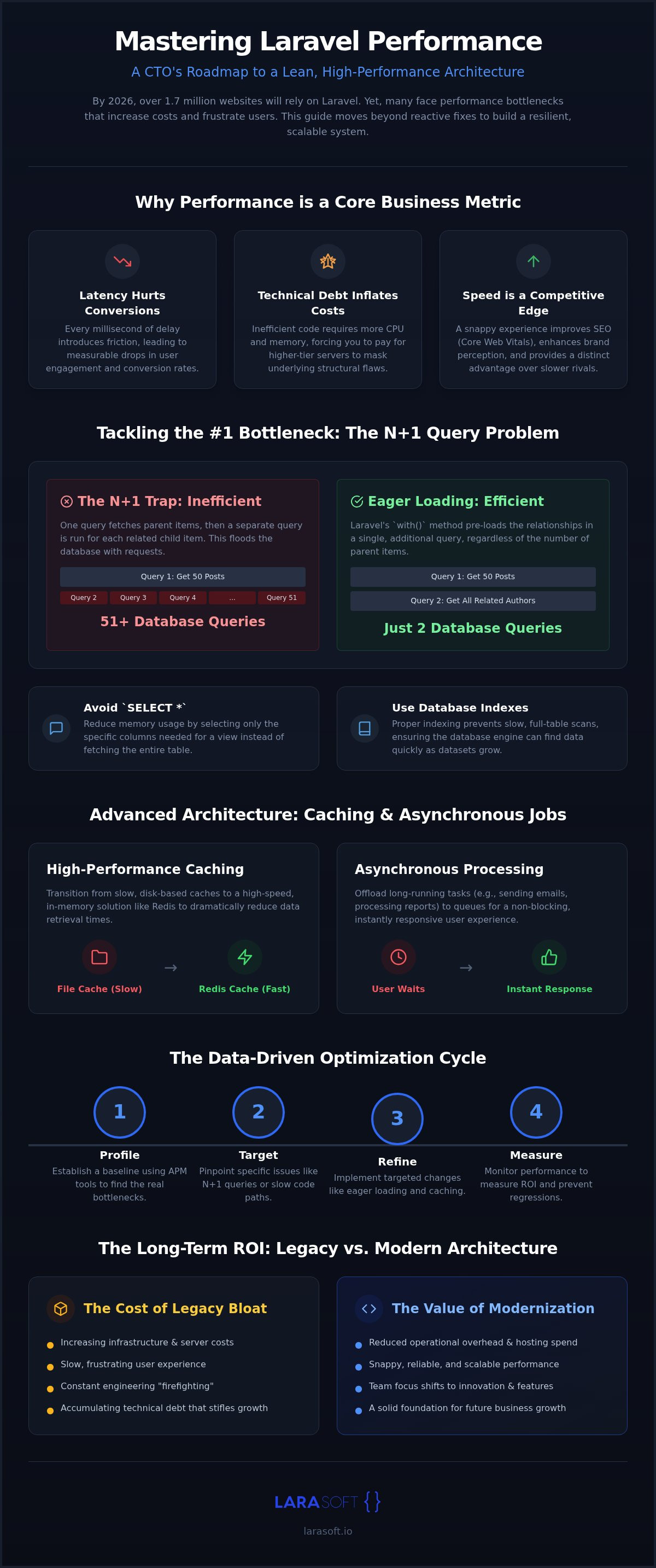
Precision defines the modern technical artisan. Guessing where latency originates is a costly use of engineering resources that rarely yields long-term results. In 2026, laravel performance optimization must be a data-driven discipline. You can't improve what you haven't measured. Establishing a performance baseline involves two distinct perspectives: synthetic monitoring for controlled benchmarking and Real-User Monitoring (RUM) to capture the actual experience of your UK-based audience. Most bottlenecks follow the Pareto principle; identifying the 20% of code responsible for 80% of your performance issues allows for surgical, high-impact interventions.
The latest iterations of Laravel 12 and 13 have introduced more sophisticated telemetry. Modern AI-driven profiling tools now integrate directly with the framework to detect anomalies in real-time. These systems identify patterns of inefficiency, such as memory leaks in long-running Octane workers or unusual spikes in middleware execution time, before they trigger a system-wide slowdown. By moving away from reactive "firefighting" and toward proactive profiling, you maintain the structural integrity of your application as it scales.
A structured audit prevents your team from chasing "ghost" issues. Follow this logical progression to isolate bottlenecks:
Your choice of tooling dictates the depth of your insight. Laravel Telescope and Debugbar are excellent for local development and identifying immediate issues like N+1 queries. For deep architectural analysis in production, commercial solutions like Blackfire.io provide a granular view of the function call graph. These tools help you monitor server-level metrics, including CPU saturation, RAM usage, and I/O bottlenecks that might be hidden by framework-level abstractions. To ensure these gains are permanent, our proactive software maintenance services provide ongoing profiling to catch and resolve performance regressions before they impact your users.
Legacy applications present a unique set of challenges for laravel performance optimization. Over time, codebases accumulate technical debt that manifests as sluggish response times and increased infrastructure costs. You likely find yourself at a crossroads: continue patching a bloated system or commit to a structural modernisation. While minor refactoring can resolve immediate bottlenecks, a comprehensive strategy is required to transform a legacy asset into a high-performance engine capable of supporting modern business demands without constant intervention.
Adopting the "Strangler Fig" pattern is a proven architectural approach for managing this transition. Instead of a risky, all-at-once rewrite, this method involves gradually replacing slow legacy modules with modern, high-performance services. This ensures continuous availability while systematically eliminating the weight of inefficient code. A structured software maintenance plan acts as the safety net for this process, preventing performance decay from re-entering the system during the modernisation phase.
Upgrading to PHP 8.3 and Laravel 13 is the most effective way to leverage modern engine optimizations like Just-In-Time (JIT) compilation. These updates provide a cleaner syntax and improved developer experience, but the real value lies in the underlying speed improvements. Beyond versioning, you must address "God Classes" and bloated controllers that hinder execution speed. Integrating Laravel AI solutions can accelerate this process by detecting anomalies and suggesting automated refactoring paths that would take human engineers weeks to identify manually.
Executing a large-scale modernisation requires a level of technical authority that internal teams, often stretched by feature delivery, may lack. A specialized Laravel development agency brings the artisan's eye for detail needed to build efficient, clean systems. This partnership ensures that your application isn't just "fixed" but is rebuilt as a foundational asset for future growth. We focus on the cleanliness of the code and the structural integrity of the architecture to ensure your system performs perfectly under pressure. Our problem-solving framework makes complex development processes a manageable, structured journey toward growth.
Ready to eliminate bottlenecks? Speak to our Laravel experts about a performance audit.
Achieving peak application speed requires more than surface-level tweaks. It demands a disciplined commitment to structural integrity, from eliminating silent N+1 query bottlenecks to implementing high-performance Redis caching layers. By transitioning from reactive patching to a proactive, data-driven profiling strategy, you ensure your platform remains resilient as user demands evolve. Mastering laravel performance optimization isn't just a technical requirement; it's a strategic move to lower operational costs and build a snappier, more reliable user experience.
Transforming a bloated legacy system into a high-performance asset is a journey that requires specialized expertise. As a UK-based team of technical artisans, Larasoft has delivered expert Laravel Web Development since 2018. We're specialists in Legacy Code Modernisation who find genuine satisfaction in building systems that excel under pressure. Don't let technical debt hinder your growth. Optimise your application performance with Larasoft and turn your software into a foundational asset for the future. Your path to a faster, more scalable architecture starts with a single, decisive step.
Precision profiling is the first step toward improvement. Use tools like Laravel Telescope or Debugbar for local development to identify immediate issues like N+1 queries. For production environments, Blackfire.io provides a granular call graph that reveals exactly which functions consume the most CPU and memory. Analyzing slow query logs and measuring the Time to First Byte (TTFB) allows you to apply targeted laravel performance optimization where it matters most.
Upgrading to Laravel 13, which launched on March 17, 2026, provides a faster foundation because it requires PHP 8.3. This version of PHP includes engine-level optimizations that reduce framework overhead and improve execution speed. While the upgrade offers immediate gains through cleaner syntax and better resource management, it won't fix underlying architectural flaws. You must combine framework updates with structural code refinements to achieve the best results for your application.
The N+1 query problem is a silent killer of database speed. It occurs when your application executes one query to fetch a parent record and then separate queries for every related child record. In a list of fifty items, this results in fifty-one database hits. This overhead creates massive latency as your dataset grows. Implementing eager loading via the with() method is a critical laravel performance optimization that collapses these requests into efficient queries.
Redis is the superior choice for modern enterprise applications due to its support for complex data types and cache tagging. While Memcached is fast and simple, Redis provides persistence and advanced eviction policies that are vital for scaling national platforms. In 2026, Redis remains the production standard, especially for teams using Laravel Horizon to monitor queue workers. Its versatility allows it to handle both simple key-value caching and complex application state management.
You can achieve substantial speed improvements without the risk of a full rewrite. Most performance issues are concentrated in a small percentage of the codebase. By applying the "Strangler Fig" pattern, you can incrementally replace slow legacy modules with high-performance services. This approach allows for continuous improvement and modernisation while the application remains live. It's a manageable way to reduce technical debt and improve the user experience without significant operational downtime.
Technical debt acts as a performance anchor that increases infrastructure costs. Bloated controllers and inefficient service providers force the PHP engine to work harder, leading to higher CPU and memory usage. This debt often results in memory leaks and sluggish response times that frustrate users. Addressing these issues through legacy code modernisation ensures your software remains a scalable asset. Clean, disciplined code is fundamentally faster and more predictable under heavy traffic conditions.
A comprehensive performance audit should be conducted quarterly or after any major release. Performance decay is often gradual; it happens as your database grows and new features are integrated. Establishing a regular auditing rhythm allows you to catch regressions before they impact the user experience. Proactive software maintenance ensures that performance profiling remains a continuous discipline. This ongoing attention prevents the accumulation of technical debt and keeps your infrastructure costs optimized as you scale.
Laravel scales exceptionally well when paired with the correct architectural strategies. It currently powers over 1.7 million websites, including those for major global brands like Nike and Oracle. By utilizing Laravel Octane for high-performance runtimes and offloading heavy tasks to background queues, the framework handles massive concurrency with ease. Its robust ecosystem of tools for caching, database replication, and load balancing makes it a reliable choice for building high-traffic, national-scale enterprise platforms.
Here’s what we've been up to recently.
Certified Quality. Great Prices