Laravel Octane Performance Benefits: What Faster PHP Execution Really Means

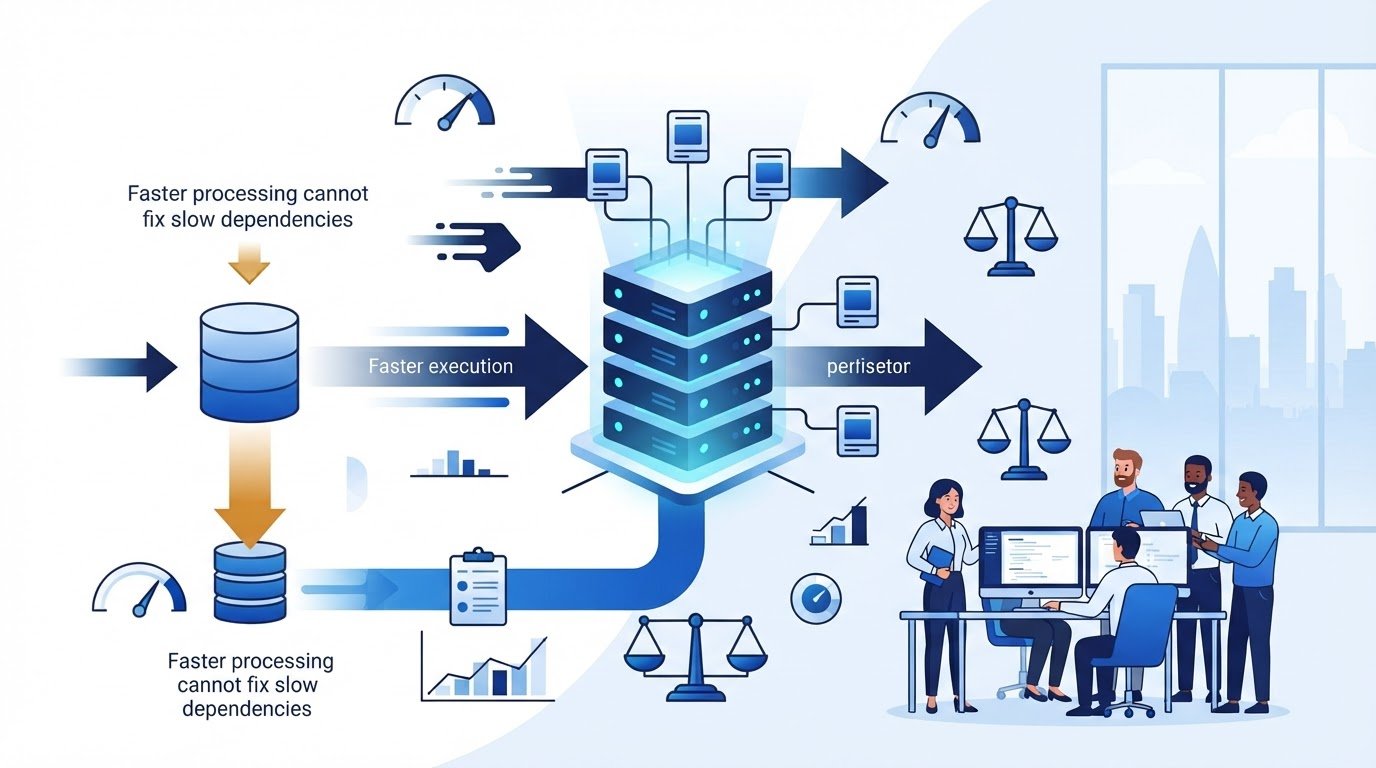
A faster PHP server won’t fix a slow database. That’s the first thing to understand when weighing laravel octane performance benefits: Octane can reduce the work Laravel repeats for every request, but it can’t remove bottlenecks elsewhere in your application. Benchmarks may show impressive gains, yet your results depend on what’s actually slowing your workload down.
If responses feel sluggish, find out whether PHP startup is the cause or whether requests are waiting on database queries, external APIs or other services. Octane keeps the Laravel application in memory between requests, which can reduce per-request overhead and improve throughput. That long-lived lifecycle also calls for careful handling of state, memory and deployments.
This guide explains what Octane changes, where faster execution can make a practical difference, and where its limits remain. You’ll learn which workloads are more likely to benefit, what trade-offs to plan for, and how to compare Octane with your current performance baseline. The aim is a measured decision based on your application’s bottlenecks, not a benchmark headline.
Laravel Octane serves web requests through long-lived application workers. The workers keep the framework booted, so it can handle successive requests without repeating the full startup process each time. Octane changes how requests are served, not what your application does. Routes, business rules and database design remain part of the Laravel application; Octane provides a different runtime for handling requests.
That distinction matters when assessing laravel octane performance benefits. Octane extends the Laravel framework with a serving layer. It isn’t a replacement framework, hosting platform or automatic redesign of application code. Its potential gain comes from avoiding repeated setup work, not from removing the work each request needs to perform.
In a typical PHP-FPM setup, a web server passes a request to an available PHP process. PHP runs the application for that request, including Laravel’s framework bootstrapping, then returns the response. PHP-FPM processes can handle multiple requests over their lifetime, but Laravel’s request-level application startup is generally repeated.
With Octane, an application worker boots Laravel and stays alive to serve further requests. Reusing that booted application can reduce repeated framework setup overhead, particularly when that overhead forms a meaningful share of request time. The worker still has to match routes, run middleware and application code, access the database or other services, and generate a response. A slow query or delayed external API call doesn’t disappear because the worker persists.
Long-lived workers also make state management important. Request-specific data should not accidentally remain available to the next request through static properties or improperly managed singletons. Octane manages parts of the request lifecycle, but application code still needs to be safe across repeated use of the same worker.
Octane sits between the Laravel application and the process serving its requests. It can use FrankenPHP, RoadRunner, Swoole or Open Swoole as its application server. The chosen server runs application workers; it doesn’t replace the web server or the infrastructure that hosts the application.
Keep the roles clear. An Octane application worker handles incoming web requests. A queue worker processes background jobs, while a web server accepts or routes HTTP traffic. Adding workers or servers can increase capacity, but that’s infrastructure scaling, not the same change as adopting Octane. Octane changes the request-serving lifecycle within the existing application architecture. Understanding that boundary helps you evaluate the runtime on its own merits, without assuming it will solve database, network or capacity constraints.
Octane’s potential advantage is specific: it can reduce the time Laravel spends preparing to handle each request. If repeated framework bootstrapping accounts for a meaningful part of response time, reusing a booted application worker may lower that overhead. Across a busy service, less time spent on setup can also leave workers available to handle more requests.
Those gains aren’t automatic. Results depend on application code, infrastructure, traffic patterns and test conditions. A request dominated by database or network waits may see little change, while a workload where PHP startup is a significant part of processing is more promising. The Laravel Octane official documentation explains Octane’s runtime behaviour and configuration, but measurements from your own application determine whether it helps in practice.
Octane doesn’t automatically make every Laravel application faster; it helps only when the overhead it removes is a meaningful part of the workload.
Frequent requests give any reduction in per-request setup more chances to matter, but traffic volume alone doesn’t prove Octane is the right choice. API-heavy or continuously busy services are candidates for investigation when profiling shows Laravel startup taking a material share of request time. Compare startup time with time spent in database queries, network calls, rendering and other application work before drawing conclusions.
For example, an endpoint that performs modest application work but repeatedly pays substantial framework startup overhead may be worth testing. An endpoint that waits on a slow external service is a different case: reducing PHP setup won’t remove the wait. Look at specific routes and request types, since one application can contain both suitable and unsuitable workloads.
Octane doesn’t optimise the work your application performs. A slow SQL query remains slow unless you address the query, database access pattern or underlying database performance. Inefficient algorithms still use unnecessary processing time, and latency from an external API still affects the response while the application waits.
Separate diagnosis helps direct effort. If measurements point to database time, investigate queries and data access. If application code is doing excessive work, profile and improve that logic. If bootstrap overhead stands out, an Octane trial may be worthwhile. This keeps a runtime change from obscuring the issue without resolving it.
Benchmark headlines can provide context, but they don’t predict results for your code or infrastructure. A reproducible comparison on the application’s normal and busy request patterns is more useful. For a Laravel workload, structured Laravel performance planning can connect measurements to an appropriate architecture decision.
PHP-FPM is a common PHP process manager, not a slower or outdated version of Octane. The two approaches manage request handling differently, so a useful comparison looks at your application’s behaviour under controlled conditions rather than treating either runtime as a guaranteed winner. Keep the application code, server resources, traffic pattern and test method consistent. Otherwise, a difference in results may reflect the setup rather than the runtime.
With PHP-FPM, a pool of PHP processes handles incoming requests, and Laravel’s application setup is generally repeated for each request. Octane uses persistent application workers, which may reduce repeated bootstrapping. The remaining work, such as executing application logic and accessing the database, still needs to be measured separately.
| Comparison area | PHP-FPM | Laravel Octane |
|---|---|---|
| Request lifecycle | Laravel’s request-level setup is generally repeated. | Workers can reuse the booted application across requests. |
| Worker behaviour | PHP-FPM manages a pool of PHP processes. | Long-lived application workers serve successive requests. |
| Operations | A familiar process model for many PHP deployments. | Requires attention to persistent state, worker lifecycle and deployment. |
| Evaluation question | Is current throughput and response time sufficient for the workload? | Does testing show that reduced setup overhead improves the required outcomes? |
Articles discussing the benefits of Laravel Octane can help explain the runtime’s potential, but broad claims aren’t a substitute for testing your own application. The laravel octane performance benefits that matter are the ones shown against a repeatable baseline.
Test representative routes under the same traffic and infrastructure conditions, then compare response times and throughput alongside error rates and resource use. Profile first: if a slow query dominates a route, changing the serving model won’t resolve it. Runtime comparisons are useful when they answer a specific performance or service objective.
Octane’s persistent workers also affect operational responsibilities. Account for worker restarts, deployments, monitoring and code that might retain request-specific state. PHP-FPM may remain the more straightforward fit when its measured performance meets requirements. Choose based on workload, evidence and the team’s ability to operate the model reliably, not on a label or an isolated benchmark.
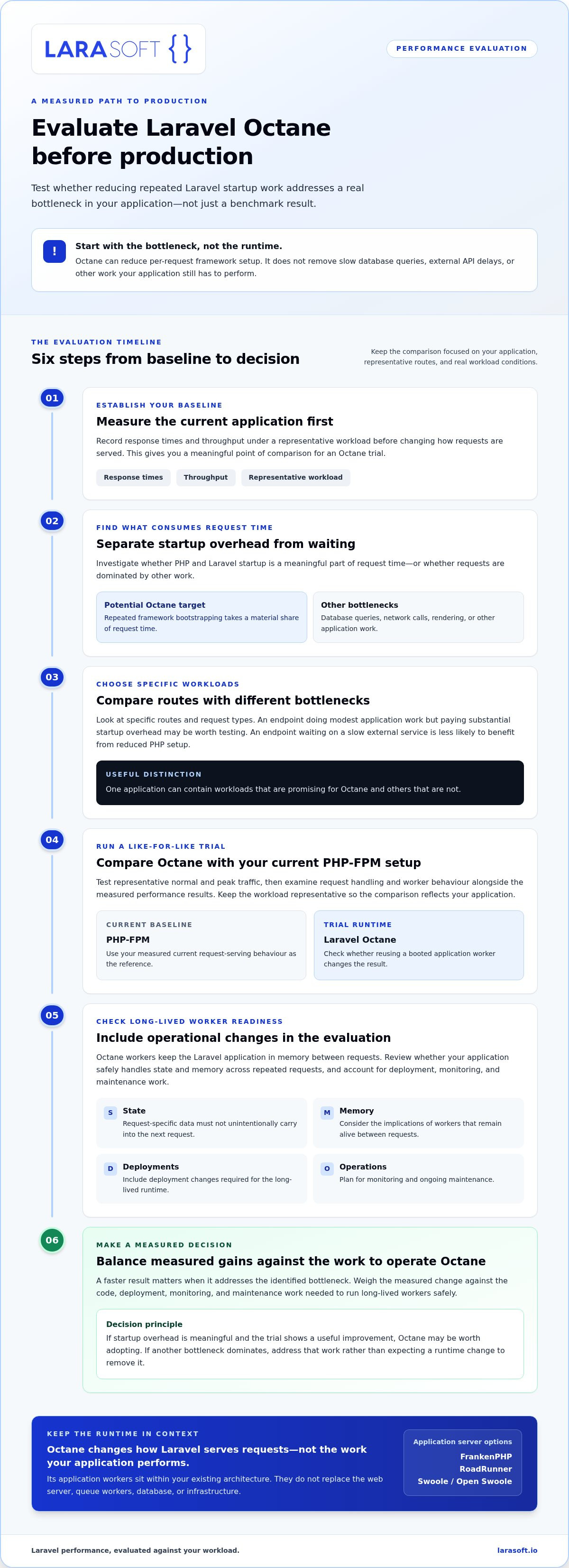
A reliable Octane decision starts with evidence from your application, not a benchmark from a different environment. Use a staged evaluation to find out whether the runtime addresses a real constraint and whether any performance gain is worth the operational changes. Keep the process reversible until you understand the results and worker behaviour.
A baseline is essential for attributing any performance gain to a runtime change. Without one, you can’t distinguish Octane’s effect from changes in traffic, infrastructure, application code or test conditions.
Before testing, inspect code that could retain request-specific data beyond a single request. Review singleton services, static properties, in-memory caches and any handling of authenticated users or request-scoped values. Confirm that one request cannot leave data behind for the next request on the same worker.
Also verify worker recycling, graceful shutdown and deployment procedures against the current Octane documentation for your chosen server. Test that updated code reaches workers cleanly and that workers can restart without disrupting active requests.
Compare the same build under consistent infrastructure and monitoring. Include warm-up conditions, repeat runs and traffic patterns that represent normal use as well as expected peaks. Track response-time distributions, throughput, errors, CPU and memory; a faster average alone may hide regressions elsewhere.
Record setup and operational effort alongside the measurements. This makes the comparison useful beyond a single test run and helps clarify whether the laravel octane performance benefits support your service objectives.
Use the findings to make a measured runtime decision and guide ongoing Laravel application optimisation. Plan a Laravel performance assessment around your workload, baseline and production requirements.
Octane is worth considering when measurements show that Laravel’s repeated application startup is a meaningful part of request time, the workload can make use of persistent workers, and the team can manage their lifecycle safely. A busy service alone isn’t enough to justify a change. The decision should reflect evidence from the application and the outcomes the business needs.
For a bespoke application, weigh potential improvements in response time or throughput against the work required to review code, monitor workers, adapt deployments and maintain the runtime. If testing doesn’t show a useful improvement, standard PHP-FPM may remain the more appropriate choice. A simpler, well-understood setup is valuable when it already meets user and service requirements.
Start with the largest verified bottleneck, then connect its technical effect to the user experience. For example, identify whether slow responses affect a critical workflow or whether limited throughput threatens a service objective during busy periods. Reliability matters too: a faster result in a test has limited value if the change makes production behaviour harder to operate consistently.
Use a staged proof of concept on representative routes before changing the production runtime. Agree in advance what would count as success, such as a meaningful improvement in an agreed response-time measure without unacceptable errors or resource use. Define rollback criteria as well. If the test misses its targets or introduces operational problems, return to the existing setup and address the underlying bottleneck.
Runtime selection is one part of Laravel architecture, not a standalone optimisation. As application features, traffic and integrations evolve, revisit performance measurements and operational needs. That review may show Octane remains a good fit, or that another issue now deserves attention. The laravel octane performance benefits are most useful when they support lasting application outcomes rather than a one-off benchmark.
Larasoft’s Laravel development, software maintenance and legacy modernisation work supports application-specific architecture decisions across the software lifecycle. A structured review can consider the existing codebase, the workload and the effort needed to sustain a runtime change. Discuss a Laravel performance challenge to explore an approach grounded in your application’s evidence and priorities.
Performance decisions are most useful when they become part of a broader engineering roadmap. As features, integrations and user expectations change, revisit the outcomes your application needs to deliver and whether its architecture still supports them. That keeps runtime choices connected to real product priorities, rather than treating optimisation as a one-off exercise.
The right next step may be refining the existing application before changing how it runs. Larasoft’s primary service is Laravel web development, supported by software maintenance and legacy code modernisation. That combination helps align application improvements with the codebase’s longer-term reliability and growth. The goal is a considered technical direction your team can sustain.
Bring your current performance challenge and priorities into a focused discussion. Discuss a Laravel performance challenge with Larasoft and identify a practical path forward. With clear objectives and an architecture shaped around your application, you can build confidence in the laravel octane performance benefits that matter to your users and business.
No. Octane is most useful when the application’s request startup work is a meaningful part of processing time. If users mostly wait for a database, external service or file operation, changing the runtime may have little effect. A small site with modest demand may also see no practical difference. Profile important routes first, then test the runtime against the actual workload before making an architectural change.
Yes, APIs can be suitable, especially when they handle frequent requests and profiling identifies avoidable application startup overhead. The endpoint’s work still matters: a response waiting on a third-party API, for example, may remain slow. Review authentication, middleware and request-specific data handling as well. For an API serving different customers, test that one request cannot leave tenant or user data accessible to the next request handled by the same worker.
Potentially. Reducing repeated application setup can shorten the time before a request’s main work begins, which may improve response time when setup is a material delay. Workers may also complete more requests over a period if that overhead previously constrained them. Measure both outcomes separately: compare response-time distributions, including slower requests, and completed requests under equivalent traffic. One metric improving doesn’t guarantee the other will.
Review code that persists between requests, particularly singleton services, static properties and in-memory data. Test authentication and user-specific behaviour across consecutive requests, then confirm worker restarts and graceful shutdown work with your deployment process. Check the current Laravel Octane documentation for your Laravel, PHP and application-server versions. Finally, monitor memory, errors and worker health during a staged release, with a clear route back to the previous runtime.
Octane changes how the Laravel application serves requests, so it typically uses an Octane-supported application server rather than PHP-FPM as that application’s request-serving model. It doesn’t replace PHP, Laravel or the wider hosting environment. PHP-FPM can remain in use for other applications or services on the same infrastructure. Treat this as a deployment architecture choice, and confirm how traffic is routed in your own setup.
Compare the same application build under equivalent infrastructure and traffic conditions, then repeat the tests to check that results are consistent. Track response-time percentiles, throughput, errors, CPU and memory rather than relying on one headline number. Include a representative mix of routes and realistic request data. The laravel octane performance benefits are meaningful only if measured changes improve the outcomes your service needs without introducing unacceptable regressions.
No. Octane doesn’t rewrite SQL, add missing indexes or reduce unnecessary database calls. If an endpoint is slow because it runs repeated queries or retrieves more data than it needs, those database issues require separate investigation. Use query logs or application profiling to identify slow statements and patterns such as repeated lookups. After improving database work, measure again to see whether application startup remains a significant part of request time.
Here’s what we've been up to recently.
Certified Quality. Great Prices