Bespoke Commerce: The Strategic Guide to Custom E-Commerce Solutions in 2026

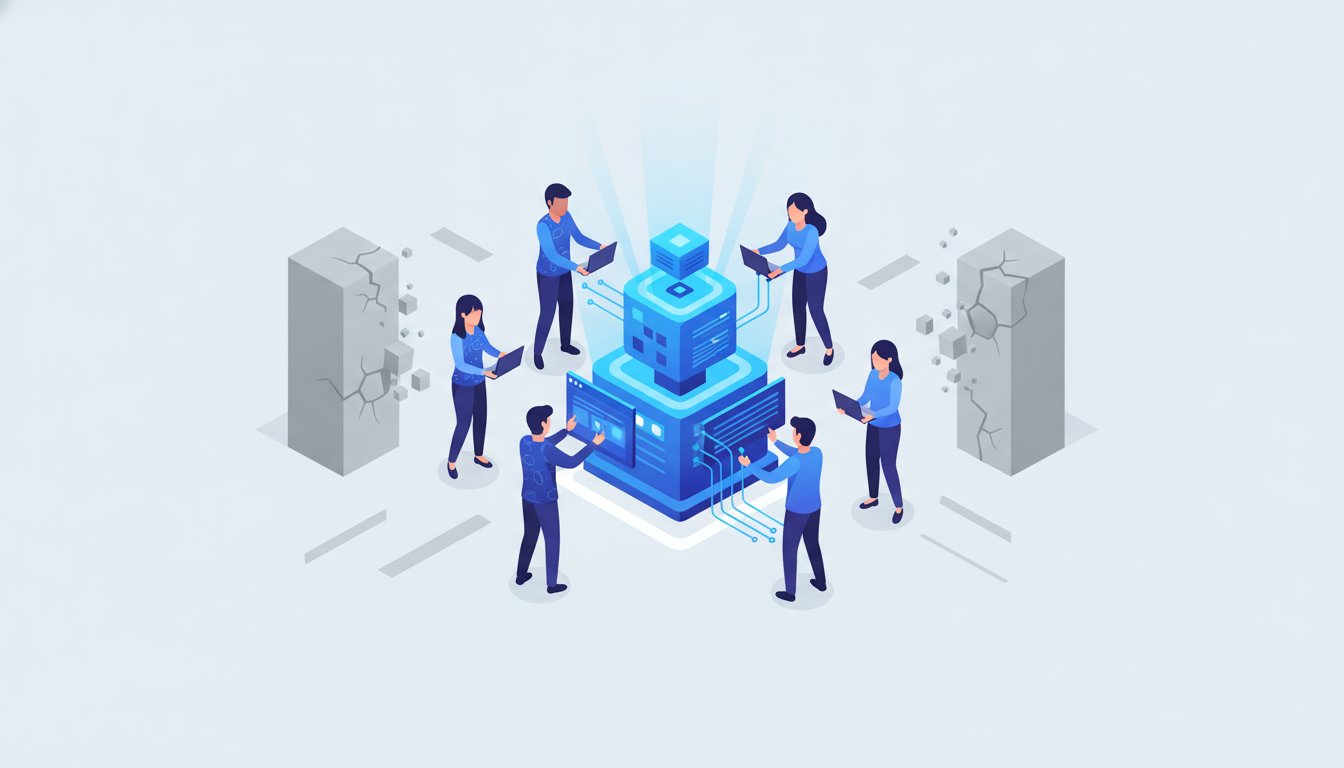
Why should your most successful sales months be met with higher transaction fees and degraded site performance? For many growing brands, the very tools meant to facilitate expansion eventually become the primary obstacles to it. You've likely experienced the frustration of platform bloat slowing your user experience or the "success taxes" that eat into your margins as you scale. Moving toward bespoke commerce isn't just about aesthetics; it's about building a digital asset that you own entirely, free from the rigid constraints of off-the-shelf templates.
We understand that your business workflows are unique and shouldn't have to be compromised to fit into a standard plugin. This guide provides a strategic roadmap for moving beyond the limitations of SaaS and the security vulnerabilities inherent in generic software. You'll discover how a custom-built architecture delivers full code ownership, infinite scalability for high-traffic events, and seamless integration with your existing ERP and CRM systems. We will examine the transition from being a platform tenant to becoming a platform owner, ensuring your technical infrastructure serves as a driver of growth rather than a bottleneck.
At its core, bespoke commerce is a tailor-made digital storefront engineered from the ground up to satisfy precise business requirements. Unlike generic templates, these systems are built without the restrictive guardrails of pre-packaged software. As the global landscape of E-commerce (electronic commerce) becomes increasingly data-driven, the limitations of "one-size-fits-all" solutions are becoming more apparent. In 2026, a standard template isn't just a design choice; it's often a technical ceiling that prevents brands from implementing the complex logic required for modern market competition.
For many UK businesses, the transition to custom builds is driven by the need for technical ownership. When you own the source code, the platform becomes a balance-sheet asset rather than a recurring operational expense. You're no longer a tenant on a third-party server, subject to their roadmap and fee increases. Instead, you hold the keys to your own infrastructure. You'll know your brand has outgrown standard solutions when you encounter these indicators:
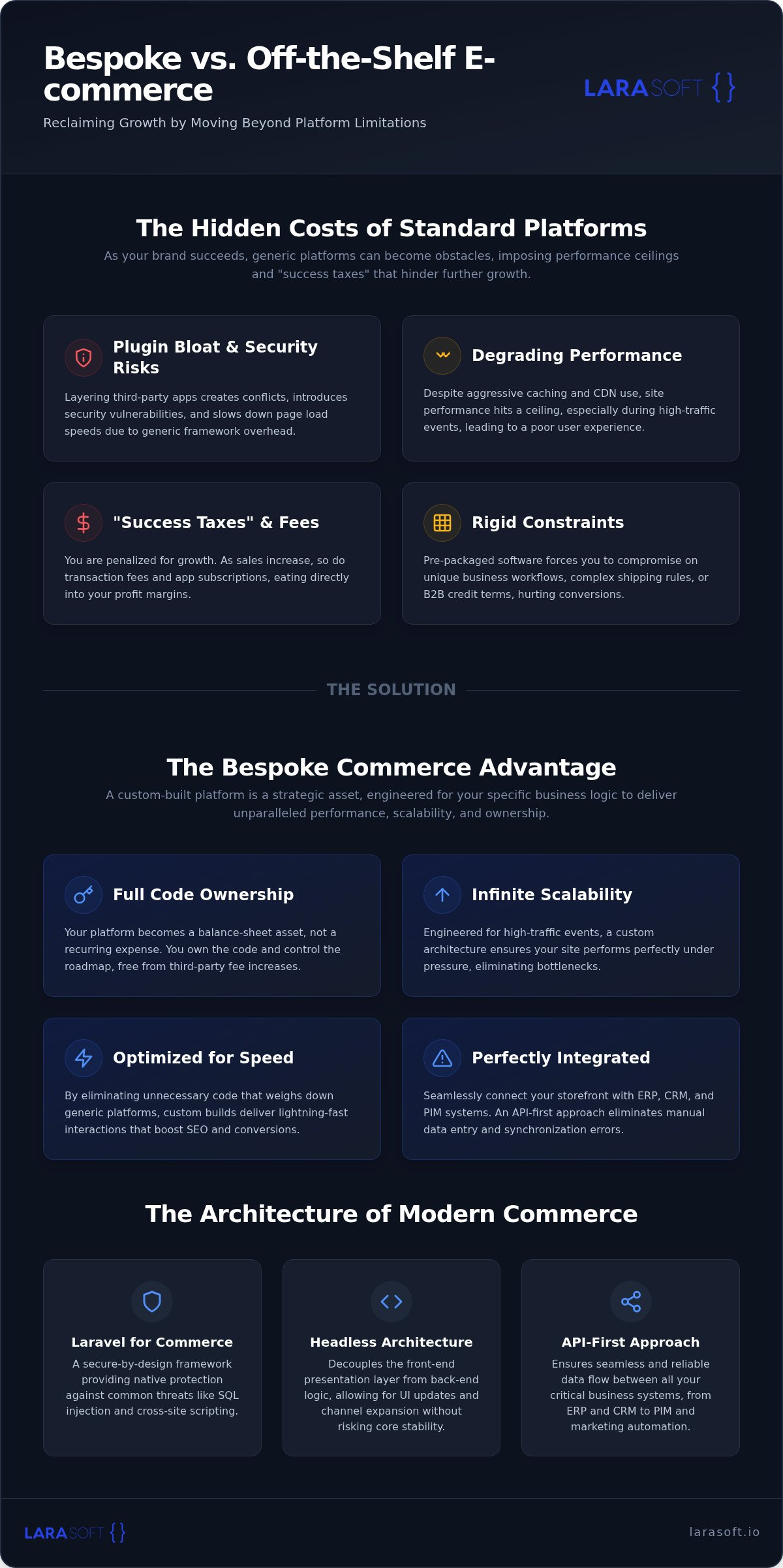
Standard platforms often suffer from "plugin bloat." To achieve even basic custom functionality, retailers must layer dozens of third-party apps on top of the core engine. These plugins frequently conflict, creating security vulnerabilities and slowing down page load speeds. This performance ceiling is a direct result of generic framework overhead. Furthermore, rigid checkout processes in SaaS environments often prevent brands from offering unique shipping rules or complex B2B credit terms, which directly hurts conversion rates for specialised products. These "success taxes," in the form of transaction fees, mean you're penalised for your own growth.
Custom builds allow you to tailor the user journey to specific B2B or complex B2C catalogues without compromise. By building for speed, custom code eliminates the unnecessary features that weigh down generic platforms, resulting in lightning-fast interactions that boost SEO rankings. Bespoke commerce represents a strategic architectural choice that prioritises long-term scalability by aligning every line of code with specific business logic. This approach ensures your platform performs perfectly under the pressure of high-traffic events while providing a seamless, branded experience that templates simply cannot replicate.
The structural integrity of your digital storefront depends entirely on its underlying framework. In 2026, the shift toward a modern e-commerce platform architecture that prioritises modularity is no longer optional for high-growth brands. A bespoke commerce solution built on an API-first foundation ensures that data flows seamlessly between your storefront and critical business systems like ERPs, CRMs, and PIMs. This connectivity eliminates the manual data entry and synchronisation errors that often plague standard, siloed platforms.
By decoupling the core commerce logic from the presentation layer, businesses gain the agility to update their user interface without risking backend stability. This architectural choice isn't just about technical sophistication; it's about future-proofing. When your systems communicate via high-performance APIs, adding new sales channels or integrating advanced AI tools becomes a structured implementation rather than a risky overhaul. It's the difference between a rigid box and a flexible ecosystem designed for evolution.
Laravel has solidified its position as the premier PHP framework for custom e-commerce backends. Its "security by design" approach provides native protection against common threats like SQL injection and cross-site scripting. For businesses managing complex product databases, Laravel's Eloquent ORM simplifies data relationships, making it easy to handle multi-variant SKUs or tiered B2B pricing. Partnering with a specialised team for Laravel development ensures your backend is both robust and maintainable. It's about building a clean, scalable engine that supports your unique business logic without the baggage of unnecessary core files.
The rise of headless commerce allows brands to decouple the frontend from the backend, offering ultimate flexibility for multi-channel selling. Whether you're pushing products to a web browser, a mobile app, or an IoT device, a headless approach serves data via APIs to any "head." Modern Vue.js frontend development or React implementations deliver the "app-like" speed and fluid transitions that customers now expect. However, for brands with less complex multi-channel needs, a monolithic Laravel build can be more efficient, reducing initial development time while still allowing for future headless transitions. If you're unsure which path fits your growth trajectory, we can help you evaluate your technical roadmap to find the most sustainable solution.
Deciding between a subscription-based model and a custom build requires a clear-eyed look at the commercial horizon. While SaaS platforms present an attractive entry point, they often introduce "success taxes" that penalize your growth. Over a three-year period, the cumulative cost of transaction fees, monthly app subscriptions, and specialized developer hours frequently eclipses the upfront investment of a custom build. Bespoke commerce changes the financial dynamic by turning your technical infrastructure into a capitalized asset rather than a recurring operational drain.
Performance benchmarks tell a similar story. Template-based sites carry the weight of unused code, generic scripts, and heavy plugins that degrade page load speeds. Clean code wins. In contrast, a custom-engineered storefront only executes the code necessary for its specific functions. This lean architecture ensures your site meets the strictest Core Web Vitals, which is essential for maintaining search visibility in 2026. Data sovereignty also remains a critical factor. Owning your customer data entirely ensures you aren't at the mercy of a third-party provider's privacy policy changes or international data transfer complexities, which simplifies UK GDPR compliance.
The financial return on custom development extends beyond just saving on fees. By eliminating percentage-based transaction charges, you can reinvest those margins directly into your marketing or product development. Conversion rate optimisation (CRO) becomes significantly more effective when you aren't restricted by a standard platform's checkout logic. You can build multi-step flows, unique upsell opportunities, and frictionless payment integrations that match your customers' exact buying habits. Ultimately, a custom platform is a saleable business asset that adds tangible value to your company's valuation.
Technical SEO is often treated as an afterthought in standard builds, but in bespoke commerce, it's baked into the initial architecture. Clean, semantic HTML and optimized server-side rendering provide a superior foundation for search engine crawlers. Custom structures allow for precise control over advanced schema markup and metadata management, ensuring your products are indexed correctly and stand out in rich search results. This level of technical precision drives organic traffic without the constant need for expensive plugin workarounds that often break during core platform updates.
Retailers often reach a plateau known as the "Legacy Trap." This occurs when your current platform, whether it's an aging Magento setup or a restricted Shopify store, can no longer support the complex workflows your business requires. A custom-built solution eliminates the "platform debt" that forces you to adapt your operations to the software's limitations. The transition to bespoke commerce isn't just about a new interface; it's about a fundamental shift in how your data is handled. Zero-downtime migrations are essential to this process. We focus on moving your customer records, order history, and product data to a custom architecture without interrupting your daily sales. This ensures your brand maintains its momentum while upgrading its core capabilities from the ground up.
Identifying technical debt is the first step in a successful legacy code modernisation strategy. Technical debt accumulates when quick fixes and outdated plugins create a fragile ecosystem that's difficult to secure or scale. We often recommend the "Strangler Fig" pattern for complex migrations. This approach allows us to replace specific modules of your existing store, such as the checkout or the payment gateway, with new Laravel-based components. Over time, the new system completely replaces the old one until the legacy platform is retired. This incremental method reduces risk and allows for continuous testing of every new feature. Refactoring legacy code during this transition doesn't just fix existing bugs; it rebuilds the foundation for long-term security and maintainability.
AI integration in 2026 has moved far beyond basic customer service bots. Within a bespoke commerce architecture, we can build custom models for predictive inventory management. These systems analyze seasonal trends to provide accurate demand forecasting, optimizing your supply chain. Personalised shopping experiences are delivered through machine learning models that adapt to real-time user interactions, offering intuitive product recommendations. These specialized AI tools are integrated directly into your Laravel backend, ensuring high-speed data processing without relying on expensive, third-party API calls that can introduce latency. AI-driven search functionality significantly improves UX by understanding customer intent and delivering precise results. If you're ready to move beyond the constraints of your current setup, explore our custom development services to see how we can modernise your infrastructure.
Larasoft views bespoke commerce not as a series of isolated development tasks, but as the creation of a foundational business asset. Our philosophy centers on building systems that grow with you, ensuring that the code we write today supports the innovations you'll need tomorrow. This long-term perspective is why we prioritize structural integrity and scalability from the very first discovery session. By acting as a deeply invested technical ally, we help UK brands transition from being platform tenants to becoming platform owners. We don't just deliver software; we provide a manageable, structured journey toward sustainable growth.
Technical excellence requires more than just a successful deployment. It demands a commitment to ongoing refinement and a partnership built on transparency. Our collaborative process ensures that your specific business logic is woven into every layer of the architecture, from complex API integrations to custom frontend experiences. This high-touch approach is particularly valuable for national commerce infrastructure, where reliability under pressure is non-negotiable. We take pride in the cleanliness and efficiency of our work, ensuring that every system performs perfectly when it matters most.
Building a high-performance storefront is only the beginning. Proactive software maintenance is essential for long-term stability, involving regular security patching and performance monitoring to prevent technical debt from accumulating. We don't treat SEO as a layer to be added later; instead, we integrate technical SEO strategy into the development lifecycle. This ensures that your site's architecture is optimized for Core Web Vitals and search engine crawlers from day one, delivering immediate organic impact. Our commitment to clean, efficient code means your bespoke commerce platform remains fast and secure as you scale.
We bridge the gap between ambitious business goals and meticulous technical execution. Understanding the nuances of the UK e-commerce landscape allows us to anticipate challenges that generic, offshore agencies might overlook. Whether you're modernising a legacy system or building a new headless storefront, our team provides the specialized knowledge required to navigate complex development journeys. We find satisfaction in building systems that perform perfectly under the most demanding conditions. If you're ready to eliminate platform constraints and take full ownership of your digital future, discuss your bespoke commerce project with Larasoft today.
The shift toward bespoke commerce represents a decisive move from platform dependency to technical sovereignty. By choosing a custom-engineered architecture, you eliminate the restrictive fees and performance ceilings that often stifle high-growth brands. We've explored how a Laravel-based foundation provides the structural integrity needed for seamless API integrations and advanced AI capabilities, ensuring your storefront remains a high-performance asset for the long term.
True scalability isn't just about handling more traffic. It's about having the flexibility to adapt your digital infrastructure as your business logic evolves. As specialists in high-performance Laravel builds and complex ERP integrations, we're dedicated to driving technical excellence for UK-wide businesses. Transitioning away from off-the-shelf constraints allows you to reclaim your margins and focus on what truly differentiates your brand.
Ready to build a commerce platform without limits? Consult with our Laravel experts.
Your journey toward a more resilient digital storefront starts with a single strategic decision. We look forward to helping you build a system that performs perfectly under pressure.
The investment for a bespoke commerce platform varies based on the complexity of your business logic and required integrations. Instead of a monthly subscription fee, you're investing in a capitalized asset that eliminates recurring transaction taxes. Most brands find that the total cost of ownership becomes more efficient than SaaS alternatives over a three-year period. We provide detailed project scoping to ensure the build aligns with your specific commercial objectives.
Development timelines are determined by the scope of your unique workflows and the depth of system integrations. A custom build typically moves through structured phases including discovery, architectural design, and iterative development. While simpler builds move faster, complex enterprise solutions require more time for rigorous testing and security auditing. We prioritize a phased deployment strategy to ensure your brand maintains momentum while we build out the full suite of custom features.
Yes, custom builds are designed with an API-first approach specifically to connect with your existing ERP, CRM, or PIM systems. This eliminates the manual data entry and synchronization errors common with off-the-shelf plugins. By building custom connectors, we ensure data flows seamlessly between your storefront and your back-office operations. This creates a unified ecosystem where inventory levels, customer profiles, and order histories are always accurate across all your business channels.
Custom platforms offer superior security by eliminating the vulnerabilities found in generic, open-source plugins. Since the code is built specifically for your brand, it doesn't suffer from the "plugin bloat" that often creates entry points for attackers. We utilize Laravel's built-in protection against SQL injection and cross-site scripting to ensure your customer data remains safe. This "security by design" approach provides a much more robust defense than relying on third-party app updates.
Custom-built sites deliver significant SEO advantages through cleaner code and superior page load speeds that satisfy Google's Core Web Vitals. Unlike templates that carry heavy, unused scripts, bespoke commerce only executes the code your site actually needs. We integrate advanced schema markup and metadata management directly into the architecture during the build phase. This technical precision ensures your products are indexed correctly and rank higher in organic search results without needing extra plugins.
You don't need an internal technical team when you partner with a dedicated development ally for ongoing software maintenance. We handle the proactive security patching, performance monitoring, and server optimizations required to keep your platform running perfectly. This allows your internal team to focus on marketing and business growth while we manage the technical infrastructure. Our goal is to make complex development processes feel like a manageable, structured journey for your business leaders.
Migrating existing customer and product data is a standard part of our implementation process. We specialize in zero-downtime migrations from platforms like Magento or Shopify, ensuring your order history and SEO rankings are preserved. Our team uses automated scripts to map your legacy data to the new custom architecture with high precision. This transition is handled in phases to ensure data integrity and prevent any disruption to your current sales operations.
Laravel is the premier framework for building custom e-commerce stores in 2026 due to its security, scalability, and developer-friendly ecosystem. Its Eloquent ORM makes managing complex product databases and multi-variant SKUs highly efficient. The framework's modular nature allows us to build specific features that match your unique business logic without the baggage of unnecessary core files. It provides a clean, robust engine that supports long-term growth and easy integration with modern AI tools.
Here’s what we've been up to recently.
Certified Quality. Great Prices