Developing a Custom Inventory Management System: The Strategic Guide for UK Businesses

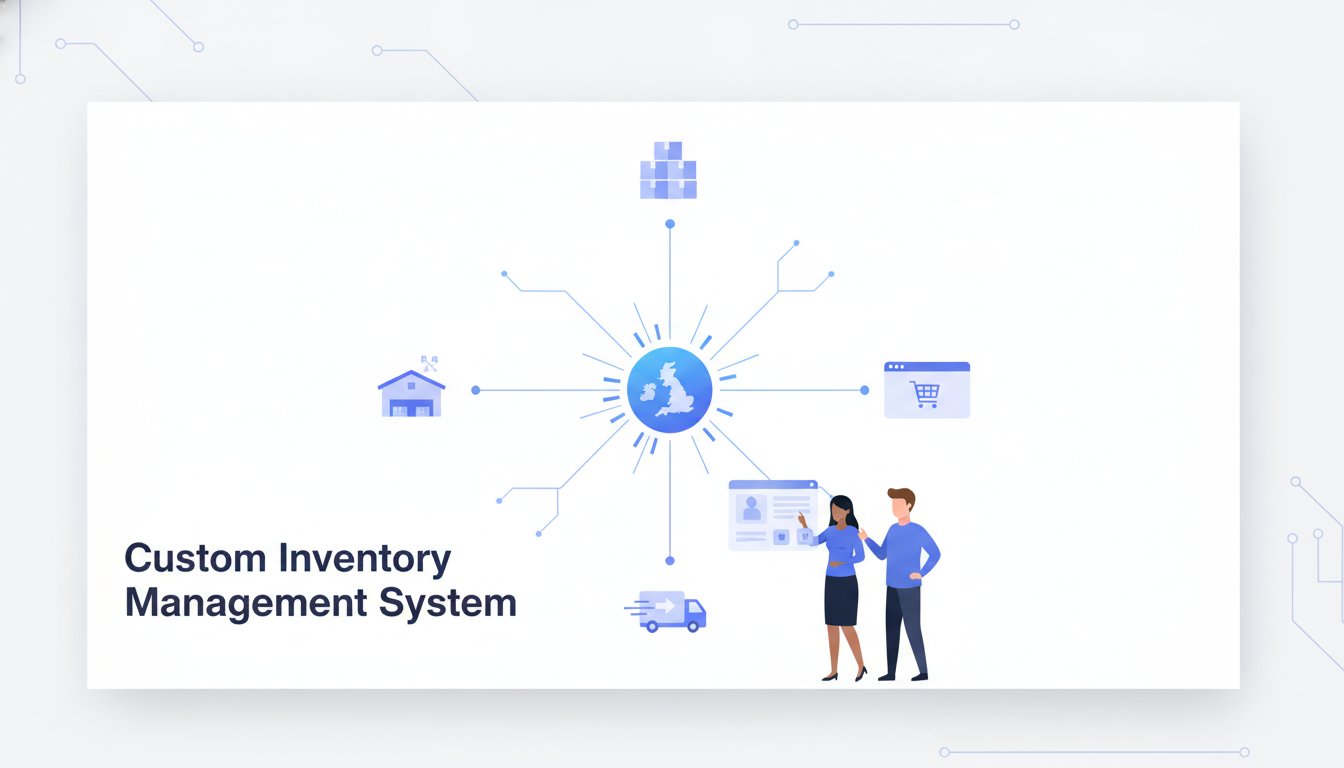
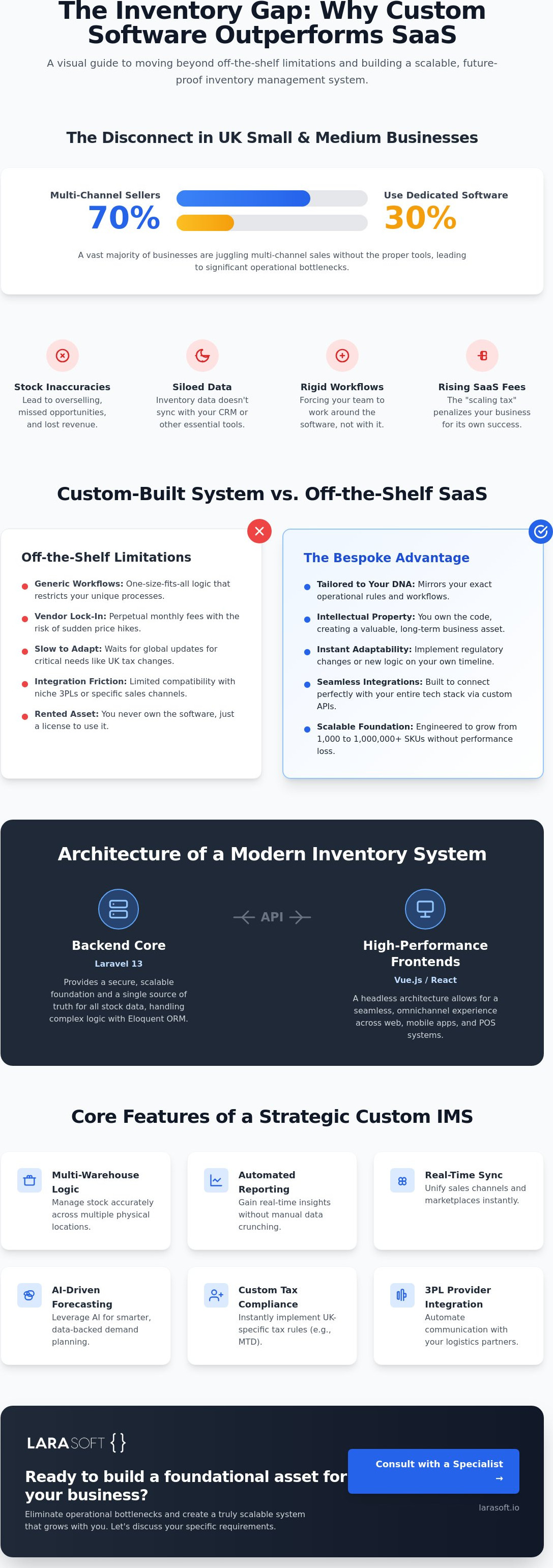
Did you know that while 70% of UK small and medium-sized sellers trade across multiple channels, only 30% actually use dedicated software to manage their stock? Most businesses eventually hit a wall where off-the-shelf tools can't keep up with their growth. You've likely felt the friction of stock inaccuracies leading to lost revenue or the headache of siloed data that won't sync with your CRM. It's a common struggle to pay rising monthly SaaS fees for a platform that wasn't built for your specific business logic.
This guide explains how a custom inventory management system built on Laravel 13 can eliminate these operational bottlenecks. By moving away from restrictive legacy code and embracing a bespoke architecture, you'll gain a single source of truth for all your stock data. We'll walk through the process of automating your reporting, integrating with essential marketplaces, and leveraging AI-driven demand forecasting to build a resilient, scalable foundation for your future growth.
A Inventory management software typically serves as the digital ledger for a business's physical assets. However, a custom inventory management system is far more than a simple tracking tool. It's a bespoke web application engineered to mirror your specific operational DNA. Instead of forcing your warehouse staff or procurement teams to work around the limitations of a generic interface, a custom system enforces your unique business rules and workflows. It acts as a single source of truth that connects every point of your supply chain, from the initial purchase order to the final mile of delivery.
Many UK businesses eventually fall into the "inventory gap." This occurs when your growth outpaces the capabilities of standard SaaS platforms. You might find that off-the-shelf tools struggle with complex product bundling, multi-warehouse logic, or the specific nuances of UK tax requirements. For instance, with the temporary 5% VAT rate for certain family supplies set to take effect in June 2026, a bespoke system allows you to implement these changes instantly. You don't have to wait for a third-party provider to update their global codebase. Your software adapts to your process, ensuring real-time visibility and structural integrity across all channels.
SaaS platforms are designed for the average user, which often leads to rigid workflows. If your business logic requires a non-standard picking sequence or bespoke 3PL communication, you'll likely face integration friction. There's also the "scaling tax" to consider. Many platforms charge per user or per transaction, meaning your software costs spike exactly when your business is succeeding. Furthermore, global tools often lack deep compatibility with niche UK shipping carriers or the specific digital record-keeping standards required for Making Tax Digital (MTD) compliance. These friction points create siloed data and manual workarounds that drain your team's productivity.
Building a custom solution means you own the intellectual property. You're creating a foundational asset rather than paying a perpetual rent to a vendor. This eliminates the risk of vendor lock-in and protects you from sudden subscription price hikes. Because we build on modern frameworks like Laravel 13, scalability is part of the architecture. Your system can grow from managing 1,000 SKUs to 1,000,000 without the performance degradation common in legacy systems. Security is also a primary focus. We develop custom-built protocols tailored to your internal compliance needs, ensuring your proprietary data is handled with the highest level of precision and care.
A robust technical architecture is the backbone of any high-performing custom inventory management system. While many discussions about stock control focus on hardware like scanners or printers, the true competitive advantage comes from the software's structural integrity. By choosing a modern stack, you ensure that your system remains a foundational asset rather than a technical burden. This framework plays a strategic role for the business by providing a stable environment where data integrity is never compromised, even during high-concurrency stock updates in peak trading periods.
Modern systems often adopt a headless architecture. This separates the inventory core from your various sales channels, such as your website, mobile app, or physical POS. It allows for a truly omnichannel experience, where stock levels sync instantly across every touchpoint. If you're ready to discuss how this architecture can support your growth, you might want to consult with a specialist developer to map out your specific requirements.
Laravel has emerged as the industry standard for secure, scalable backends in the UK. Its Eloquent ORM allows us to map intricate relationships between products, multiple warehouses, and shifting order statuses with ease. This precision is vital for maintaining a single source of truth. Security is baked into the framework, protecting sensitive commercial data from evolving threats. For businesses struggling with outdated platforms, our approach to legacy code modernisation ensures a smooth transition to this modern architecture without losing historical data. Using Laravel 13, which requires PHP 8.3+, we ensure your system leverages the latest performance benchmarks.
The frontend is where your team interacts with the data, making speed and responsiveness essential. We use Vue.js to build intuitive, reactive interfaces that update stock levels in real-time without requiring a page refresh. This is ideal for fast-paced office environments where data entry must be rapid. For complex, component-heavy mobile applications used on the warehouse floor, React offers the flexibility needed for high-performance cross-platform development. Choosing between these depends on your specific workflow, but both ensure long-term stability when paired with a proactive plan for software maintenance.
Deciding between a recurring subscription and a one-off capital investment is a fundamental strategic pivot for any growing UK business. While off-the-shelf SaaS platforms offer a low barrier to entry, they often introduce a "complexity tax" as your operations mature. To understand the true value of a custom inventory management system, you must look beyond the initial invoice and calculate the Total Cost of Ownership (TCO) over a five-year horizon. This long-term view reveals the hidden drain of seat-based licensing and the escalating costs of transaction fees that penalise your growth.
Efficiency gains are the primary driver of this ROI. When you automate manual stock reconciliations, you aren't just saving time; you're eliminating the human error that leads to costly stockouts or bloated overstock. Precise data is critical for supply to flow efficiently through your organisation. This level of precision protects your revenue by ensuring you never miss a sale due to a data lag. It also provides the structural flexibility to pivot your business model, such as moving from B2B wholesaling to a direct-to-consumer (D2C) model, without the need to migrate your entire software stack.
Partnering with a laravel development agency requires a higher upfront commitment compared to a monthly SaaS fee. However, you must factor in the cumulative cost of per-user licenses and the expensive workarounds your team currently uses to make generic software fit your workflow. Unlike a subscription, custom software is a business asset that sits on your balance sheet. It provides long-term value that doesn't vanish if you stop paying a monthly bill, effectively turning a recurring expense into a foundational asset.
The human element of inventory management is often overlooked in financial models. Rigid, unintuitive systems cause significant staff frustration and increase the risk of churn among your most skilled warehouse and procurement personnel. A bespoke system mirrors your existing successful workflows, making it far easier for new hires to reach full productivity. Training becomes a streamlined process rather than a battle against counterintuitive software logic. Ultimately, your ROI is the intersection of reduced manual hours and increased order accuracy.
Strategic systems do more than just record stock levels; they act as a central nervous system for your entire commerce operation. A custom inventory management system should provide a seamless bridge between your physical warehouse and your digital storefronts. This requires real-time synchronisation across marketplaces like Amazon, eBay, Shopify, and Magento. In a UK e-commerce market projected to be worth £152 billion in 2026, the ability to update stock levels instantly across all channels is no longer a luxury. It's a requirement for maintaining account health and customer trust.
Beyond simple tracking, a bespoke solution excels at API orchestration. We build systems that communicate directly with UK shipping carriers and Third Party Logistics (3PL) providers. This automation ensures that as soon as an order is picked and packed, the tracking data is sent back to the customer without manual intervention. By focusing on mobile-first warehouse management, we empower your team with rapid barcode scanning and optimised pick-and-pack workflows. This digital layer must match the physical speed of your operations to eliminate the bottlenecks typically found in generic software.
The trend in 2026 has moved from experimental AI to embedding intelligence directly into core business platforms. We integrate Laravel AI solutions to identify anomalies in stock levels and predict demand before a crisis occurs. This isn't just about setting basic reorder points. It's about using predictive analytics to account for seasonal demand shifts and evolving UK market trends. The system can trigger automated reordering based on precise lead times and safety stock levels, ensuring you remain resilient against unpredictable supply chain disruptions. This proactive approach transforms your inventory from a static list into a dynamic business asset.
Many established UK businesses are held back by legacy ERPs that are "unbreakable" but entirely rigid. We solve this through sophisticated api integration, connecting your historical data to modern, high-performance web interfaces. This process is a core part of legacy code modernisation, where we transform outdated systems into agile assets without risking data loss. We ensure that every connection remains GDPR compliant and secure, providing a safe environment for your commercial data to flow between platforms. If you're struggling with siloed data or manual reconciliations, you can book a technical discovery session to map out a more integrated future.
The successful deployment of a custom inventory management system requires a structured, disciplined methodology. It's not just about writing code; it's about translating your operational reality into a digital framework. Our approach begins with a deep Discovery Phase. We don't just look at your stock lists. We map your entire business logic, from the way you handle returns to how you manage supplier lead times. This stage is critical for identifying the specific bottlenecks that generic software ignores, ensuring the final build is a perfect fit for your team.
We use an Agile Development framework to maintain momentum and transparency throughout the project. This means we build the system in iterative sprints, allowing you to see and test core features as they're developed. It's a collaborative process that prevents the "black box" development style often associated with large-scale projects. By testing early and often, we ensure the system performs perfectly under the pressure of real-world warehouse conditions before the final go-live date. Transitioning from legacy systems is handled through a structured migration plan, where we prioritise data integrity and use parallel running to prevent any operational downtime.
Before a single line of code is written for the final production environment, we use collaborative prototyping to validate your workflows. This visual stage allows stakeholders to interact with the interface and suggest refinements. Once development is underway, we move into rigorous testing phases. This includes load testing to ensure your system can handle the high traffic volumes of peak UK trading seasons, such as Black Friday or the December holidays. We also conduct thorough security audits to protect your proprietary commercial data. Finally, we provide comprehensive staff training and documentation, ensuring your team feels confident and capable from day one.
A bespoke system is a living asset. As web standards evolve and UK regulations like Making Tax Digital (MTD) update, your software must keep pace. Our ongoing software maintenance ensures your platform remains secure, performant, and compliant for years to come. We don't just build and leave; we act as your technical ally. Additionally, we provide strategic SEO services to ensure your integrated e-commerce channels aren't just efficient, but also highly visible to your target audience. A high-performing back end is most valuable when it's supporting a high-traffic front end. Ready to transform your operations? Discuss your custom inventory requirements with Larasoft.
Moving from restrictive, off-the-shelf software to a bespoke solution isn't just a technical upgrade; it's a strategic investment in your business's future. We've explored how a custom inventory management system built on Laravel 13 provides the structural integrity needed to handle complex multi-channel syncing and AI-driven forecasting. By owning your platform, you eliminate the friction of siloed data and the escalating costs of per-user licensing, creating a foundation that scales alongside your UK e-commerce growth.
Our UK-based team brings specialized expertise in Laravel development and high-performance frontends to every project. Whether you're looking to integrate advanced APIs or require deep experience in legacy code modernisation, we act as a dedicated technical ally to ensure your transition is seamless and secure. We focus on building assets that perform perfectly under pressure, providing the reliability you need to lead in a competitive market. It's time to replace manual workarounds with a system designed to support your long-term scalability. Partner with Larasoft for your bespoke software development and start building a platform that mirrors your unique operational DNA.
The journey toward a more efficient, automated supply chain starts with a single architectural decision. We're ready to help you take that step.
The investment for a bespoke system depends entirely on your operational complexity and the number of third-party integrations required. Factors such as SKU volume, multi-warehouse logic, and specific reporting requirements influence the final project scope. While the upfront commitment is higher than a standard SaaS subscription, you're building a foundational asset that eliminates recurring per-user fees and transaction-based licensing costs.
A bespoke system typically takes between three to six months to develop, depending on the complexity of your business logic. We use an agile methodology with iterative sprints, which allows you to review and test core features every few weeks. This ensures the final product aligns perfectly with your staff's needs and provides a clear, manageable timeline for the transition from your legacy software.
Yes, we can integrate your system with accounting platforms like Xero or Sage through secure API connections. This automation ensures your financial records and stock levels remain in sync without manual data entry. It's a critical feature for maintaining Making Tax Digital (MTD) compliance and providing your finance team with a single source of truth for all commercial transactions.
Laravel is widely considered the industry standard for building secure, scalable inventory systems. It offers a robust ecosystem that supports complex data relationships and provides built-in security features to protect sensitive commercial information. Its modular architecture makes it the ideal choice for businesses that need a system capable of growing from 1,000 to 1,000,000 SKUs without performance degradation.
A standard ERP provides a broad suite of generic tools for the entire enterprise, whereas a custom inventory management system is specialized for the nuances of stock control and logistics. Standard ERPs often force your team to use rigid workflows that don't fit your specific process. A bespoke system is designed to mirror your unique operational DNA, focusing deeply on inventory precision rather than generic administration.
We handle data migration through a structured plan that prioritizes data integrity and minimizes downtime. This involves mapping your existing data fields, cleaning the records, and performing trial migrations in a staging environment. We often run the new system in parallel with your legacy software during the final transition to ensure every record is accounted for and accurate before the full go-live.
While not always mandatory, a mobile interface is highly beneficial for warehouse staff who need to perform barcode scanning and pick-and-pack tasks on the move. We can build high-performance frontends that work seamlessly on hand-held devices. This eliminates the need for paper-based systems and provides real-time updates from the warehouse floor directly to your central management dashboard.
A custom system requires proactive software maintenance to remain secure and performant as web standards and UK regulations evolve. This includes applying security patches, updating the underlying framework, and monitoring server performance. Regular maintenance ensures your custom inventory management system continues to function as a reliable, foundational asset that supports your long-term business growth and technical resilience.
Here’s what we've been up to recently.
Certified Quality. Great Prices