Calculating ROI on Custom Software Development: A Strategic Guide for 2026


Choosing a restrictive SaaS platform because it looks cheaper upfront is often the most expensive mistake a board can make in 2026. While a subscription feels predictable, the true cost of software isn't the sticker price; it's the widening gap between your business vision and a platform's rigid limitations. You likely understand the long-term value of ownership, yet you're facing pressure to cut costs amid the 15% hike in AWS EC2 capacity pricing seen in January and the rising complexity of new data privacy laws in states like Indiana and Kentucky. It's difficult to justify a bespoke build when the "soft" benefits feel impossible to measure.
This guide provides the frameworks you need for calculating roi on custom software development so you can present a bulletproof case to your stakeholders. We'll move beyond simple spreadsheets to quantify employee morale and the strategic advantage of owning your architecture. With 41% of code now generated by AI, the speed of bespoke development has fundamentally shifted the math in favor of the builder. You'll gain a clear ROI formula, a framework for the board, and an understanding of how custom builds reduce the technical debt that often stifles growth in off-the-shelf systems.
At its core, the formula for Return on Investment (ROI) is straightforward: the total value created by an asset minus its total cost of ownership. However, when you're calculating roi on custom software development, the math becomes non-linear. Unlike buying a piece of hardware, bespoke code is a living asset that scales with your business. It's the difference between a fixed expense and a foundational engine for growth.
The complexity arises because software value doesn't hit the balance sheet all at once. You have to account for Time-to-Value (TTV), which measures the duration from the first line of code to the moment the system generates its first dollar of efficiency. Sticking with inefficient legacy systems also carries a heavy "Opportunity Cost." If your current stack prevents you from processing 20% more orders, that's a direct loss you must factor into your investment decision. With the average US software developer salary reaching $111,845 in April 2026, and AWS increasing EC2 Capacity Block pricing by 15% in January 2026, your calculation must balance high-quality craftsmanship against the rising costs of infrastructure and talent.
Hard ROI represents the measurable, "cold" data that CFOs prioritize. It is the most direct way to justify your development spend.
Soft ROI is harder to quantify but often more impactful for long-term survival. These benefits create a moat around your business that competitors can't easily replicate.
Mastering the art of calculating roi on custom software development means looking at these two categories as a unified whole. It's about building a system that works perfectly under pressure while providing the flexibility to evolve as your vision expands.
To move from a vague estimate to a concrete business case, you need a structured mathematical approach. The standard formula for ROI is (Net Profit / Cost of Investment) x 100. While this looks simple, the variables require deep technical insight to populate accurately. For bespoke software, we recommend an observation window of 3 to 5 years. This timeframe accounts for the initial development dip and the subsequent years of high-efficiency output where the software truly pays for itself. When calculating roi on custom software development, you're essentially measuring how quickly your vision turns into a tangible financial asset.
You can't measure progress without knowing your starting point. Start by auditing your existing manual processes. If three staff members spend 10 hours a week each on manual data entry, that is 1,560 hours a year lost to "leakage." Factor in the cost of errors, data silos, and lost leads that fall through the cracks of a fragmented system. Finally, document the recurring license costs of any SaaS tools the new build will replace. These savings represent immediate "Day 1" returns on your investment.
Value comes from both efficiency and growth. Estimate how a 20% reduction in admin time through automation would allow your team to focus on higher-value tasks. The Pareto Principle suggests that 80% of your business value will likely come from just 20% of your software's features. By focusing your build on these high-impact areas, you can project revenue increases from improved conversion rates or faster entry into new markets. Additionally, quantify the risk mitigation of avoiding data breaches or system downtime, which can cost thousands per hour in lost productivity.
TCO includes more than just the initial invoice. You must account for the CAPEX of discovery and development, alongside the OPEX of ongoing maintenance, security patching, and hosting. Total Cost of Ownership (TCO) is the sum of all direct and indirect expenses associated with the software throughout its entire lifecycle, from the first line of code to the final decommissioning. If you're unsure where your current baseline sits, our team can help you audit your existing technical architecture to identify these hidden costs.
A critical advantage for UK businesses is the availability of R&D Tax Credits. These credits act as a direct reduction in your investment cost, allowing you to reclaim a significant portion of your development spend. When calculating roi on custom software development for a UK-based firm, ignoring these tax incentives is a major oversight that can skew your results. By following this step-by-step process, you transform software from a perceived expense into a documented driver of profit and scalability.
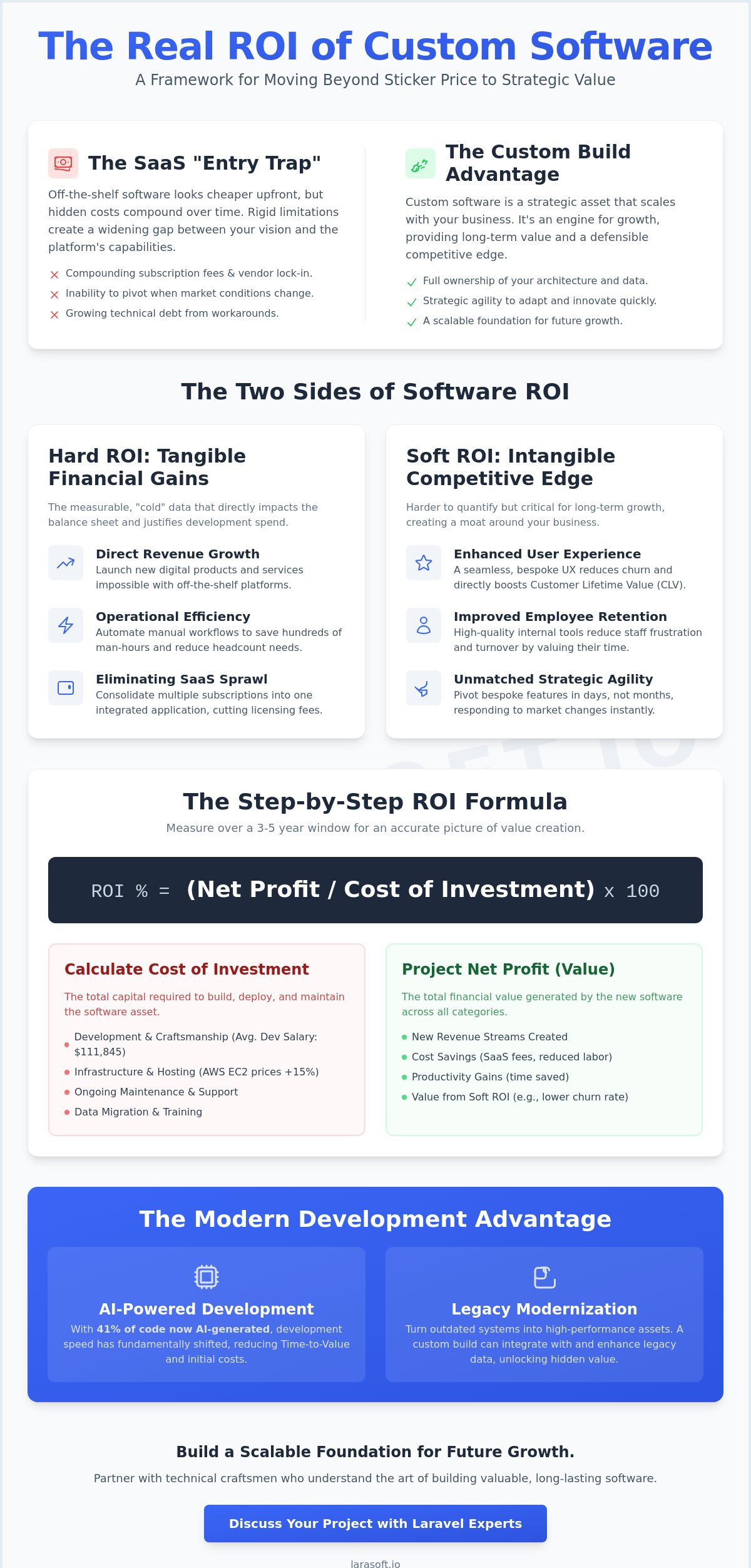
Many decision-makers fall into what we call the "Entry Trap." It's the allure of a low monthly subscription fee that promises a quick fix without the upfront CAPEX of a custom build. However, when calculating roi on custom software development, you must look past the first six months. By 2026, the global IT outsourcing market is projected to exceed $541 billion, largely because businesses are discovering that "cheap" SaaS options often become their most significant bottleneck. Off-the-shelf tools force you to bend your unique business processes to fit their rigid architecture, creating hidden costs in the form of manual workarounds and lost efficiency.
Bespoke development offers a different trajectory. While the initial investment is higher, the cost curve flattens over time. You aren't just paying for a tool; you're building a proprietary asset that sits on your balance sheet. This ownership eliminates the "SaaS Tax" and ensures that your technical foundation evolves alongside your vision, rather than being held hostage by a third-party vendor's roadmap.
The per-user pricing model of most SaaS platforms is a penalty on your success. As your team grows, your software costs increase linearly, even if the value you derive from the tool remains stagnant. This friction is compounded by the "Workaround Tax." When a platform can't handle a specific workflow, you end up paying staff to perform manual data transfers or hiring developers to build fragile "bridge" scripts. These disparate tools rarely talk to each other perfectly, leading to an ROI drain through data silos and integration friction that stifles your strategic agility.
Building on a clean Laravel and Vue.js stack provides what we call a "Scalability Dividend." Because the architecture is designed specifically for your data structures, adding new features doesn't require tearing down existing foundations. This technical sovereignty means you own the database, the code, and the future of the product. It allows for seamless growth where your costs don't spike just because your user count does.
For many UK business leaders, the path to high ROI starts with reclaiming value from outdated systems. Strategic legacy code modernisation allows you to transform a clunky cost centre into a lean, profit-driving machine. By moving away from vendor lock-in and toward a bespoke solution, you ensure that your software remains a foundational asset for your future. When calculating roi on custom software development, the true winner is always the system that scales without friction.
Modernisation is often the most overlooked lever when calculating roi on custom software development. Many organisations view their aging systems as "cost centres"—unavoidable expenses required just to keep the lights on. However, strategic modernisation flips this narrative. By refactoring legacy code into a clean, modular Laravel architecture, you transform a stagnant liability into a profit-driving engine. This process isn't just about aesthetic updates; it's about reclaiming the 30% to 40% of developer time typically lost to "Maintenance Drag" in outdated environments.
The ROI of "Clean Code" is a direct result of disciplined craftsmanship. When your codebase is well-architected, the cost of adding new features remains stable over time rather than increasing exponentially. This technical velocity is critical in 2026, as the average US software developer salary has reached $111,845 as of April 28. Wasting high-value senior talent—who now command upwards of $200,000 annually—on patching fragile, unsupported frameworks is a significant drain on your investment. Modernisation allows your team to focus on innovation that moves the needle for your business.
Technical debt is more than a nuisance; it's a measurable financial burden. Old codebases frequently suffer from security vulnerabilities and lack the API-first structure required for modern integrations. By modernising, you reduce the risk of downtime and data breaches, which is particularly vital as new data privacy laws in Indiana, Kentucky, and Rhode Island took effect on January 1, 2026. A modern, API-ready platform also expands your ROI by allowing you to integrate seamlessly with partners, effectively turning your software into a platform for third-party ecosystems.
As of February 10, 2026, 84% of software development professionals are using or planning to use AI tools in their workflow. In a custom Laravel environment, AI integration goes far beyond simple chatbots. We're seeing businesses implement predictive analytics to identify customer churn before it happens and automated decision-making engines that handle high-value logistics without human intervention. These AI-integrated systems can reduce operational costs by up to 30% in specific sectors like manufacturing and fintech by removing human error and accelerating processing speeds.
This shift toward intelligent automation ensures that your bespoke build remains at the cutting edge. If you're ready to turn your legacy system into a high-performance asset, you can consult with our Laravel specialists to map out your modernisation journey. By combining clean architecture with advanced AI, you ensure that calculating roi on custom software development results in a number that justifies the investment many times over.
Achieving a high return on investment requires more than just clean code; it demands a deep alignment between your business objectives and technical execution. At Larasoft, we operate under the principle of "Your vision, our code." This means we don't just act as a service provider but as a deeply invested technical ally. When you're calculating roi on custom software development, the quality of the partnership often determines the longevity of the asset. A poorly built system may look functional on day one, but it will quickly succumb to technical debt, necessitating a costly re-build within 24 months. Our craftsmen focus on architectural integrity from the start, ensuring your platform is a foundational asset for the next decade.
Laravel is the strategic choice for UK businesses because it offers a mature ecosystem of packages and a vast talent pool. This reduces the risk of vendor lock-in and ensures you'll always have access to skilled developers. In an environment where senior developers command significant salaries, choosing a popular, well-supported framework like Laravel is a hedge against the global talent shortage. It provides the perfect balance of rapid development speed and enterprise-grade security, which is essential for maintaining a high ROI as your user base expands.
Protecting your investment involves consistent maintenance and a strategic focus on visibility. Software isn't static. It requires security patching and performance optimisations to stay competitive. While it's predicted that over 75% of new applications will be developed using low-code technologies by late 2026, bespoke Laravel builds remain the gold standard for high-performance systems that require true scalability. We integrate robust software maintenance into our delivery cycle, ensuring your product remains efficient and secure. Real-world examples show that bespoke systems often outperform rigid SaaS options by allowing for granular data control and compliance with evolving UK and international privacy standards.
The most critical step in calculating roi on custom software development happens before the first line of code is written. We utilise a structured discovery phase to define key performance indicators (KPIs) and validate the financial logic of your project. This phase acts as a safeguard, ensuring the proposed features align with the core functionality that will drive the majority of your business value. When you present your findings to the board, you can confidently discuss hard data, efficiency gains, and risk mitigation. If you're ready to move beyond estimates and secure a high-performance future, you should Book a consultation to calculate your project's potential ROI today. We'll help you turn technical complexity into a manageable, structured journey toward growth.
The shift from renting generic platforms to owning bespoke infrastructure is the defining technical move of this decade. As we've explored, the true value of software isn't just in the code itself, but in the strategic agility it grants your business. By calculating roi on custom software development with a focus on long-term scalability and technical sovereignty, you move beyond surface-level costs and into the realm of sustainable profit. You're now equipped to justify this investment by highlighting the delta between rigid SaaS limitations and the freedom of a custom Laravel stack.
This journey requires a partner who values craftsmanship as much as you value your business results. Larasoft brings expert Laravel specialists and a deep background in legacy modernisation to every project. We combine UK-based technical craftsmanship with a commitment to building systems that grow alongside your vision. Ready to build a high-ROI software asset? Contact Larasoft today to begin your discovery phase. Let's build a foundation that doesn't just meet today's needs but powers your growth for years to come.
Positive returns typically materialize between 12 and 24 months post-launch. While the initial development phase is a capital-intensive period, the efficiency gains and revenue growth usually cross the break-even point within the first two years. We recommend a 3 to 5 year observation window for calculating roi on custom software development to fully capture the compounding value of a bespoke asset that doesn't require recurring per-user licensing fees.
Custom software has a higher initial CAPEX but often a lower total cost of ownership (TCO) over a five-year period. Off-the-shelf solutions carry monthly subscriptions that increase linearly as you scale. By the end of 2026, the global IT outsourcing market is projected to exceed $541 billion because firms want to escape the "SaaS Tax." Bespoke builds eliminate these per-user costs, making them more economical for growing teams.
Neglecting the discovery phase is the primary cause of ROI failure. Without clear KPIs and a technical roadmap, projects suffer from scope creep that delays the Time-to-Value (TTV). Other mistakes include ignoring user feedback during the build and failing to account for ongoing maintenance. These errors turn a potential profit driver into a stagnant cost centre that drains resources without delivering the projected efficiency gains.
Yes, UK businesses can often reclaim a portion of their development spend through R&D Tax Credits. If your project involves overcoming technical uncertainties or creating a significant improvement over existing technology, it likely qualifies for this HMRC incentive. This acts as a direct reduction in your investment cost. It's a vital component when calculating roi on custom software development for any UK-based enterprise seeking to maximise capital efficiency.
Mobile app ROI is frequently tied to user engagement and retention metrics, such as daily active users (DAU) or in-app conversions. Web applications, conversely, are typically measured by their impact on internal workflow efficiency and lead generation. While a mobile app might focus on reducing churn, a web-based Laravel portal often targets a reduction in manual admin hours, providing a more direct "Hard ROI" through operational savings.
Mid-project scope changes usually extend the development timeline and increase the initial investment, which can delay your break-even point. This is why we advocate for a structured discovery phase to define the MVP early. Using an agile approach allows for flexibility, but every addition should be weighed against its potential to generate value. Unchecked changes can dilute your final ROI by significantly increasing the TTV.
Technical debt acts as a high-interest loan that consumes your future budget. If code is written poorly, you'll eventually spend 30% to 40% of your developer's time simply maintaining old features rather than building new ones. This "Maintenance Drag" significantly lowers your ROI over time. Disciplined craftsmanship and clean architecture are essential to ensure the software remains a profitable asset rather than a growing liability.
Laravel accelerates the development lifecycle through its extensive library of pre-built modules and elegant syntax. This speed reduces the initial cost of investment and shortens the Time-to-Value. Its focus on security and scalability makes it a strategic choice for businesses that need a robust foundation. By using a framework with a massive global ecosystem, you ensure your software is future-proof and easier to maintain as your business grows.
Here’s what we've been up to recently.
Certified Quality. Great Prices