Bespoke Mobile App Development London: A Strategic Guide

The most expensive mobile application your business will ever own isn't the one with the highest initial build cost; it's the one that lacks the structural integrity to scale. You likely already feel the limitations of rigid, off-the-shelf solutions that force your operations to adapt to the software rather than the other way around. Investing in bespoke mobile app development London isn't just about writing code. It's about engineering a foundational asset that eliminates the anxiety of legacy technical debt and the hidden costs of poor-quality code.
This guide provides the strategic clarity you need to move from technical confusion to a high-performance digital product. You'll discover how bespoke engineering transforms internal operations and learn the exact framework for selecting a tech stack and a long-term development partner in 2026. We'll break down the decision between native and cross-platform development, examine the impact of current releases like iOS 27 and Android 17, and show you how to secure a clear ROI through improved efficiency.
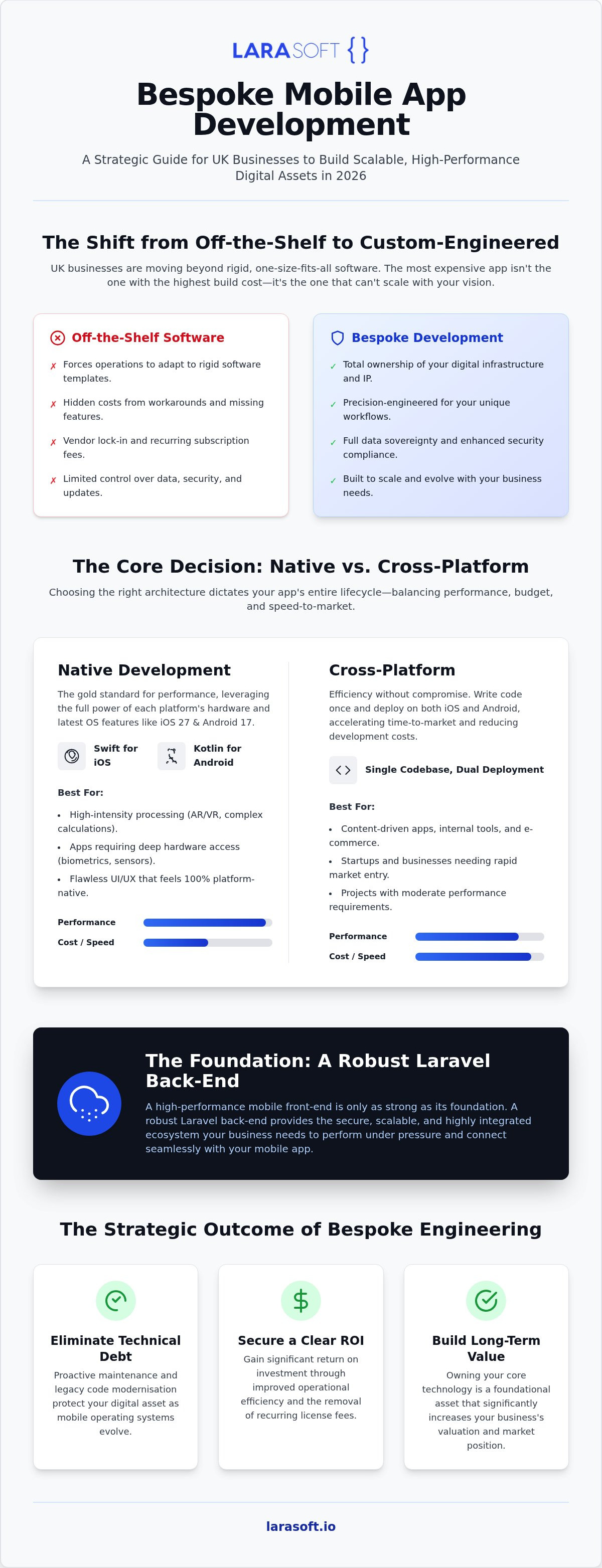
Bespoke development represents a fundamental shift from generic software to custom-engineered solutions. It involves building an application from the ground up to mirror your specific business logic and operational requirements. In the competitive landscape of 2026, bespoke mobile app development London has evolved into a strategic necessity rather than a luxury. UK enterprises are increasingly moving away from restrictive SaaS models that provide immediate access but offer zero flexibility as the business scales. This shift is driven by the need for absolute control over digital infrastructure.
Custom mobile solutions act as a foundational asset. Unlike generic platforms, these systems are designed to grow alongside your company. They provide a level of structural integrity that allows for seamless updates and integrations, ensuring your technology never becomes a bottleneck for growth. By treating software as an investment in intellectual property, businesses secure long-term value that far outweighs the convenience of temporary subscriptions.
The primary driver for custom engineering is the elimination of recurring licensing fees and the removal of vendor lock-in. When a business relies on a third-party platform, they're essentially renting their operational capacity. Custom builds provide total ownership of the stack. This allows for:
Integrating these elements into the mobile app development process ensures that the final product is a precise reflection of the brand's strategic goals.
Comparing these two paths requires looking beyond the initial invoice. Off-the-shelf software often carries hidden costs, such as the time lost to inefficient workarounds or the expense of "bolting on" necessary features that the core product lacks. Bespoke mobile app development London focuses on a lean, efficient architecture where every line of code serves a purpose. This efficiency reduces long-term maintenance burdens and technical debt.
Proprietary code also significantly impacts business valuation. An enterprise that owns its core technology is more attractive to investors and stakeholders than one that relies on a patchwork of subscriptions. Custom systems offer the flexibility to integrate deeply with existing UK business systems, creating a unified digital ecosystem that performs perfectly under pressure.
Selecting the right mobile architecture is a strategic decision that dictates your application's entire lifecycle. In the context of the UK's digital economy, where mobile traffic reached 60.5% of all internet usage by 2025, the stakes for performance and accessibility are higher than ever. Decision-makers in bespoke mobile app development London must weigh the immediate benefits of speed-to-market against the long-term requirements of architectural stability. This choice isn't just about code; it's about how your technology will respond to future shifts in the mobile landscape.
Native development remains the benchmark for applications requiring deep hardware integration or high-intensity processing. By using platform-specific languages like Swift for iOS and Kotlin for Android, engineers leverage the full capabilities of the latest operating systems. With iOS 27 and Android 17 already in the hands of users, native code ensures your app can adopt new system features the moment they're released. This approach provides the direct support from Apple and Google necessary for apps dealing with complex biometric data, advanced AR/VR, or heavy background processing tasks that demand maximum efficiency.
Cross-platform frameworks like React Native and Flutter have matured significantly for 2026 enterprise requirements. These tools allow for a "Single Codebase" strategy, which can reduce development time and costs by 30% to 40% compared to building two separate native apps. For the majority of business use cases, modern cross-platform performance is virtually indistinguishable from native standards. This efficiency simplifies the maintenance cycle and ensures feature parity across devices, making it an excellent choice for businesses prioritizing a unified user experience and rapid deployment.
The role of React and Vue.js has expanded within these ecosystems, allowing for a highly modular frontend that mirrors your web applications. By adopting an API-first architecture, your mobile product becomes a fluid extension of your existing digital presence. This structure ensures that business logic remains centralized, allowing for seamless data transitions between desktop and mobile interfaces. If you're evaluating how these technologies align with your growth plans, exploring cross-platform mobile development can reveal significant opportunities for operational efficiency and scalability. A robust API foundation, frequently anchored by a Laravel back-end, ensures that your data remains secure while providing the flexibility to pivot as your market demands change.
A project's success is determined long before the first line of code is written. Adopting a rigorous approach to The Engineering Lifecycle is the most effective way to mitigate technical and financial risks. For stakeholders investing in bespoke mobile app development London, this means mapping complex business logic to a robust technical architecture. We move beyond surface-level design to build a blueprint that accounts for data flow, security, and future scalability. Agile methodology facilitates this by providing a framework for iterative progress and transparent communication. It ensures the technical team remains aligned with commercial objectives through regular sprints and feedback loops.
Establishing this foundation requires a shift from building a product to engineering a system. It involves constant validation and a commitment to architectural integrity that prevents the accumulation of legacy code from the outset. This discipline ensures the application remains performant as user numbers grow and operational demands evolve. By prioritizing structural health early, businesses avoid the expensive "refactoring" cycles that plague poorly planned projects.
The discovery phase focuses on defining a Minimum Viable Product (MVP). This strategy accelerates time-to-market by prioritizing core features that deliver immediate value while gathering essential user data. Prototyping goes deeper than aesthetics; it involves creating wireframes that adhere to the UK's Public Sector Bodies Accessibility Regulations 2018 and WCAG 2.2 Level AA standards. This ensures the app is inclusive and legally compliant for all users. Simultaneously, engineers establish the API architecture to ensure secure, low-latency data flow between the mobile interface and the back-end infrastructure. This stage is critical for identifying potential integration hurdles before they become costly development delays.
Execution begins with writing clean, maintainable code using the frameworks identified in the tech stack selection. High-quality engineering requires rigorous QA across a diverse range of mobile hardware to ensure stability. Testing isn't a final step but a continuous process integrated into every sprint. Navigating the complexities of Apple App Store and Google Play Store submissions is a specialized task. It requires staying ahead of evolving guidelines and technical requirements. By implementing Continuous Integration (CI) and Deployment (CD) pipelines, we automate the testing and deployment process. This ensures that updates for iOS 27 or Android 17 are deployed reliably, maintaining a seamless experience for the end user and protecting the long-term health of the application.
The deployment of a mobile application marks the transition from a development project to a live business asset. It's a common misconception that the heavy lifting ends at the app store launch. In reality, the long-term value of bespoke mobile app development London depends entirely on proactive lifecycle management. Mobile operating systems evolve rapidly; with the release of iOS 27 and Android 17 in 2026, applications that aren't maintained quickly become obsolete. This isn't just about fixing bugs. It's about preventing software rot and ensuring your application continues to perform perfectly under the pressure of increasing user demands.
A critical component of this lifecycle is legacy code modernisation. Many UK enterprises operate with core business logic trapped in aging systems. For a modern mobile app to be effective, it must integrate seamlessly with these existing databases, ERPs, or CRMs. Strategic modernisation allows you to refactor these older codebases, creating a secure bridge between your historical data and your new mobile frontend. This approach transforms a potential liability into a scalable foundation for future growth.
Effective maintenance functions as a strategy for continuous improvement rather than a reactive chore. It involves more than just security patching. A disciplined maintenance cycle includes:
By treating maintenance as an ongoing investment, you protect the integrity of your code and ensure a high ROI through sustained operational efficiency.
Ignoring technical debt in a mobile-first economy is a significant business risk. When legacy systems aren't modernised, they limit your ability to implement new features, such as Laravel AI solutions designed to automate complex workflows. Refactoring these systems doesn't require a complete "rip and replace" approach. Instead, we focus on modular updates that support modern API integrations. This ensures your mobile app can pull real-time data from legacy databases without compromising security or speed. If your current software is struggling to keep pace with your mobile vision, exploring our services in legacy code modernisation can provide the technical intervention needed to restore momentum and scalability.
Success in the mobile market isn't just about the launch. It's about how your application responds to the first 100,000 users or the first major OS update. At Larasoft, we provide the technical authority required to navigate these challenges. Choosing a Laravel development agency provides your mobile product with a robust, enterprise-grade back-end foundation. This architectural choice ensures that your application remains fast, secure, and capable of handling complex data integrations as you scale.
Our approach to bespoke mobile app development London focuses on the synergy between custom web platforms and high-performance mobile solutions. We understand that your app is often part of a wider digital ecosystem. By integrating SEO services and advanced API structures, we ensure your mobile presence drives organic growth and operational efficiency simultaneously. We don't act as a one-off vendor; we serve as a deeply invested technical ally dedicated to your long-term commercial objectives.
We've structured our agency to eliminate the friction typical of large-scale software projects. You get direct access to senior UK developers and technical architects who take pride in the cleanliness and efficiency of their code. This results-oriented communication ensures that every technical intervention aligns with your business strategy. We focus on building systems that perform perfectly under pressure, prioritizing structural integrity over quick-fix products that eventually lead to technical debt. Our partnership is built on transparency, providing you with a manageable journey from the initial concept to a scalable digital asset.
The transition from a strategic vision to a functional product begins with a clear roadmap. We recommend initiating a technical audit of your current software to identify bottlenecks or legacy risks that could hinder your mobile expansion. This audit allows us to plan a precise mobile roadmap for the upcoming fiscal year, ensuring your budget is allocated toward high-impact features and architectural stability. Ready to transform your operations? You can request a consultation for your bespoke mobile project to discuss your technical requirements and long-term growth goals with our engineering team.
Building a mobile application is an investment in your company's operational future. We've explored how custom-engineered solutions provide the control and scalability that restrictive SaaS models lack. By prioritizing a structured engineering lifecycle and addressing legacy technical debt, you ensure your software remains a high-performance asset rather than a liability. True ROI isn't found in the initial launch; it's realized through disciplined maintenance and a partnership that values technical excellence as much as business growth.
Navigating the complexities of bespoke mobile app development London requires a partner who understands both high-level strategy and deep architectural integrity. Our UK-based senior engineering team specializes in Laravel and modern frontend frameworks, bringing a proven track record in legacy code modernisation to every project. We don't just deliver code; we engineer systems designed to perform perfectly under pressure.
Partner with Larasoft for Expert Bespoke Mobile Development and let's build a digital foundation that grows with your vision.
The investment for bespoke mobile app development London depends entirely on the project's technical complexity and integration requirements. While simple MVPs require fewer resources, enterprise-level applications with complex business logic and high-security protocols demand a more significant commitment. We focus on providing a transparent breakdown of costs during the discovery phase. This ensures that every pound spent contributes to a scalable, high-performance asset rather than a one-off product.
Building a custom application from scratch usually takes between three and nine months. A streamlined Minimum Viable Product can often be deployed in four months, while complex enterprise systems requiring deep legacy integrations may take longer. This timeline includes rigorous phases for discovery, architectural design, iterative development, and exhaustive quality assurance. We prioritize a structured lifecycle to ensure the final product is stable and ready for the UK market.
Native development is the preferred choice for apps requiring maximum performance or deep hardware access. If your project prioritizes speed-to-market and budget efficiency, cross-platform frameworks like React Native offer a single codebase that performs at near-native standards. We evaluate your specific business goals and technical requirements to recommend the architecture that provides the best long-term stability and scalability for your digital ecosystem.
We specialize in integrating modern mobile applications with existing legacy software through custom API development. This process often involves legacy code modernisation to ensure your aging databases or ERP systems can communicate securely with a high-performance mobile frontend. By refactoring core business logic, we transform your historical data into a functional mobile asset. This approach is a cornerstone of our bespoke mobile app development London services.
Mobile applications are installed directly on a device, allowing for offline functionality, push notifications, and full access to hardware like cameras or GPS. Web applications are accessed through a browser and don't require installation. While web apps are easier to deploy across all devices, mobile apps provide a more immersive and responsive user experience. The choice depends on how your users interact with your business logic and operational workflows.
Our team handles the entire submission process for both the Apple App Store and Google Play Store. This includes ensuring your application meets the latest technical requirements for iOS 27 and Android 17. We navigate the complexities of privacy policies, metadata optimization, and hardware compatibility checks. This managed approach reduces the risk of rejection and ensures a smooth transition from the development environment to a live public release.
A bespoke application requires proactive maintenance to remain secure and performant as mobile operating systems evolve. This includes regular security patching, database query optimization, and updates for compatibility with the latest iOS and Android versions. We also monitor performance metrics to identify potential bottlenecks before they affect the user experience. Continuous maintenance prevents software rot and protects your long-term investment in custom-engineered technology.
Laravel is a premier choice for mobile back-ends because of its robust security features and excellent API-first architecture. It provides a clean, maintainable foundation that integrates seamlessly with modern frontend frameworks like React and Vue.js. Its built-in tools for data encryption and authentication make it ideal for handling sensitive business information. We frequently utilize Laravel to build scalable back-ends that support high-performance mobile applications under heavy user load.
Here’s what we've been up to recently.
Certified Quality. Great Prices