WCAG 2.2: The Complete Business Reference for Web Accessibility in 2026

In 2024, the WebAIM Million report found that 95.9% of the world's leading homepages failed basic accessibility tests. For UK businesses, these failures represent more than a poor user experience; they are a direct violation of the Equality Act 2010. You likely find the technical complexity of the W3C documentation overwhelming, especially when trying to apply dry wcag standards to modern frameworks like React or Vue.js. It's a common challenge to balance high-performance code with the meticulous requirements of inclusive design.
We've created this guide to transform that complexity into a structured journey toward growth. You'll learn how to master the latest technical standards to build robust software that meets legal requirements and expands your market reach. We will provide a clear roadmap for WCAG 2.2 compliance, offering actionable technical guidance that your development team can implement immediately to ensure your digital assets remain foundational for years to come.
Digital inclusion isn't a trend; it's a technical requirement for modern software architecture. The Web Content Accessibility Guidelines (WCAG) serve as the international benchmark for creating software that works for everyone. These standards are maintained by the World Wide Web Consortium (W3C), the governing body responsible for the web's core protocols. By 2026, the transition from version 2.1 to 2.2 will be the expected standard for any enterprise-level application. This evolution reflects a shift toward more human-centric engineering.
Building with wcag compliance isn't just about avoiding legal risk. It's about craftsmanship. When we develop bespoke applications, we treat accessibility as a core feature rather than a late-stage add-on. This approach ensures that your digital assets are scalable and ready for a global audience. Reliable code must be inclusive by design, ensuring that no user is left behind due to technical oversight.
The W3C organizes accessibility into four foundational pillars known as POUR. These principles ensure that software remains functional regardless of how a user interacts with it:
WCAG 2.2 became a formal recommendation in October 2023. It introduces nine new success criteria specifically designed to improve mobile accessibility and support users with cognitive disabilities. For example, new rules for pointer target spacing ensure that users with limited motor skills can interact with mobile buttons without error. These updates aren't optional for brands aiming for market leadership in 2026.
Ignoring these updates creates immediate technical debt. Modern web applications built on version 2.0 or 2.1 will require expensive refactoring as the European Accessibility Act (EAA) takes full effect in June 2025. One notable change in 2.2 is the removal of the "Parsing" criterion (4.1.1). The W3C retired this because modern browsers now handle code errors more effectively. This allows our team to focus on high-impact usability rather than legacy validation. Adopting 2.2 now ensures your software remains a foundational asset for years to come.
WCAG follows an additive architecture. Version 2.2 builds directly upon 2.1 and 2.0; it doesn't replace them but extends their reach. If your platform meets the 2.2 standard, it inherently satisfies previous versions. This backward compatibility ensures that legacy systems don't require a total structural overhaul but rather targeted technical interventions to meet the nine new success criteria introduced in the latest update. Referencing the official WCAG 2.2 recommendation provides the precise technical blueprint for these requirements.
Conformance is structured into three tiers. Level A addresses the most basic barriers to access. Level AA serves as the global business benchmark for commercial applications. Level AAA represents the highest possible standard, often reserved for specialized environments. Failing to meet even one success criterion at the AA level can render an entire digital asset non-compliant. Data from the 2023 WebAIM Million report shows that 96.3 percent of home pages still fail basic accessibility tests, creating a massive market gap for businesses that prioritize clean, inclusive code.
Level AA is the legal baseline for the UK Equality Act 2010. It also dictates compliance for the Public Sector Bodies Accessibility Regulations 2018. For most commercial entities, AA offers the best balance between high-level accessibility and modern design flexibility. It ensures your software remains usable for the 16 million people in the UK living with a disability. Key requirements at this level include:
AAA conformance is rarely a blanket requirement but is vital for specific sectors like primary education, public health portals, and government-funded resources. The technical demands are rigorous and can impact design aesthetics. For instance, you must push contrast ratios to 7:1 and provide sign language interpretation for all pre-recorded media. Determine if your bespoke build requires AAA by checking these factors:
Building for longevity requires a technical ally who understands how to translate these rules into functional software. If you're planning a high-performance build, our team can help you architect a compliant solution that prioritizes both user experience and legal security. We believe in your vision, our code, and a digital future that excludes no one.
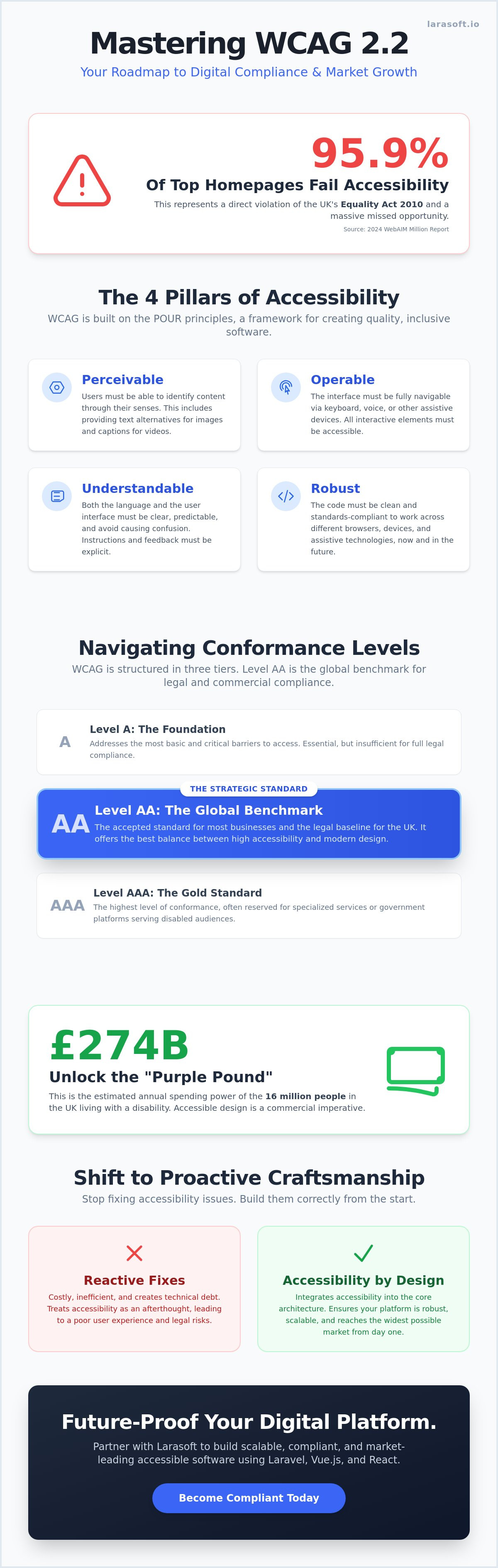
Digital accessibility isn't a secondary HR initiative; it's a high-stakes revenue driver. In the UK, the "Purple Pound" refers to the combined spending power of disabled households, currently valued at £274 billion per year. When your platform fails to meet wcag standards, you're effectively locking your doors to 22% of the UK population. This isn't just about social responsibility. It's about capturing a massive, underserved market that rewards inclusive brands with fierce loyalty. At LaraSoft, we view accessibility as a core component of high-performance architecture, ensuring your vision reaches every possible user without friction.
Clean, accessible code is the foundation of technical SEO. When developers use semantic HTML correctly, they provide search engine crawlers with a clear roadmap of the page's context and hierarchy. This structural clarity helps bots index your content more accurately, which can lead to higher rankings. There is a direct overlap between WCAG success criteria and Google's Core Web Vitals, particularly regarding mobile usability and stable layouts. AI-driven search models prioritize well-structured, accessible data to deliver precise answers to user queries. By building for screen readers, you're simultaneously optimizing for the next generation of search technology.
The legal landscape for digital services is tightening. Under the UK Equality Act 2010, businesses must make "reasonable adjustments" to ensure their services are accessible to everyone. In 2023, the UK saw a marked increase in legal challenges directed at inaccessible digital platforms, following trends seen in the US. Maintaining wcag conformance acts as a defensive shield, protecting your business from costly litigation and reputational damage. As noted by the U.S. Access Board on WCAG 2.2, these international standards are becoming the benchmark for global regulatory compliance. For bespoke software, integrating these standards early is far more cost-effective than attempting to retroactively fix deep-seated architectural flaws.
Friction is the enemy of conversion. The 2019 Click-Away Pound survey revealed that 71% of disabled customers will leave a website that they find difficult to use. This isn't limited to users with permanent disabilities; better contrast, larger touch targets, and logical navigation improve the experience for everyone. When you reduce the cognitive load required to navigate your site, bounce rates drop and conversion targets become easier to hit. We don't just build software that works; we build systems that scale by being usable for the widest possible audience.
Advocating for the rights of those with disabilities extends beyond the digital realm into essential legal protections. For individuals seeking support with personal injury claims or navigating immigration and estate planning, the Arlington Law Office provides the specialized counsel necessary to ensure fair treatment and accessibility in all aspects of life.
Modern development demands more than aesthetic appeal; it requires structural integrity. As we approach 2026, the complexity of Single Page Applications (SPAs) built with Vue.js or React presents unique hurdles for wcag compliance. While Laravel provides a robust backend, the frontend often fails users if developers don't actively manage the DOM state. Our approach focuses on technical precision to ensure every user, regardless of how they browse, experiences a seamless interface.
In a headless architecture, the browser doesn't automatically reset focus during route changes. Developers must programmatically move focus to the page header or a main wrapper element. Without this, screen reader users remain stuck at the bottom of the previous "page" after clicking a link. It's essential to use ARIA live regions to announce dynamic content like validation errors or success messages. A common pitfall in bespoke component libraries is "div-itis." Swapping a generic div with an onClick handler for a proper button element instantly restores keyboard operability. This simple change ensures your interactive elements are natively focusable and functional.
Auditing an existing Laravel application starts with a comprehensive scan of Blade templates. We prioritize fixes by identifying "blockers" first. These include keyboard traps in navigation menus and missing labels on mission-critical forms. Data from 2024 audits suggests that refactoring legacy code for accessibility often costs 40% less than a full rebuild, provided the underlying architecture is stable. We focus on injecting semantic clarity into existing structures to extend the software's lifecycle. By using Blade components to enforce consistent ARIA attributes, we create a scalable system that prevents future accessibility regressions.
Tools like Axe-core, Lighthouse, and WAVE provide a solid foundation for automated checks. However, these tools only identify between 30% and 40% of accessibility issues. They can't judge if a label makes logical sense or if a complex interactive map is usable via keyboard. Larasoft integrates these automated tools into the CI/CD pipeline while mandating manual keyboard testing for every release. This dual-layered approach ensures that your application meets the strict wcag requirements of 2026. We don't just rely on scripts; we verify the user journey manually to guarantee compliance.
Build a more inclusive digital future with experts who understand the nuances of accessible code. Partner with Larasoft for your next Laravel project
Web accessibility isn't a final layer applied to a finished product. At Larasoft, we practice Accessibility by Design. This means integrating wcag standards into the initial wireframing and prototyping phases. By addressing contrast ratios, keyboard navigation, and semantic structures before a single line of code is written, we eliminate the 67% of accessibility errors typically introduced during the design phase. This proactive method reduces development costs and prevents the need for expensive retrofitting as your business scales.
Our bespoke Laravel builds are architected for long-term scalability and inclusion. Laravel’s blade templating and robust middleware allow our developers to enforce semantic HTML and ARIA roles at the component level. We treat accessibility as a core architectural requirement, ensuring that your platform remains usable for the 1 in 6 people worldwide who live with a significant disability. This structural integrity means your software isn't just compliant today; it's built to adapt to the technical demands of 2026 and beyond.
Ongoing software maintenance is vital to prevent "accessibility drift." Research indicates that 30% of previously compliant websites lose their status within six months because of unmonitored content updates or new feature deployments. We view our clients as long-term partners. Our "Your vision, our code" philosophy ensures that we act as your technical ally, protecting the integrity of your digital assets. We build high-performance applications that deliver a seamless experience for every user, regardless of how they interact with their screen.
Our development process moves through a structured lifecycle from the initial UX audit to final User Acceptance Testing (UAT). We utilize assistive technologies, including NVDA and JAWS screen readers, to verify that every user journey is friction-free. Once the build is complete, we provide dedicated training to your internal teams. This empowers your staff to maintain compliance when adding new content or features. Larasoft is dedicated to writing clean, efficient, and inclusive code that serves as a foundational asset for your company’s future growth.
A professional technical audit is the first step toward meeting the legal requirements of the European Accessibility Act, which takes full effect on June 28, 2025. When you partner with Larasoft, you receive a clear, prioritized roadmap for remediation. We identify critical barriers and provide technical solutions that align with wcag 2.2 success criteria. Whether you require a specialized technical SEO review or comprehensive Software Maintenance, we provide the specialized expertise needed to mitigate risk and improve your site’s performance. We transform complex compliance requirements into a manageable, structured journey toward a better digital presence.
Achieving wcag 2.2 compliance by the 2026 deadline requires more than a surface level patch; it demands a fundamental commitment to high performance architecture. You've seen how the shift through A, AA, and AAA conformance levels directly impacts user retention and long term legal safety. By modernising legacy codebases today, you eliminate the technical debt that eventually hinders global growth. Our UK based team of Laravel development specialists focuses on building these scalable, bespoke foundations. We treat every line of code as technical craftsmanship, ensuring your platform remains accessible as digital standards evolve.
Transitioning your existing framework into a modern, compliant system is a structured journey we manage with technical precision. Don't leave your accessibility strategy to chance or superficial plugins that fail under pressure. We're ready to transform your platform into a foundational asset for the future. Ensure your platform is inclusive and compliant; request a professional audit from Larasoft today. Your vision deserves code that performs perfectly for every user.
Yes, the Equality Act 2010 requires all UK service providers to make reasonable adjustments for persons with disabilities. While the Public Sector Bodies Regulations 2018 specifically name wcag standards for government sites, private firms face significant litigation risks if they exclude users. UK courts saw a 25% rise in digital accessibility claims in 2023, making compliance a critical safeguard for your business architecture.
WCAG 2.2 expands the 2.1 standard by adding nine new success criteria that focus on mobile interface interactions and cognitive disabilities. These updates include specific requirements like "Target Size," which mandates that interactive elements occupy at least 24x24 CSS pixels. This evolution ensures your bespoke software remains functional for the 16 million people in the UK currently living with a disability.
No, Level AA is the accepted global benchmark for most commercial and public software projects. Level AAA represents the highest tier of inclusivity but it's often technically impractical for complex data visualizations or high-performance web applications. Our Laravel specialists typically target Level AA to ensure legal compliance and broad usability without sacrificing the sophisticated functionality of your custom platform.
Adhering to wcag guidelines boosts SEO by improving site structure, crawlability, and user engagement metrics. Search engines reward sites that use semantic HTML, descriptive alt text, and clear heading hierarchies. Industry data from 2024 shows that accessible websites often experience a 12% increase in organic traffic because they provide a superior experience for both bots and human users.
No, automated tools like Lighthouse or Axe generally identify only 35% of all potential accessibility barriers. These scanners excel at catching low color contrast or missing alt tags; however, they can't judge the logical sequence of a page or the effectiveness of keyboard navigation. Our craftsmen use a hybrid approach, combining automated checks with manual testing to ensure your code is truly inclusive.
The investment required depends entirely on the complexity of your current software architecture and the volume of custom components. We don't offer fixed pricing because every bespoke application presents different technical challenges. Instead, we perform a detailed audit to map out a structured remediation journey. This ensures your development budget focuses on high-impact fixes that provide the best ROI for your business.
The most frequent errors involve poor focus management in Single Page Applications and the use of non-semantic components. Developers often use "div" tags for buttons, which breaks screen reader functionality. In frameworks like Vue or React, failing to update the page title after a route change confuses users. We prioritize clean, semantic code to avoid these common pitfalls and ensure seamless full-stack performance.
You should schedule a full accessibility audit every 12 months or whenever you launch a major feature update. Continuous delivery cycles can introduce new regressions that compromise your compliance status. Regular reviews protect the longevity of your digital assets and ensure your platform remains accessible as browser technologies change. This disciplined schedule reflects our commitment to building reliable, future-proof software for our partners.
Here’s what we've been up to recently.
Certified Quality. Great Prices