Upgrading Legacy PHP to Laravel: A Strategic Guide for UK Businesses in 2026

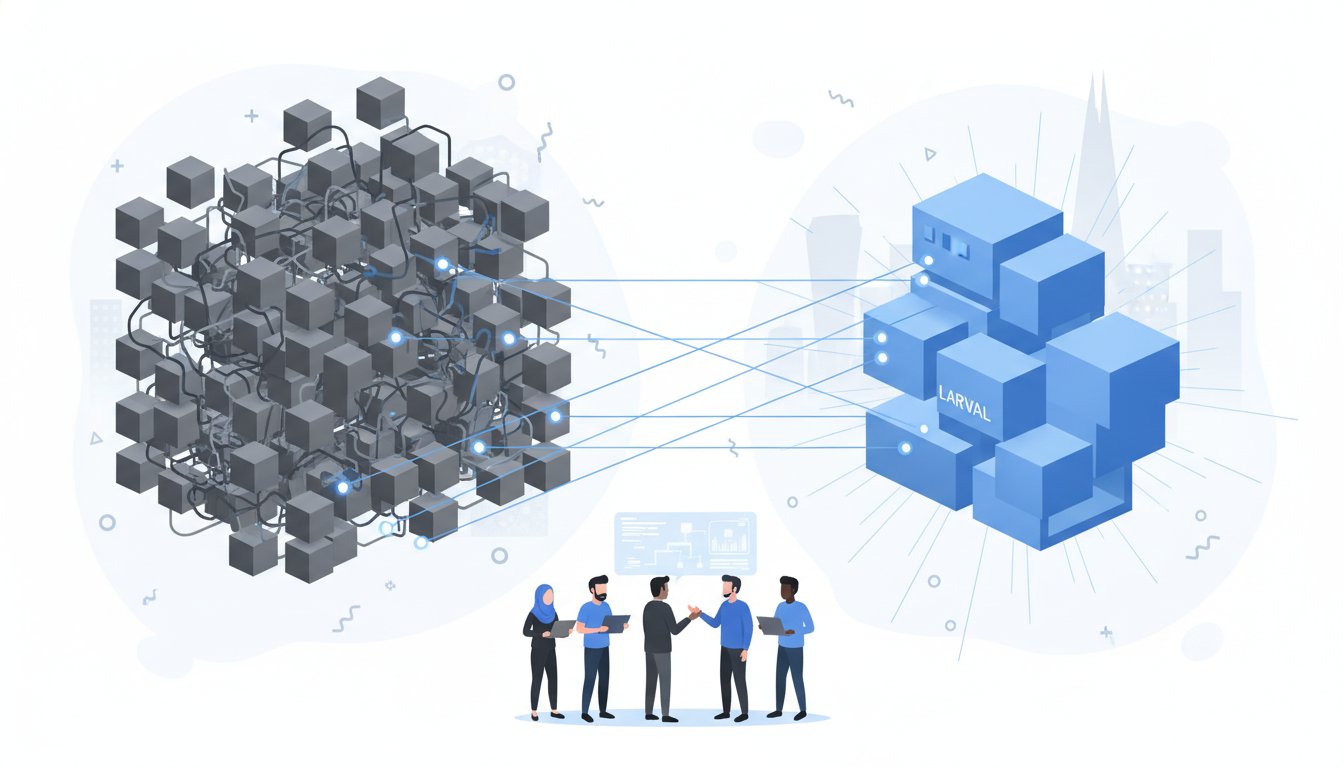
Did you know that 60% of full software rewrites fail to meet their objectives, while incremental migrations boast an 85% success rate? If you're managing an aging application, the decision to modernize is often clouded by the fear of significant downtime. You're likely already feeling the friction of high maintenance costs and the mounting security risks of EOL versions like PHP 8.1. Upgrading legacy php to laravel doesn't have to be a high-stakes gamble. It's a strategic transition that preserves your existing value while building a robust foundation for the future.
We understand that your software is the engine of your business. You need a system that isn't just fixed but is actively driving growth through modern API integrations and AI-native workflows. In this guide, we'll show you how to transform your outdated PHP systems into high-performance Laravel 13 applications without disrupting your daily operations. We'll cover the transition from technical debt to scalability, the benefits of modern frontend frameworks like Vue.js, and how UK businesses can leverage R&D tax credits to offset the costs of this essential evolution.
In the fast-moving technical landscape of 2026, legacy PHP systems are defined by more than just their age. If your application still relies on PHP 8.1, which reached its end of life in late 2025, or even PHP 8.2, you're operating on borrowed time. These versions no longer receive official security patches, leaving your business exposed to vulnerabilities that modern firewalls won't catch. Upgrading legacy php to laravel isn't just a technical preference; it's a defensive necessity for any organisation that values its data integrity and operational uptime.
Many UK businesses suffer from what we call the "Innovation Tax." This is the portion of your development budget spent simply keeping old code alive rather than building new value. When developers spend 70% of their time patching bugs in spaghetti code or managing brittle manual deployments, they aren't integrating the AI-driven workflows or API services your competitors use to gain market share. This drain on resources creates a cycle of stagnation where the cost of maintenance eventually exceeds the cost of a strategic upgrade.
Scalability is another casualty of aging systems. Legacy codebases often lack the modular structure required to handle modern traffic spikes or integrate with cloud-native services. By upgrading legacy php to laravel, you replace rigid, procedural scripts with a clean, Model-View-Controller (MVC) architecture. This shift allows your application to scale horizontally and respond to user demand without the constant threat of a system crash under pressure.
Identifying an unmaintainable codebase is straightforward: look for long lead times on simple features and a growing fear among developers to touch core modules. Technical debt is the hidden interest paid on outdated architectural choices. As this debt compounds, the complexity of your system grows, making it increasingly difficult to hire top-tier talent who prefer working with modern tools like Laravel 13. Delaying modernisation only makes the eventual transition more expensive as the gap between your system and modern standards widens.
For UK firms, the risks of running outdated software extend into the legal sphere. UK GDPR mandates "security by design and default," a standard that's virtually impossible to maintain on unsupported PHP versions. Laravel provides a hardened foundation with built-in protection against SQL injection, cross-site scripting, and cross-site request forgery. By migrating, you shift the burden of security from custom, error-prone patches to a battle-tested framework. This move ensures your business remains compliant with evolving UK digital regulations while protecting your reputation from the fallout of a preventable data breach.
Choosing between a full rewrite and a gradual refactor is often the most contentious decision in a project's lifecycle. While the lure of a "clean slate" is strong, industry data suggests a cautious approach is usually more effective. Research shows that full rewrites have a success rate of only 40%, whereas incremental migrations succeed 85% of the time. For a UK business, a failed rewrite doesn't just waste budget; it creates a period of operational paralysis that competitors can exploit.
The "Big Bang" rewrite is only advisable when the existing codebase is so structurally compromised that it cannot support even basic security patches. In most other cases, upgrading legacy php to laravel through a structured refactoring process offers a more predictable ROI. This method allows you to address the highest-risk areas first, such as payment gateways or user authentication, while the rest of the system continues to serve your customers. It's about surgical precision rather than demolition.
The Strangler Fig pattern is the gold standard for zero-downtime migrations. It involves placing a new Laravel application in front of your legacy system, acting as a proxy. When a user requests a feature that has already been modernised, Laravel handles it. If the feature still resides in the old code, the request is passed through seamlessly. This allows for a feature-by-piece replacement that ensures business continuity throughout the entire legacy code modernisation lifecycle. You don't have to wait for a "launch day" to see the benefits of modern code.
To choose the right path, you must evaluate the complexity of your current dependencies and the quality of your existing documentation. For UK SMEs, the gradual approach is particularly attractive because it spreads the capital expenditure over several months. You aren't forced to pay for a massive project upfront without seeing functional improvements for a year. Instead, each sprint delivers a modernised, high-performance module that reduces your maintenance burden.
If your internal team is already stretched thin by daily operations, attempting a complex migration in-house often leads to burnout and project delays. Partnering with a specialized agency provides the technical artisan's eye needed to navigate these transitions safely. You can consult our technical team to conduct a deep audit of your current architecture before committing to a specific strategy. This ensures your journey toward a scalable system is grounded in reality rather than optimism.
Successful modernisation depends on a disciplined, phased execution. Upgrading legacy php to laravel requires more than a simple file transfer; it's a structural overhaul that demands meticulous planning to avoid business disruption. By following a structured roadmap, our technical artisans ensure that every transition point is validated against your specific business logic and performance requirements. This process moves from high-level discovery into granular implementation, ensuring the final application is both secure and scalable.
The roadmap typically follows five distinct phases:
The first step is identifying how your current system handles core functions. We often find that legacy PHP applications use bespoke, non-standard authentication methods that are vulnerable to modern exploits. Part of upgrading legacy php to laravel involves replacing these brittle scripts with Laravel’s robust, built-in security features. We also map critical third-party integrations, such as UK-specific payment gateways or bespoke CRM hooks, to ensure they remain functional throughout the migration. A feature audit is the most critical step in preventing scope creep because it defines the exact boundaries of the migration before a single line of code is written.
Moving data from an aging system is a high-precision task. Legacy databases often lack foreign key constraints or use non-standard naming conventions that don't align with modern standards. We utilise Laravel’s Eloquent ORM to create a clean abstraction layer over your data, allowing for more efficient queries and easier maintenance. To prevent downtime, we often employ "dual-writing" strategies where data is synchronised between the old and new schemas in real-time. This ensures that when you finally switch to the Laravel environment, every record is accurate and accounted for. Our focus remains on structural integrity, ensuring your database can handle the increased throughput of a modern web application.
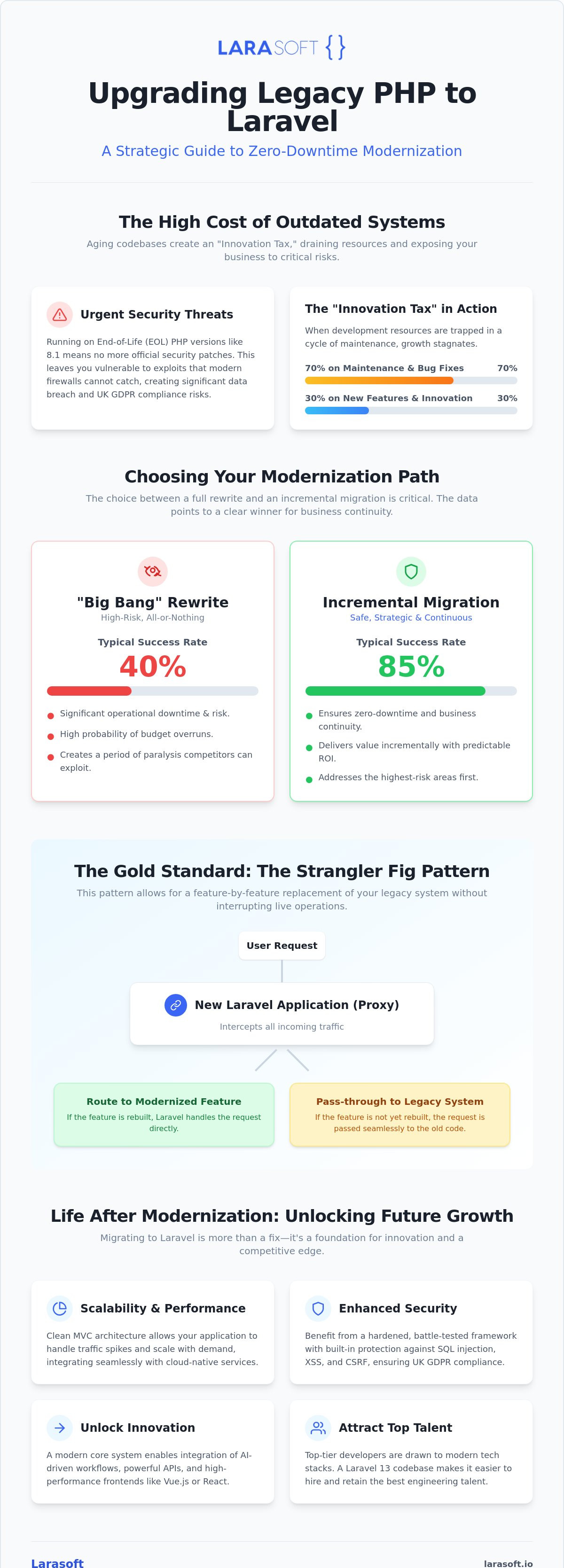
Completing the transition to a modern framework is more than a technical milestone; it's the moment your software shifts from a maintenance burden to a growth engine. Once the "Innovation Tax" of your old system is eliminated, your team can pivot from patching vulnerabilities to deploying competitive features. Upgrading legacy php to laravel provides the architectural freedom to adopt technologies that were previously incompatible with your codebase, such as real-time data processing and advanced automation.
A modern Laravel 13 foundation allows you to build an API-first ecosystem. This approach ensures your core business logic is accessible to various platforms, whether you're launching a native mobile app or integrating with third-party logistics providers. By treating your backend as a robust service layer, you future-proof your investment against changing market demands and hardware shifts.
Laravel 13 is designed with modern workflows in mind, making it the ideal host for Large Language Models (LLMs) and bespoke machine learning scripts. You can now automate complex business processes, such as intelligent customer support routing or predictive inventory management, which would have been impossible in a procedural PHP environment. Strategic Laravel AI integration allows you to process vast datasets directly within your application, turning raw information into actionable business intelligence without the need for manual exports.
Modernisation also allows you to decouple your frontend from your backend logic. By transitioning to a headless architecture, you can utilise powerful frameworks like Vue.js or React to create seamless, high-performance user interfaces. These Single Page Applications (SPAs) offer a fluid, app-like experience that keeps users engaged and improves conversion rates. Beyond the user experience, a modern stack significantly enhances your SEO capabilities through server-side rendering and faster time-to-interactive metrics.
Building a high-performance frontend requires a deep understanding of how modern browsers interact with your API. If you're ready to move beyond basic web pages and build a sophisticated digital platform, you can explore our custom development services to see how we bridge the gap between complex backends and elegant user interfaces. Upgrading legacy php to laravel is the first step toward this level of technical maturity.
The complexity of upgrading legacy php to laravel requires more than just a passing familiarity with modern syntax. It demands a partner who understands the structural nuances of both old-world procedural code and modern object-oriented frameworks. While generalist agencies often juggle multiple tech stacks, a specialised laravel development agency brings the depth of experience needed to anticipate migration bottlenecks before they occur. Our role as technical artisans is to ensure your transition is a controlled, strategic evolution rather than a reactive scramble.
Working with a UK-based team offers distinct advantages for businesses navigating local regulatory frameworks. We understand the specific implications of UK GDPR and the digital requirements of Making Tax Digital (MTD), ensuring your software remains compliant as it modernises. Real-time collaboration eliminates the friction of time-zone delays, allowing for a dedicated project management style that prioritises transparency. Bespoke development is a foundational asset for your future. Unlike off-the-shelf software, a custom-built Laravel application provides a superior long-term ROI by aligning perfectly with your unique operational workflows.
A successful migration is only the beginning of your software's lifecycle. We focus on long-term software maintenance to ensure your application remains secure and performant as new Laravel versions emerge. This involves establishing a proactive update schedule for core dependencies and monitoring performance metrics in real-time. Continuous improvement prevents the accumulation of new technical debt, turning your code into a scalable platform that grows alongside your business. Upgrading legacy php to laravel is a significant investment; we protect that investment through disciplined, ongoing care.
Planning your modernisation roadmap starts with a clear-eyed assessment of your current risks. You don't need to commit to a full rewrite to start seeing improvements. By identifying the most critical bottlenecks today, you can begin an incremental migration that delivers immediate value. If you're ready to move away from the limitations of aging code, you can contact our UK technical team to begin your audit. We'll help you map out a journey toward a high-performance system that performs perfectly under pressure.
Modernising your software isn't just about fixing what's broken; it's about reclaiming your capacity for innovation. By shifting from aging procedural scripts to a structured MVC architecture, you eliminate the hidden "Innovation Tax" and open the door to advanced AI integrations and high-performance frontends. The Strangler Fig pattern provides a safe, incremental path for upgrading legacy php to laravel without the operational risks of a total rewrite. This disciplined approach ensures your business remains resilient against security threats while staying compliant with evolving UK digital standards.
Success in these complex transitions requires more than just technical skill; it demands a partner who understands the intersection of clean code and business objectives. Our UK-based Laravel specialists provide the specialized expertise needed for complex legacy refactoring and dedicated long-term software maintenance. We don't just deliver a product; we build a foundational asset that scales with your ambitions. If you're ready to transform your technical debt into a competitive advantage, discuss your legacy PHP modernisation with our UK experts today. Your journey toward a faster, more secure digital platform starts with a single strategic step.
Timelines vary based on application complexity and the state of the existing codebase. A mid-sized business application usually requires three to six months for a comprehensive transition. This includes the initial audit, environment setup, and feature-by-piece refactoring. Larger enterprise systems with extensive third-party integrations can take twelve months or more to fully modernise while ensuring zero business disruption.
No, your application shouldn't experience downtime if you use an incremental migration strategy. By employing a proxy layer, we ensure the legacy system remains live while we replace individual modules. Users continue to access the platform as usual, unaware that the underlying architecture is being modernised in the background. This approach is essential for UK businesses that require 24/7 operational availability.
Gradual migration is almost always more cost-effective because it spreads the capital expenditure and reduces the risk of project failure. A full rewrite often uncovers hidden complexities that lead to budget overruns and delayed launches. Incremental modernisation allows you to realise ROI sooner by deploying high-value features first, making it the preferred choice for UK SMEs managing tight development budgets.
The primary risks are security vulnerabilities and regulatory non-compliance. Versions like PHP 5.6 and 7.4 reached their end of life years ago and no longer receive security patches. This leaves your data exposed to modern exploits and may violate UK GDPR requirements for "security by design." Additionally, old versions are significantly slower and cannot support modern API or AI services.
Yes, you can keep your existing database, though it often requires some structural cleanup. When upgrading legacy php to laravel, we use the Eloquent ORM to map your existing tables to modern objects. If your schema is non-standard, we create custom mappings to ensure data integrity. This allows you to preserve your historical data while gaining the performance benefits of a modern framework.
You don't necessarily need a new provider, but your hosting environment must meet Laravel 13 technical requirements. This includes a minimum of PHP 8.3 and specific extensions like BCMath and Ctype. If your current host only offers legacy shared hosting, moving to a cloud-native environment like AWS or DigitalOcean is recommended. This shift supports the scalability and automated deployment workflows that Laravel enables.
Laravel improves SEO by offering faster server-side execution and cleaner URL routing. Modernising your stack often includes transitioning to a faster frontend, which reduces PageSpeed loading times, a critical ranking factor in 2026. Upgrading legacy php to laravel also allows for easier implementation of schema markup and meta-tag management, ensuring your application is fully optimised for search engine crawlers.
The Strangler Fig pattern is a risk-mitigation strategy where a new system gradually replaces a legacy one. You "wrap" the old application in a modern Laravel shell that intercepts incoming requests. Over time, you migrate individual features into the Laravel environment until the old system is completely replaced. This ensures the application remains functional throughout the process, providing a safety net for complex business logic.
Here’s what we've been up to recently.
Certified Quality. Great Prices