The Essential Checklist for Secure Software Development Practices in 2026

AI-driven attacks now account for one in four malicious breaches, a 56% year-over-year increase that has redefined the digital battlefield in 2026. You likely feel the mounting pressure of NIS2 compliance and the very real fear that a single vulnerability could result in a breach costing nearly £4 million. It's difficult to maintain confidence in your technical partners when the complexity of modern frameworks seems to outpace the security measures meant to protect them. We understand these concerns; security shouldn't be a final hurdle but a foundational discipline that protects your business value and enables long-term growth.
This guide provides a definitive roadmap for secure software development practices, offering a clear checklist to help you audit your current processes and build with total precision. We'll explore how to integrate "shift-left" methodologies, secure your software supply chain, and modernise legacy systems to eliminate security debt for good. By following this structured journey, you can transform your development lifecycle into a resilient asset that performs perfectly under pressure while meeting every UK regulatory requirement.
In 2026, the legacy model of building software and "bolting on" security at the end is a significant business liability. We define Application security (AppSec) as a proactive, lifecycle-long commitment rather than a simple perimeter-based defense. As network boundaries dissolve due to cloud-native architectures and remote work, the industry has shifted toward internal application resilience. The code itself is now the primary line of defense.
The financial logic behind this shift is undeniable. Industry data indicates that remediating a security flaw during the production phase costs up to 30 times more than addressing it during the initial design. For UK business leaders, implementing secure software development practices is a matter of fiscal responsibility. It's about ensuring that your capital is spent on innovation rather than expensive, retrospective fixes.
The National Cyber Security Centre (NCSC) continues to set the standard for UK digital infrastructure. Their benchmarks emphasize that resilience must be baked into the architectural foundation of every custom-built platform. This creates a stable environment where systems can perform perfectly under pressure, even when facing sophisticated modern threats.
Adopting a "secure by design" philosophy transforms security from a restrictive cost centre into a strategic competitive advantage. It safeguards your intellectual property and sensitive customer data, which are the core assets of your enterprise. By prioritising structural integrity from day one, you significantly reduce long-term technical debt. This disciplined approach builds immense trust with stakeholders and technical partners. They need to know that your platform is a foundational asset, not a future vulnerability.
Compliance requirements have expanded far beyond the initial scope of GDPR. For UK firms exporting digital products or services, the EU Cyber Resilience Act (CRA) introduces strict baseline requirements that demand attention in 2026. Non-compliance isn't just a legal risk; it's a barrier to market entry. Adopting secure software development practices also streamlines the process of achieving Cyber Essentials certification. This standard is now a common prerequisite for UK government contracts and high-value supply chain tenders. Staying ahead of these evolving standards ensures your custom-built applications remain compliant and scalable for years to come.
Effectively managing secure software development practices requires a shift from viewing security as a checkpoint to treating it as a continuous thread woven through the entire project. This structured approach, often referred to as the Secure Software Development Life Cycle (SSDLC), ensures that every phase of creation is hardened against potential compromise. From the initial requirements gathering to the final deployment, each step must be deliberate and measured. This methodology aligns with the Secure Software Development Framework (SSDF), which provides a globally recognised set of best practices for reducing risk and improving the structural integrity of code.
The Requirements Phase establishes the security baseline by identifying regulatory needs and business-specific risks. During the Design Phase, teams engage in threat modelling to anticipate how an attacker might attempt to subvert the system. The Development Phase then translates these safeguards into actual code, followed by a Testing Phase that employs both Static (SAST) and Dynamic (DAST) analysis. Finally, the Deployment Phase focuses on secure environment configuration and continuous monitoring protocols to maintain the platform's integrity in the live environment.
A preliminary risk assessment is the first step in building resilient bespoke software. You must identify your "crown jewel" data; the sensitive information that would cause the most damage if leaked. For many UK businesses, this includes customer financial records, PII, or proprietary intellectual property. Establishing clear security Key Performance Indicators (KPIs) ensures the development team is held to a measurable standard of excellence. These metrics allow you to track vulnerability density and ensure that security remains a priority throughout the build, rather than being sacrificed for speed.
Modern frameworks such as Laravel and React offer significant advantages because they include native security defaults that protect against common exploits like SQL injection. However, technology alone isn't enough. Manual code reviews remain essential for catching complex logical flaws that automated tools often miss. We recommend a culture of peer review where every line of code is scrutinised by a second specialist. This process reinforces the principle of least privilege, ensuring that each component of the application architecture has only the access it strictly needs to function. If you're concerned about the integrity of an existing platform, software maintenance and regular audits are vital for preventing security debt from accumulating.
Technical guardrails serve as the automated enforcement of your security strategy. In 2026, relying on manual oversight is a risk no UK business should take. We align our technical choices with the OWASP Software Assurance Maturity Model (SAMM) to ensure that every architectural decision strengthens the platform. Adopting these secure software development practices extends to cloud-native security. Hardening environments on AWS, Azure, or GCP involves more than simple configuration; it requires infrastructure-as-code that eliminates human error and ensures repeatable, secure deployments.
A specialised Laravel development agency leverages the framework's native security features to block SQL injection and Cross-Site Request Forgery (CSRF) by default. These tools act as a first line of defence, ensuring that data handling remains consistent and secure across the entire application. On the client side, Vue.js frontend development provides built-in data sanitisation to prevent Cross-Site Scripting (XSS). These modern frontends ensure that user-generated content is safely rendered; preventing malicious actors from compromising the user's session or stealing sensitive cookies.
Securing API integrations is equally critical to prevent data leakage between systems. We implement robust access control using OAuth2 and OpenID Connect, ensuring that only authorised services can interact with your data. To defend against automated threats, we apply rate limiting and rigorous input validation at every endpoint. These measures stop denial-of-service attacks before they impact performance or system availability. By encrypting all data in transit with TLS 1.3, we ensure that your communications remain private and secure, even across public networks. These technical layers are fundamental to secure software development practices in a hyper-connected environment.
Effective session management and secure authentication are the final pieces of the puzzle. We move beyond simple passwords, integrating multi-factor authentication (MFA) and secure token handling as standard components of bespoke builds. This ensures that even if a credential is compromised, the broader system remains protected. By treating infrastructure and code as a single, unified security entity, we build platforms that don't just host data, but actively defend it against the evolving threats of 2026.
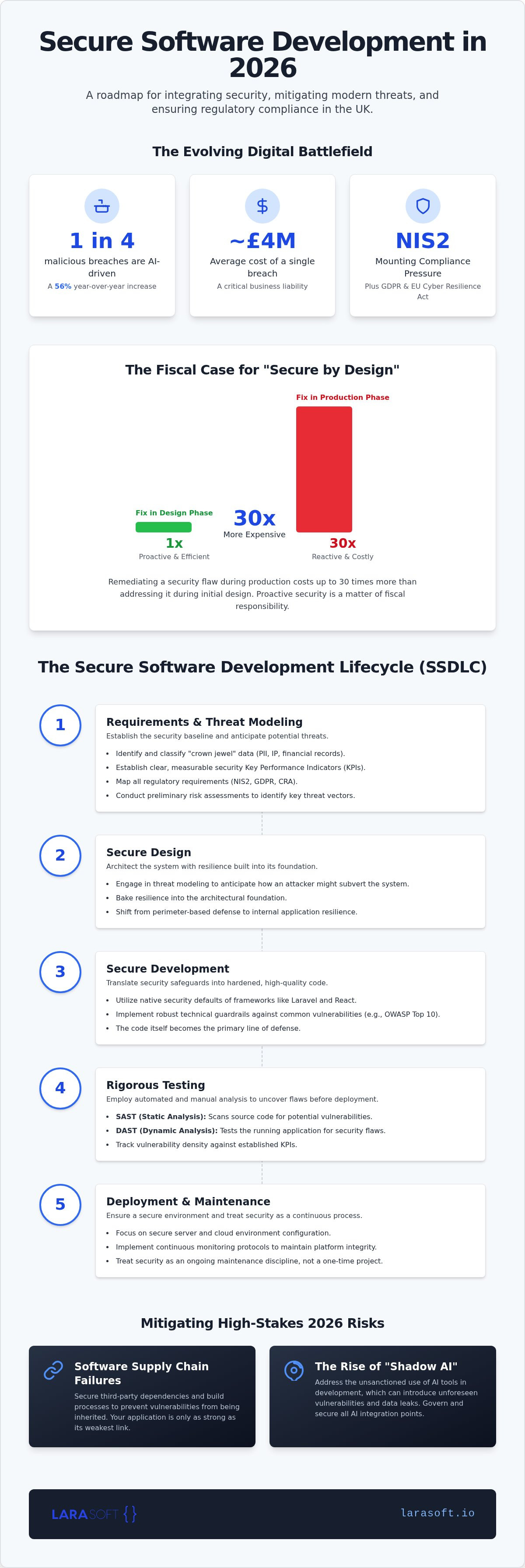
The rapid adoption of artificial intelligence has introduced a new class of vulnerabilities that traditional security models aren't equipped to handle. In 2026, "Shadow AI" represents a significant risk; this occurs when developers use unapproved AI tools to generate or audit code without formal oversight. Such practices can inadvertently leak proprietary logic or introduce unverified dependencies into your codebase. Maintaining secure software development practices now requires a strict governance framework for AI usage, ensuring that every line of machine-generated code is subjected to the same rigorous peer review as human-written logic.
Transparency is the cornerstone of modern resilience. We advocate for the use of a Software Bill of Materials (SBOM) for every custom project. An SBOM acts as a comprehensive inventory of every component, library, and third-party dependency within your application. This level of detail is essential for rapid response when a new vulnerability is discovered in a common library, allowing your team to identify and patch affected systems within hours rather than days. In a landscape where supply chain attacks are increasing in frequency, knowing exactly what sits inside your "vendor" directory is a business necessity.
Integrating AI capabilities into bespoke Laravel environments requires specific technical guardrails. We focus on preventing prompt injection, where malicious users attempt to subvert the AI's logic, and data poisoning, which could compromise the integrity of your LLM outputs. Protecting user privacy is equally paramount. You must ensure that sensitive data is properly anonymised before it's processed by external models. By establishing ethical guardrails within the application code, you can leverage AI innovation without exposing your business to reputational or technical risk.
The "vendor" directory in a modern application often contains thousands of lines of third-party code. Regularly auditing these dependencies is a non-negotiable aspect of secure software development practices. Automated tools can flag known vulnerabilities, but manual oversight is necessary to evaluate the structural impact of updates. In many cases, legacy code modernisation is the only effective way to patch deep-seated security holes in older systems. Updating a single library often triggers a cascade of breaking changes that only an expert partner can navigate safely. If you're concerned about the hidden risks in your software supply chain, our team can provide a comprehensive security audit to identify and neutralise potential threats.
Building a secure application is only the first phase of a long-term strategy. In 2026, the threat landscape evolves daily, meaning that secure software development practices must extend deep into the operational life of the software. We don't view a project as finished upon deployment. Instead, we see it as a living asset that requires disciplined upkeep to maintain its structural integrity and performance under pressure. Security is a continuous process of refinement, not a one-time project to be ticked off a list. Without an ongoing commitment to maintenance, even the most robustly built systems will eventually develop vulnerabilities as new exploit techniques emerge.
Our approach is grounded in the practical realities of business returns. We understand that UK leaders need systems that are both innovative and disciplined. By treating security as a foundational architectural discipline, we ensure that your software can scale without the weight of accumulated security debt. This transition from managing legacy risk to maintaining a modern, hardened posture requires a technical ally who understands the nuances of custom-built code and the specific demands of the UK regulatory environment.
Our maintenance model prioritises 24/7 monitoring and granular error logging to detect anomalies before they escalate into breaches. This proactive stance is essential for threat detection in an era of automated, AI-driven attacks. Regular software maintenance is the only way to ensure that the security guardrails established during the build phase remain effective against modern exploits. We conduct scheduled security audits and performance tuning for custom apps, ensuring that the code remains clean and efficient. This disciplined approach to version control and dependency management prevents the accumulation of technical debt, which is often the root cause of late-stage vulnerabilities in bespoke platforms.
We act as a dedicated technical ally for UK businesses, providing the specialised Laravel and mobile expertise needed to navigate complex digital environments. While off-the-shelf software often contains hidden vulnerabilities and generic code structures, our bespoke solutions are built with a focus on your specific operational goals. This partnership is built on trust and a shared dedication to high-quality execution. Transitioning away from vulnerable systems requires a strategic roadmap of upgrades and legacy code modernisation. Assessing your current software security posture is the essential first step toward long-term scalability. We invite you to request a comprehensive security audit for your existing platforms to ensure your technical foundation is as robust as your business ambitions.
The shift toward internal application resilience is no longer a choice but a commercial necessity. By integrating secure software development practices into every phase of your lifecycle, you protect your intellectual property and ensure your platform remains a scalable asset. We've explored how framework-level guardrails and vigilant supply chain management form the basis of a modern, hardened posture. This disciplined approach eliminates technical debt and builds the stakeholder trust required for sustained growth.
As your technical ally, we provide the specialized expertise needed to navigate these complexities. We're specialists in secure Laravel development and offer expert legacy code modernisation to eliminate security debt before it impacts your bottom line. Our comprehensive maintenance plans provide the long-term resilience your business demands in an increasingly volatile digital landscape. We don't believe in one-off fixes; we believe in building systems that endure.
Secure your digital future with a comprehensive technical audit from Larasoft and ensure your systems are built to perform perfectly under pressure. Your journey toward a more resilient, secure, and scalable digital future starts with a single, decisive step.
The most common security mistake is treating security as a final checkpoint rather than a foundational requirement. This reactive approach creates significant technical debt and leaves systems vulnerable to exploits that could've been prevented during the design phase. By the time a vulnerability is discovered in production, the cost of remediation is often 30 times higher than if it had been addressed during the initial architecture. True resilience requires embedding security into every sprint.
Laravel handles security by default through built-in protection against the most common web vulnerabilities. Its Eloquent ORM prevents SQL injection by using PDO parameter binding; while its Blade templating engine automatically escapes data to block Cross-Site Scripting (XSS). The framework also includes native middleware for Cross-Site Request Forgery (CSRF) protection. These technical guardrails allow our developers to focus on building custom features while maintaining a robust, secure foundation for your business.
Bespoke software offers a higher degree of security than off-the-shelf solutions because it lacks a publicly documented exploit database. Attackers frequently target mass-market software because a single vulnerability can compromise thousands of sites simultaneously. Custom builds allow for the implementation of specific secure software development practices that are unique to your business logic. This makes your platform a much harder target; requiring a dedicated, targeted effort rather than a generic automated attack.
You should conduct manual penetration testing at least once a year or after any significant structural update to your platform. While automated scans (SAST and DAST) are essential for continuous monitoring, they often miss complex logical flaws that a human expert can identify. In 2026, the average time to contain a breach is 247 days; regular testing helps close this window by identifying vulnerabilities before malicious actors can exploit them.
A Software Bill of Materials (SBOM) is a formal, machine-readable inventory of every software component and dependency within your application. You definitely need one in 2026 to manage supply chain risks and ensure transparency. If a vulnerability is discovered in a common third-party library, an SBOM allows your technical partner to instantly determine if your system is affected. It's a critical tool for rapid response and maintaining a secure development posture.
Ensuring your mobile app follows secure practices involves prioritising secure data storage and encrypted API communications. We use TLS 1.3 for all data in transit and implement robust authentication protocols like OAuth2. Native development often provides better access to device-specific security features; such as biometric authentication and secure enclaves. By following a structured Secure Software Development Life Cycle (SSDLC), we ensure that your mobile platform is resilient against both device-level and network-based threats.
The primary security risks of using AI in custom software include prompt injection and potential data leakage. If your application isn't properly hardened, malicious users can manipulate AI inputs to bypass security logic or access sensitive data. You must also ensure that any data sent to large language models is anonymised to protect user privacy. We recommend establishing ethical guardrails and rigorous peer reviews for all machine-generated code to maintain structural integrity.
Software maintenance is essential for security compliance because it ensures your system is always running the latest, most secure versions of its dependencies. Compliance standards like NIS2 and GDPR require proactive monitoring and rapid response to emerging threats. Regular maintenance includes patching vulnerabilities in the "vendor" directory and performing legacy code modernisation to remove outdated, insecure functions. It transforms security from a static state into a continuous, manageable process that protects your long-term business value.
Here’s what we've been up to recently.
Certified Quality. Great Prices