The CTO’s Guide to Technical SEO for Laravel Applications in 2026

Your Laravel application is technically impressive. It handles complex business logic, scales gracefully under load, and your engineering team is rightly proud of the architecture. So why is Google struggling to see it? The reality is that technical SEO for Laravel applications isn't a marketing concern bolted on at the end of a project; it's a structural integrity challenge baked into every routing decision, every Eloquent query, and every choice between server-side and client-side rendering.
If that tension feels familiar, you're not alone. CTOs building on Laravel regularly encounter the same cluster of problems: Googlebot timing out on N+1 query-heavy pages, Vue or React frontends rendering content that crawlers simply never see, and complex route structures quietly generating duplicate content penalties that erode months of organic progress. These aren't marketing failures. They're architectural ones.
This guide addresses exactly that. You'll come away with a clear, actionable framework for auditing and restructuring your Laravel application's backend and frontend so that it passes Core Web Vitals, supports seamless indexing of dynamic content, and reduces server load during bot crawls. From query optimisation to crawl budget management, what follows is a CTO-level playbook built for 2026.
Technical SEO isn't about meta tags and keyword density. At its core, it's the discipline of ensuring that search engine bots can efficiently discover, crawl, render, and index your application's content without obstruction. For Laravel developers and CTOs, this translates into a specific set of architectural concerns: how your routes are structured, how quickly your server responds, whether your HTML is delivered pre-rendered or assembled client-side, and how cleanly your application handles redirects, canonical URLs, and structured data at scale.
The distinction matters because standard on-page SEO operates at the content layer. Technical SEO for Laravel applications operates at the infrastructure layer, where decisions made in routes/web.php or a middleware stack carry direct consequences for how Google interprets your site's authority and relevance. A beautifully written page that lives behind a slow route or renders exclusively in JavaScript is, from Googlebot's perspective, a page that may as well not exist.
Laravel's architecture gives development teams a structural advantage that most frameworks don't. Its MVC pattern enforces a clean separation between business logic, data retrieval, and presentation, which means SEO concerns like canonical tag injection, hreflang management, and structured data generation can be handled at the controller or middleware level without contaminating core application logic. Blade templates deliver pre-compiled, server-rendered HTML by default, which is precisely what crawlers need: clean, fast, immediately parseable markup. That expressive syntax also means SEO logic stays readable and maintainable as the codebase grows, rather than becoming a brittle collection of workarounds.
Google's Core Web Vitals measure three dimensions of user experience that directly influence search rankings. Largest Contentful Paint (LCP) tracks how quickly the main content loads; Interaction to Next Paint (INP) measures responsiveness to user input; and Cumulative Layout Shift (CLS) quantifies visual stability during page load. Each of these is shaped by server-side decisions long before the browser renders a single element.
In a Laravel context, LCP is often the most immediately actionable metric. A slow database query in a controller, an unoptimised Eloquent relationship, or an absent caching layer can add hundreds of milliseconds to Time to First Byte (TTFB), pushing LCP well beyond Google's recommended threshold. INP and CLS are influenced by how assets are loaded and whether layout-shifting resources are properly reserved in your Blade templates.
Crawl budget, simply put, is the number of pages Googlebot will crawl within a given timeframe, and slow server response times directly reduce how many of your pages get indexed on any given visit.
The business case is straightforward: structural integrity at the framework level determines whether your investment in content and backlinks actually converts into search visibility. Without it, even the strongest editorial strategy returns diminishing results.
Slow Time to First Byte is the single most damaging backend problem for search visibility, yet it's consistently underestimated in Laravel projects. When Googlebot requests a page and waits longer than a few hundred milliseconds for the server to respond, it doesn't just note a slow page; it allocates less of its crawl budget to your domain on every subsequent visit. At scale, that means large sections of your application simply don't get indexed, regardless of how strong your content strategy is.
The root cause is almost always the database layer.
Eloquent's lazy loading is convenient during development but quietly catastrophic in production. The classic N+1 problem, where a single page triggers dozens or hundreds of individual queries to retrieve related models, can push TTFB into seconds rather than milliseconds. The fix is eager loading: using with() to instruct Eloquent to retrieve relationships in a single, batched query rather than one per record.
Beyond eager loading, database indexing strategy directly shapes how frequently Googlebot returns to crawl your application. If your most-visited routes rely on unindexed columns in WHERE clauses or sort operations, query latency compounds under bot traffic. Composite indexes on high-frequency query patterns, particularly on columns used together in filtering and ordering, can reduce query execution time substantially. For large-scale Laravel databases, tools like Laravel Telescope and the query log make it straightforward to identify which queries are candidates for index optimisation.
The connection between database performance and crawl frequency is direct: faster server response signals to Googlebot that your infrastructure is reliable, which increases the rate at which it revisits and indexes your pages.
For routes that serve largely static content, full-page caching eliminates database round-trips entirely for bot requests. Laravel's response caching middleware, paired with a Redis or Memcached backend, can serve pre-built HTML to crawlers in single-digit milliseconds. Redis is the stronger choice for high-traffic applications because it supports Laravel's cache tags natively, allowing you to invalidate only the SEO-critical cached pages affected by a content update rather than flushing the entire cache and causing a temporary TTFB spike.
Route caching, enabled with php artisan route:cache, compiles your entire route table into a single cached file. For applications with complex routing structures, this removes the overhead of route resolution on every request, which is a meaningful gain when Googlebot is crawling hundreds of URLs in a session.
CDN configuration rounds out the stack. Distributing static assets, including compiled CSS, JavaScript, and images, across edge nodes reduces latency for users and bots across the UK and beyond, directly improving LCP scores on geographically distributed traffic.
Getting these layers right is where technical SEO for Laravel applications moves from theory into measurable ranking improvement. If you're unsure whether your current architecture is leaving crawl budget on the table, the engineering team at Larasoft's Laravel development specialists can assess your backend performance stack and identify where the bottlenecks are costing you visibility.
Google can crawl JavaScript. That claim is technically true, and it's also one of the most misleading half-truths in modern SEO. What Google's documentation doesn't emphasise is that JavaScript rendering is a two-wave process: Googlebot fetches the raw HTML first, queues the page for rendering, and only later executes the JavaScript to assemble the full content. That queue can take days. For applications built entirely on client-side rendering, this means product pages, blog content, and category listings may sit unindexed for extended periods, quietly suppressing organic visibility while your engineering team assumes everything is working correctly.
For CTOs building complex applications on Laravel with Vue.js or React frontends, this is a structural risk, not a configuration detail.
Server-side rendering resolves the indexing delay at its root. When your application delivers fully assembled HTML on the initial server response, Googlebot doesn't need to queue a rendering job; it can parse and index the content immediately. Laravel's integration with Vite makes SSR implementation more accessible than it's historically been, with the Vite SSR build process compiling your Vue or React components for server-side execution without requiring a separate Node.js infrastructure in all cases.
The pre-rendering impact on indexing speed is significant. Pages that previously sat in Google's rendering queue can be discovered and indexed within a standard crawl cycle when the server delivers complete HTML. For large-scale applications with hundreds of dynamic routes, that difference compounds into measurably better coverage across your indexed pages. If your frontend architecture is a limiting factor in your search performance, the strategic case for investing in Vue.js frontend development built with SSR from the ground up is difficult to argue against.
Inertia.js occupies a particularly useful position in this architectural conversation. It bridges the gap between the fluid, single-page-application experience your users expect and the server-rendered HTML that search engines require. Inertia handles routing server-side through Laravel's native router while delivering component-driven interfaces through Vue or React, which means you don't have to sacrifice UX to gain crawlability. For teams that have already invested in a rich SPA frontend, Inertia is often the most pragmatic path to SSR adoption without a full rewrite.
Rendering the right content server-side solves half the problem. The other half is metadata. In decoupled architectures, dynamic title tags, canonical URLs, OpenGraph tags, and Twitter cards are frequently injected by JavaScript after the initial HTML response. Social crawlers and search bots that don't execute JavaScript will never see them.
Meta tags must be present in the initial HTML response because many crawlers, including those used by LinkedIn, Facebook, and Slack for link previews, don't render JavaScript at all. Packages like Spatie's Laravel-SEO and Inertia Head solve this at the framework level, allowing controllers to pass structured metadata into the server-rendered document head before the response leaves the server. This ensures that every page, regardless of how dynamically its content is assembled, carries the correct signals for both search engines and social platforms from the first byte.
Getting this right is a core component of technical SEO for Laravel applications that operate at scale, where manual tag management simply isn't a viable long-term strategy.
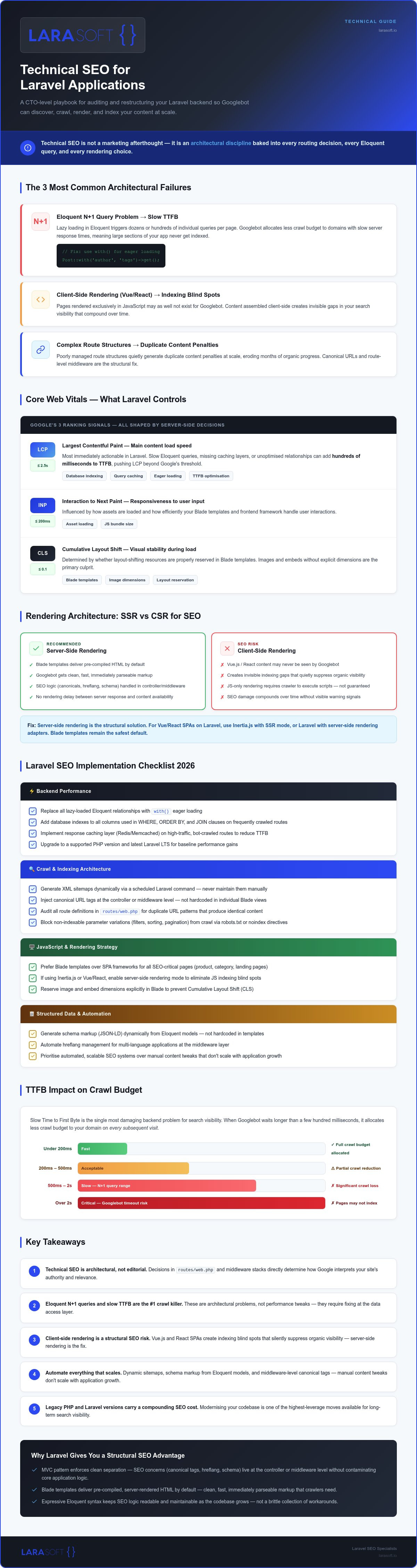
Content optimisation and link building only return value if the underlying architecture supports them. For bespoke Laravel applications, the highest-leverage work is structural: fixing the systems that govern how search engines discover, interpret, and rank your pages at scale. Manual tweaks to individual pages don't compound. Automated, framework-level implementations do.
A static XML sitemap is a liability in any application where content changes frequently. When a new product, article, or service page is published and your sitemap doesn't reflect it until someone remembers to regenerate it manually, you're leaving indexing speed entirely to chance. The Spatie Laravel Sitemap package solves this, but the real value comes from how you configure it: binding sitemap generation to your Eloquent model events so that every new record automatically triggers an update. A ProductObserver that calls your sitemap builder on created and deleted events keeps Googlebot's view of your content architecture permanently current.
Structured data follows the same logic. Implementing Schema.org JSON-LD through Laravel View Composers lets you generate context-appropriate markup, whether that's Product, Article, or BreadcrumbList, at the controller level, without scattering schema logic across individual Blade templates. The Composer resolves the correct schema type based on the route or model in context, injects it into the document head server-side, and ensures that every page carries machine-readable signals from the first byte of the response.
Breadcrumb automation deserves particular attention. Dynamically generated breadcrumb trails, built from your route hierarchy and passed through a shared View Composer, serve two functions simultaneously: they give Googlebot a clear map of your site's internal structure, and they produce valid BreadcrumbList schema without any manual maintenance overhead as your route structure evolves.
Duplicate content penalties in Laravel applications rarely come from deliberate choices. They emerge from inconsistency: the same page accessible at both /products and /products/, or served over both HTTP and HTTPS, or reachable through multiple query string permutations. Each variation splits link equity and sends conflicting signals to search engines.
The fix is middleware-level enforcement, not page-by-page corrections. A single middleware class that checks every incoming request for trailing slash consistency and HTTPS compliance, then issues a 301 redirect to the canonical form, resolves the problem across your entire application in one deployment. Canonical tags, generated programmatically in your layout template using the current route's resolved URL, reinforce that signal for pages where multiple access paths are intentional.
At scale, 301 redirect management also needs to live in the database rather than in route files. A redirects table queried through middleware gives content and SEO teams the ability to manage URL migrations without touching application code, which is essential when relaunching sections of a large application without disrupting accumulated link equity.
Getting these systems right is precisely where the complexity of technical SEO for Laravel applications justifies specialist input. If your team is managing URL architecture, schema generation, and sitemap automation across a growing application, working with a Laravel development agency that understands both the framework and search engine behaviour can compress months of iteration into a single, well-structured implementation. Speak to Larasoft's Laravel specialists about building these systems into your application's foundation.
Technical debt doesn't announce itself. It accumulates quietly across controllers written for older Laravel conventions, PHP versions that no longer receive security patches, and dependency chains that haven't been audited in years. From a search performance perspective, that accumulation carries a compounding cost: slower response times, degraded mobile rendering, and accessibility failures that erode both user experience signals and Core Web Vitals scores simultaneously. Treating software maintenance as a purely operational concern, separate from search strategy, is a structural blind spot that consistently costs applications organic visibility over time.
Older Laravel codebases tend to carry specific patterns that directly harm search performance. Bloated controllers that mix data retrieval, business logic, and presentation concerns produce slower, harder-to-cache responses. Deprecated PHP versions lose access to performance improvements that newer releases deliver at the runtime level, meaning every request carries overhead that modern PHP eliminates by default. Upgrading to the current Laravel and PHP versions isn't a cosmetic exercise; it's a performance intervention with measurable TTFB implications.
Mobile performance and accessibility failures embedded in legacy templates also carry search consequences that compound over time. Unresponsive layouts, missing ARIA attributes, and render-blocking assets inherited from older front-end conventions all contribute to poor Core Web Vitals scores that suppress rankings across your entire domain. Refactoring these controllers and templates as part of a structured modernisation programme, rather than waiting for a full rebuild, is one of the highest-leverage moves available for improving site-wide technical SEO for Laravel applications. For a strategic framework on approaching this work, legacy code modernisation guidance for UK business leaders outlines how to sequence and prioritise that process without disrupting live applications.
Larasoft integrates SEO audits directly into its software maintenance lifecycle, which means performance regressions, crawl anomalies, and Core Web Vitals degradation are identified during routine maintenance cycles rather than discovered after rankings have already slipped. That preventative posture is what separates maintenance as a strategic discipline from maintenance as a reactive cost centre.
Laravel AI integration is beginning to reshape how large applications handle content operations that have historically required significant manual effort. Automating meta-description generation at scale, where a model trained on your content taxonomy produces contextually accurate descriptions for hundreds of product or category pages, removes one of the most persistent bottlenecks in SEO programme execution. Semantic content analysis can surface internal linking opportunities across large content archives that no editorial team would realistically identify manually.
Preparing your Laravel architecture for AI-driven search also means structuring your data layer so that AI tools can query, analyse, and act on it cleanly. Applications built on well-organised Eloquent models and clearly defined API boundaries are significantly easier to extend with AI capabilities than those carrying years of unstructured technical debt. The architectural decisions you make during modernisation today directly determine how readily your application can adopt the AI-driven SEO tooling that's becoming standard practice.
Sustaining search visibility isn't a campaign. It's an engineering commitment. If your application is carrying legacy weight that's limiting both its performance and its adaptability, speak to Larasoft's Laravel specialists about building a maintenance and modernisation strategy that treats search visibility as a first-class architectural concern.
Technical SEO for Laravel applications isn't a checklist you complete once and file away. It's the cumulative result of architectural decisions made at every layer of your stack: how your database queries are structured, whether your frontend delivers pre-rendered HTML or hands the job to a JavaScript queue, and whether your URL management, schema generation, and sitemap automation are built to scale without manual intervention.
The applications that sustain organic visibility over time share a common trait: their engineering teams treat search performance as a structural concern, not a retrospective fix. Clean code and strong search performance aren't competing priorities; they're the same priority.
If your Laravel application is carrying architectural debt that's limiting both its performance and its indexing efficiency, the right move is a clear-eyed technical audit before that debt compounds further. Larasoft's UK-based Laravel specialists combine performance-first architecture with end-to-end development and SEO expertise, so the work is done once and done correctly.
Book a technical SEO audit for your Laravel application and get a concrete picture of where your architecture stands and what it takes to move forward.
Laravel is one of the stronger frameworks for SEO by default, primarily because Blade templates deliver server-rendered HTML that crawlers can parse immediately without waiting for JavaScript execution. Its MVC structure also makes it straightforward to implement canonical tags, metadata, and structured data at the controller or middleware level, keeping SEO logic centralised and maintainable.
That said, "good out of the box" doesn't mean "optimised automatically." Eloquent's lazy loading, absent caching configuration, and unindexed database columns can all introduce performance problems that harm crawl efficiency in production. The framework gives you the right tools; using them correctly is where the architectural discipline comes in.
The core requirement is ensuring that critical content and metadata are present in the initial HTML response, not assembled client-side after JavaScript executes. Server-side rendering is the structural solution, and Laravel's Vite integration makes SSR builds more accessible than they've historically been. Inertia.js is a practical middle path for teams with existing SPA frontends, handling routing server-side through Laravel while preserving the component-driven interface.
For metadata specifically, packages like Spatie's Laravel-SEO allow controllers to inject title tags, canonical URLs, and OpenGraph data into the document head before the response leaves the server. This matters not just for Google but for social crawlers used by LinkedIn and Slack, which don't execute JavaScript at all when generating link previews.
Yes, directly. Slow database queries increase Time to First Byte, and TTFB is one of the primary factors Googlebot uses to determine how frequently it revisits your domain. A server that consistently responds slowly receives a smaller crawl budget allocation, meaning fewer pages get indexed on each visit. At scale, that translates into large sections of your application simply not appearing in search results.
The practical fix involves eager loading Eloquent relationships with with() to eliminate N+1 query patterns, adding composite indexes on columns used in high-frequency WHERE and ORDER BY clauses, and implementing full-page response caching for routes serving largely static content. Laravel Telescope makes identifying problematic queries in production straightforward.
Spatie's Laravel-SEO handles metadata generation cleanly at the controller level, covering title tags, canonical URLs, and OpenGraph data without scattering logic across templates. Spatie's Laravel Sitemap package manages dynamic XML sitemap generation and can be bound to Eloquent model events for automatic updates. For structured data, most teams implement Schema.org JSON-LD through Laravel View Composers rather than relying on a dedicated package, which keeps schema logic centralised and testable.
Route caching via php artisan route:cache and response caching middleware backed by Redis aren't packages in the traditional sense, but they're among the highest-impact technical SEO interventions available in a standard Laravel installation. Laravel Telescope rounds out the toolkit for identifying the query and response time issues that harm crawl efficiency.
The Spatie Laravel Sitemap package works cleanly with both Laravel 11 and 12. The key is configuring it to regenerate automatically rather than on a manual schedule. Binding sitemap generation to Eloquent model observers, so that a ProductObserver or ArticleObserver triggers a rebuild on created, updated, and deleted events, keeps your sitemap permanently current without requiring manual intervention or a cron job that runs on a fixed delay.
For large applications with thousands of URLs, consider generating category-specific sitemaps and referencing them from a sitemap index file rather than building a single monolithic XML document. This keeps individual sitemap files within Google's recommended URL limits and makes it easier to prioritise crawling of high-value content sections.
Yes, and it's often more impactful than starting fresh because legacy applications typically carry accumulated performance debt that's suppressing rankings across the entire domain. The most practical approach is to prioritise the changes with the broadest impact: adding middleware-level redirect enforcement, implementing response caching, and resolving the worst N+1 query patterns will improve TTFB site-wide without requiring a full rebuild.
Older PHP and Laravel versions do carry a compounding performance cost, since runtime improvements in modern PHP releases reduce per-request overhead that legacy versions can't access. A phased modernisation programme, which sequences controller refactoring and dependency upgrades alongside SEO fixes, tends to deliver more durable results than treating technical SEO for Laravel applications as a layer you can bolt onto an ageing codebase without addressing the underlying architecture.
SSR eliminates the indexing delay that client-side rendering creates. When Googlebot receives fully assembled HTML on the initial server response, it can parse and index the content within a standard crawl cycle. Without SSR, pages built in Vue or React enter a rendering queue that can delay indexing by days, meaning new content and product pages may be invisible to search engines long after they're live for users.
The secondary benefit is metadata reliability. SSR ensures that title tags, canonical URLs, and structured data are present in the document from the first byte, rather than depending on JavaScript execution that many crawlers and social bots skip entirely. For applications with large numbers of dynamic routes, that consistency compounds into meaningfully better indexed page coverage over time.
A structured audit every six months is a reasonable baseline for most Laravel applications, but the more sustainable approach is integrating SEO checks into your regular maintenance cycle rather than treating audits as standalone events. Core Web Vitals scores, crawl error rates, and TTFB benchmarks should be monitored continuously, with threshold alerts that surface regressions before they translate into ranking drops.
Trigger-based audits are equally important: any significant deployment, database schema change, or routing restructure warrants a focused review of the affected URLs. Applications that are actively adding content or expanding their route structure benefit from monthly crawl budget analysis to confirm that Googlebot is indexing new pages at the expected rate rather than hitting bottlenecks introduced by recent changes.
Here’s what we've been up to recently.
Certified Quality. Great Prices