The Comprehensive Guide to Laravel Application Security Audits in 2026

Thirty-four per cent of Laravel applications scanned by StackShield contain at least one critical security vulnerability. Even with the robust features of Laravel 13, many platforms remain exposed through simple misconfigurations or inherited technical debt. As we move through 2026, a professional laravel application security audit has evolved from a simple patching exercise into a vital strategic validation of your software's architectural health. It's the difference between a resilient digital asset and a liability that risks your reputation and business continuity.
You likely feel the pressure of ensuring your developers are following the latest security standards, particularly when meeting UK GDPR and industry-specific compliance requirements. We understand that uncertainty. This guide will show you how a structured audit protects your operations while verifying the structural integrity of your codebase. We will explore the shift toward AI-native security workflows, map common vulnerabilities like exposed .env files, and provide a clear roadmap for remediating risks. By the end, you'll have the technical clarity needed to provide peace of mind for your stakeholders and investors.
A laravel application security audit is often misunderstood as a simple search for broken links or outdated patches. In 2026, the reality is far more complex. As Laravel 13 becomes the standard, the threat landscape has shifted toward risks in AI-integrated workflows and sophisticated injection flaws that target modern PHP environments. We view an audit as a deep structural validation of your entire digital asset. It ensures that the foundation of your application is resilient enough to support long-term growth while maintaining the highest standards of data protection.
Generic security consultants often apply a broad brush to specialized frameworks. While they might understand general application security principles, they frequently overlook the nuances of Laravel's Eloquent ORM or custom Middleware logic. Specialized expertise is required to identify where these built-in protections have been bypassed or incorrectly implemented by internal teams. For UK businesses, this level of detail is critical for maintaining UK GDPR compliance. A breach doesn't just result in a fine; it erodes the user trust you've spent years building.
Investing in a professional review is a strategic move to protect your brand's reputation. It's much cheaper to identify a vulnerability during a scheduled audit than to manage the fallout of a data leak. Beyond immediate risk mitigation, these audits help UK firms meet the rigorous requirements for Cyber Essentials and ISO 27001 certification. By reducing technical debt and preventing "version rot," you ensure your application remains a foundational asset rather than a liability. This stability is essential for businesses looking to scale their online presence through the SEO and performance marketing services of RANE Digital. It's about providing stakeholders with the confidence that the platform can perform perfectly under pressure.
Understanding the methodology is key to choosing the right service. Penetration testing is typically a "black-box" exercise where an external actor tries to break into your system without knowing the internal code. While useful, it often misses deep-seated architectural flaws. In contrast, a laravel application security audit is a "white-box" review. This means we examine the source code directly to find logic errors that automated tools miss. A Laravel security audit is a comprehensive review of code, configuration, and environment. This approach provides far more value for complex applications, as it uncovers the "why" behind a vulnerability, allowing for permanent remediation rather than a temporary patch.
Laravel's reputation for being "secure by default" often leads to a dangerous sense of complacency. While the framework provides excellent tools, a professional laravel application security audit focuses on the custom code where these defaults are frequently modified or bypassed. We start by scrutinizing Eloquent ORM usage. Developers often use the $guarded = [] property for speed, but this creates massive risks for mass assignment vulnerabilities. Our review ensures that every model uses strict $fillable attributes, preventing malicious users from injecting unauthorized data into your database records.
We also evaluate custom Middleware and Blade template implementations. Blade escapes output automatically, yet developers sometimes use the {!! !!} syntax to render raw HTML. If this isn't strictly controlled, it opens the door to Cross-Site Scripting (XSS) attacks. For applications relying on Laravel Sanctum or Passport, we audit the token lifecycle and scope permissions to ensure your API remains a secure gateway. This level of technical scrutiny aligns with the OWASP Web Security Testing Guide, ensuring no framework-specific pitfall remains hidden in your codebase.
Granular access control is the backbone of any enterprise-grade application. We verify that your Gates and Policies are correctly applied across all controller actions to prevent Insecure Direct Object References (IDOR). This is a common flaw where a user can access another person's data simply by changing an ID in the URL. In multi-tenant environments, we audit session management and token handling to ensure data isolation is absolute. If your team is struggling with complex permission structures, a bespoke Laravel development review can help refactor these critical layers for better security and performance.
Security extends beyond the code into your environment configuration. We check that sensitive credentials aren't sitting in plain text within your .env file but are instead managed via secure vaults or cloud-based secret managers. Our team reviews database encryption standards, ensuring you're using modern hashing algorithms like Argon2 or Bcrypt. Finally, we assess file upload handling. Without strict validation of MIME types and storage configurations, a simple profile picture upload can become a vector for remote code execution. We ensure your storage disks are configured to prevent the execution of scripts, keeping your server environment sterile and secure.
Automated tools like Larastan and Enlightn are essential for establishing a baseline of code quality. They catch low-hanging fruit such as missing type hints or unused variables. However, relying solely on automation for a laravel application security audit is a high-risk strategy. These tools are binary; they understand code syntax but fail to grasp developer intent. A hybrid approach, combining rapid scanning with deep manual inspection, creates the most resilient security posture for UK businesses.
Scanners often generate significant noise through false positives, which can distract internal teams from genuine threats. More dangerously, they suffer from false negatives regarding complex business logic. A scanner won't flag a controller that allows a user to access a competitor's data if the authorization check is technically present but logically flawed. We also audit third-party packages and Composer dependencies manually. Automated alerts for outdated packages don't always account for the specific way your application utilizes those libraries, potentially leaving unique vulnerabilities unaddressed.
Our technical artisans look for non-idiomatic Laravel code that signals deeper structural issues. Often, insecure code is a symptom of a codebase that has grown too complex to manage effectively. This is where a security audit often reveals the need for legacy code modernisation. By refactoring architectural patterns that lead to security regressions, we don't just patch a hole. We build a foundation that is inherently more difficult to exploit.
Human oversight is critical when reviewing custom-built API integrations. Scanners cannot predict how your application interacts with external services or whether those connections expose sensitive customer data. A senior engineer brings years of experience in spotting the subtle anti-patterns that lead to breaches. This combination of automated efficiency and manual precision ensures that your laravel application security audit provides the comprehensive verification your stakeholders demand.
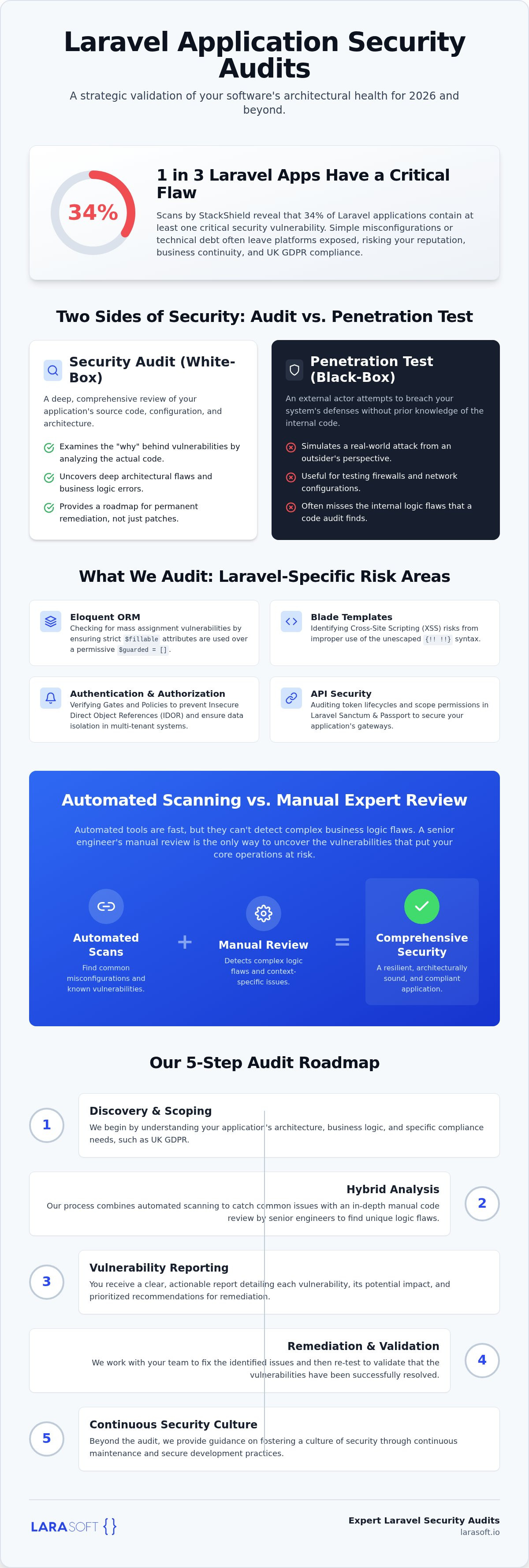
A professional laravel application security audit is a structured journey that transforms technical uncertainty into a manageable roadmap for growth. We don't just run a script and hand over a PDF. Our process is designed to integrate with your business goals, ensuring that every technical intervention serves a strategic purpose. By following a rigorous five-step methodology, we provide the clarity needed to protect your digital assets while maintaining momentum in your development cycle.
The journey begins with Discovery and Environment Scoping. We define the boundaries of the audit, identifying high-value assets such as customer databases or payment integrations. This is followed by a Comprehensive Automated Vulnerability Assessment, where we use specialized tools to establish a security baseline. The third and most critical phase is the Deep Manual Code Review and Architectural Analysis. Here, our senior engineers look for the complex logic flaws and architectural weaknesses that automated tools consistently miss. Once the analysis is complete, we move to Risk Prioritisation and Impact Reporting, followed by Remediation Support and Re-testing to ensure every patch is effective.
Success starts with transparent collaboration. To get the most out of the process, your team should prepare comprehensive documentation and grant secure access to your Git repositories. We'll need to understand your core business processes to determine which areas require the highest level of protection. Setting clear expectations for timelines and deliverables early on prevents friction and ensures that the audit doesn't disrupt your daily operations. If you're ready to secure your platform, you can book a professional Laravel audit with our UK-based team today.
The final report is an executive-level document that balances technical detail with business-centric reassurance. It's vital to distinguish between "Critical" findings, which require immediate intervention, and "Informational" points that reflect long-term best practices. We help you translate these findings into an actionable backlog for your developers. This report shouldn't sit in a drawer; it serves as a vital benchmark for your ongoing software maintenance strategy. By addressing these issues systematically, you don't just fix bugs. You strengthen the foundational integrity of your application for years to come.
A one-off laravel application security audit is a powerful diagnostic tool, but its true value is realised when it sparks a permanent shift in your development culture. Security isn't a destination; it's a continuous process that must be integrated into your daily workflow. By adopting a "security-first" mindset, your team can prevent vulnerabilities from being introduced in the first place, rather than constantly reacting to threats. This proactive stance is essential for managing the sophisticated risks of 2026.
Continuous software maintenance plays a vital role in preventing "version rot." Just as regular servicing from a trusted specialist like DSR Autocare is essential for vehicle safety, staying current with your framework is no longer optional for secure operations. With Laravel 12 bug fixes ending on August 13, 2026, transitioning to Laravel 13 and PHP 8.3 ensures you have access to the latest declarative security features and performance optimisations. Regular updates to Composer dependencies and third-party packages are equally critical. We help our partners establish automated CI/CD pipelines that include static analysis and dependency scanning, making security a seamless part of every code commit.
An audit often reveals that systemic security risks are symptoms of an aging architecture. When a codebase becomes too rigid or convoluted, developers are more likely to implement insecure workarounds. This is where we turn audit findings into a strategic legacy code modernisation plan. By refactoring monolithic structures into secure, API-driven architectures, we eliminate entire classes of vulnerabilities. Our technical artisans take pride in creating clean, efficient codebases that are inherently more difficult to exploit, transforming your application from a legacy liability into a modern foundational asset.
Selecting the right agency is about finding a technical ally who understands both the granular details of the framework and your broader business goals. When evaluating a potential partner for your laravel application security audit, ask about their approach to manual code review and their experience with UK-specific compliance. You need a team that doesn't just provide a list of problems but offers a clear, architectural roadmap for growth. We provide high-level oversight and artisan-level execution to ensure your platform remains resilient under pressure. If you're ready to secure the future of your application, Contact Larasoft for a professional Laravel security audit today.
Maintaining a resilient platform in 2026 requires more than just reactive patching. You've seen how a professional laravel application security audit serves as a strategic validation of your code's structural integrity. By combining automated precision with manual expert review, you can identify the complex logic flaws that standard scanners overlook. This process doesn't just eliminate immediate risks; it provides a clear roadmap for modernising legacy systems and ensuring long-term scalability.
Larasoft's UK-based team brings over eight years of specialized experience to every engagement. We don't just deliver a list of vulnerabilities. We provide detailed architectural reports focused on business ROI and long-term software maintenance. As specialists in legacy code modernisation and security remediation, we act as your dedicated technical ally to ensure your systems perform perfectly under pressure.
Book a Comprehensive Laravel Security Audit with Larasoft to protect your reputation and secure your business continuity. We're ready to help you turn technical challenges into a manageable journey toward growth.
The cost of a professional review depends on the complexity of your codebase and the depth of the analysis required. Factors that influence the final investment include the number of custom API integrations, the size of your database, and whether you require a full manual code review alongside automated scanning. Enterprise systems with complex architectural layers typically require a more extensive engagement to ensure full compliance with UK GDPR standards.
A professional audit typically spans between one and three weeks. The initial discovery and automated scanning phases move quickly, but the manual expert review requires dedicated time to trace logic flows and verify custom authorization policies. Larger applications with extensive legacy code or multiple third-party integrations may require additional time to provide the level of granular analysis necessary for a comprehensive security roadmap and remediation plan.
A security audit will not cause any downtime for your live application. We perform the review on a secure clone of your source code repository and a dedicated staging environment. This approach allows us to test vulnerabilities and configurations without impacting your production performance or user experience. It ensures that your business continuity remains intact while we identify and document the necessary remediations for your technical team.
Automated tools are excellent for catching syntax errors but cannot replace a manual laravel application security audit. These tools miss complex business logic flaws, such as authorization bypasses or insecure data handling in custom API integrations. Human oversight is essential to understand developer intent and identify non-idiomatic code patterns that could lead to future security regressions, ensuring your platform is resilient against sophisticated modern threats.
We recommend performing a full security audit at least once per year or after any major architectural changes. Regular reviews are vital as the threat landscape evolves and new vulnerabilities emerge within the PHP ecosystem. If your application handles sensitive customer data or undergoes frequent feature updates, quarterly reviews can ensure that your security posture remains resilient against modern attack vectors and the risks of "version rot."
Leaving debug mode enabled in production is the most frequent security misconfiguration, affecting 18% of scanned Laravel apps according to industry data. Other common issues include exposed .env files and broken access control where Gates or Policies are incorrectly applied. These vulnerabilities often stem from developers prioritizing speed over security protocols, highlighting the need for a professional review to verify that all framework protections are active.
Larasoft provides full remediation support through our software maintenance and legacy code modernisation services. Once the audit is complete, we work alongside your team to resolve critical vulnerabilities and refactor insecure architectural patterns. Our goal is to transform the audit findings into a cleaner, more secure codebase that serves as a foundational asset for your future growth rather than a technical liability that risks your reputation.
Security audits are essential for internal applications because they often serve as the first point of entry for lateral movement within a business network. Even if an app isn't public-facing, it likely contains sensitive data or connects to core infrastructure that must be protected. Ensuring these systems meet modern security standards is a critical component of maintaining overall business resilience and fulfilling your legal obligations under UK GDPR.
Here’s what we've been up to recently.
Certified Quality. Great Prices