The Comprehensive Guide to Laravel Application Audits in 2026

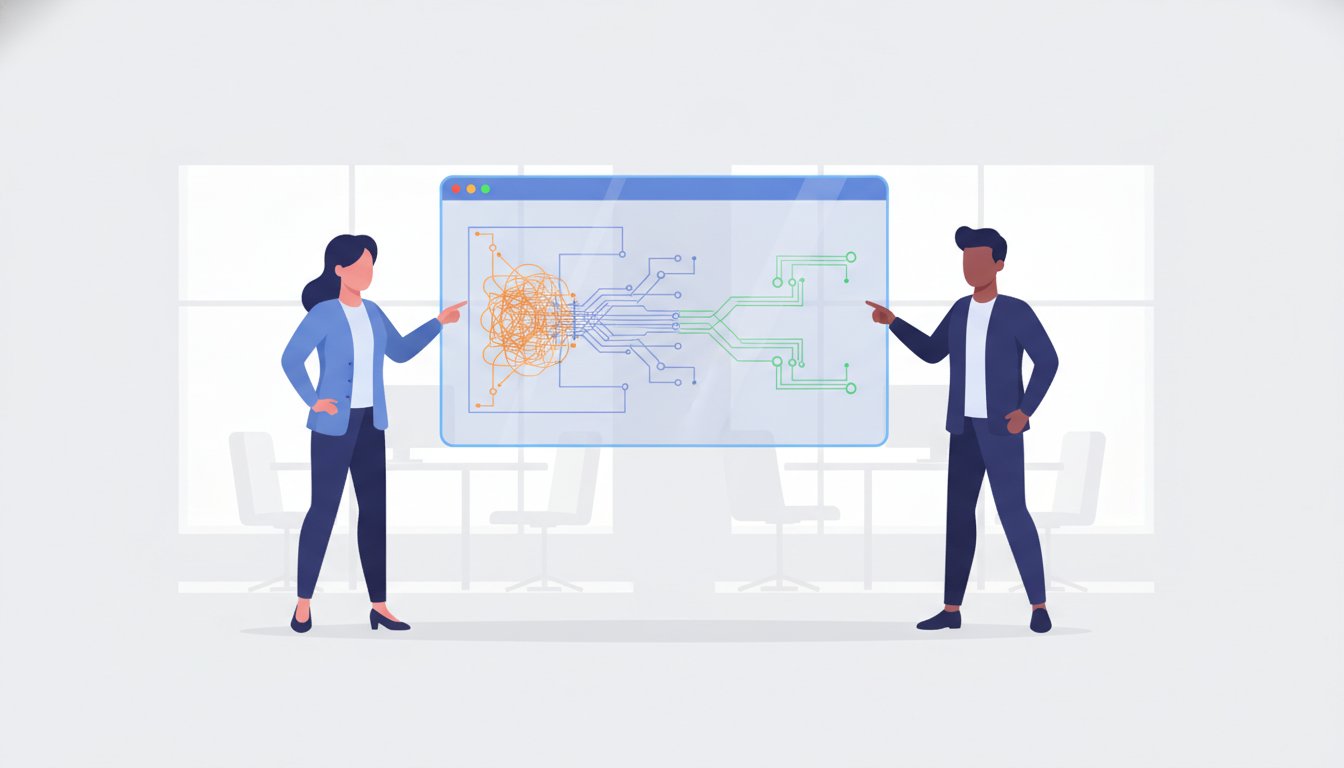
Most Laravel applications running in 2026 aren't held back by a lack of features, but by the invisible weight of architectural choices made years ago. You've likely felt the friction of performance bottlenecks causing user churn or the nagging worry that a critical vulnerability is hiding in your legacy code. It's frustrating to watch maintenance costs climb while your development velocity slows. A professional laravel application audit isn't just a security check; it's a strategic diagnostic tool designed to transform technical debt into a competitive advantage for your organization.
We'll show you how a deep technical review identifies security risks and prepares your software for national scale. You'll discover how to validate your current architectural choices and build a clear roadmap for modernisation. This guide covers the essential shift to Laravel 13, the nuances of PHP 8.5 compatibility, and the balance between automated tooling and expert manual analysis. We provide the technical clarity you need to ensure your system remains secure, stable, and ready for high-pressure growth.
A laravel application audit is a comprehensive, 360-degree examination of your software's structural integrity. It isn't a passive check-box exercise. It's an active investigation into your code, security protocols, and architectural foundations. While many developers focus on shipping features, an audit focuses on the quality of the foundation those features sit upon. When asking What is a Code Audit? in the context of a modern framework, you're looking for a deep dive into how well your application adheres to current standards, such as PSR-12, and how effectively it utilizes Laravel's built-in security features to protect your data.
There's a vital distinction between automated scanning and expert manual review. Automated tools like Larastan or Enlightn are excellent for catching syntax errors or deprecated methods. They provide a necessary baseline. However, they lack the nuance to identify business logic flaws or architectural bottlenecks. An expert manual review provides the context that software cannot. It identifies where your code might be technically "correct" but strategically flawed for your specific business goals. For UK business leaders, digital platforms are often the most valuable asset in the company. Maintaining high-performance software requires this level of proactive oversight. This process is particularly vital when preparing for legacy code modernisation, as it provides the baseline data needed to plan a successful transition without disrupting operations.
Many teams confuse audit logging with a technical audit. Packages like owen-it are designed for data history; they record which user changed which field in your database. This is essential for compliance and accountability. In contrast, a technical audit evaluates the overall health of the system. You need logging for daily operational visibility, but you need a technical audit when performance dips, security concerns arise, or you're planning a major scale-up. One tracks what your users do; the other tracks how your system performs.
Investing in technical oversight directly impacts your bottom line. By identifying technical debt early, you reduce the long-term maintenance costs that otherwise swallow your development budget. A well-executed laravel application audit ensures your application can scale nationally without suffering fundamental architectural failures under load. A technical audit is an investment in stability that prevents the exponential costs of emergency hotfixes. This proactive approach transforms your codebase from a liability into a foundational asset for future growth, ensuring your technical team spends more time innovating and less time firefighting.
A professional laravel application audit rests on four distinct pillars that ensure your software is both a resilient business asset and a high-performing tool. We move past the surface-level checks found in basic automated scans to evaluate the deeper mechanics of your platform. By examining security, performance, code quality, and architectural integrity, we provide a complete map of your system's current health and future potential. This holistic approach prevents the common pitfall of fixing a single bug while ignoring the systemic rot that caused it.
Security isn't a static feature; it's an ongoing discipline. During this phase, we scrutinise your middleware configurations, authentication flows, and API security protocols. We align our methodology with the OWASP Web Security Testing Guide (WSTG) to identify vulnerabilities that automated tools often overlook. This includes a rigorous check of your composer.lock file for outdated dependencies and known CVEs. For UK-based organisations, we specifically evaluate data encryption standards and GDPR compliance to ensure your user data remains protected against modern threats.
Performance audits focus on how your application behaves under real-world pressure. We dive deep into your database layer to identify N+1 query issues and evaluate your indexing strategies. Inefficient queries are often the silent killers of user experience. We also assess your caching implementations, such as Redis or Memcached, and ensure your queue management is optimised for background tasks. If your backend powers a modern reactive interface, we analyse how it integrates with Vue.js frontend development to ensure that data transitions are fluid and frontend state management doesn't introduce unnecessary latency.
The final two pillars focus on the long-term viability of your codebase. We check for strict adherence to PSR standards and Laravel best practices, ensuring your code is readable for any senior developer. Finally, we evaluate your architectural integrity. We look for the correct implementation of Design Patterns and Service Layers, moving logic out of bloated controllers and into manageable, testable units. If your current structure feels restrictive, our team can help you transition toward a more scalable Laravel web development architecture that supports your business goals.
This structured oversight transforms your application from a collection of scripts into a professional-grade platform. It provides the validation your stakeholders need to invest in new features with confidence, knowing the underlying foundation is secure and stable.
In a professional laravel application audit, the first line of defence is always automated. Tools like PHPStan, Larastan, and Enlightn perform static analysis to verify that your code is technically sound. They check for type safety, unused variables, and deprecated methods. This aligns with foundational security principles, such as those found in NIST's Guide to Information Security Testing, which advocates for structured, repeatable testing methodologies. However, relying solely on software is a common mistake. A tool can tell you if a function works, but it can't tell you if that function should exist in the first place.
Business logic vulnerabilities are the primary blind spot for automated scanners. While some teams might search for "laravel auditing" and find simple model-tracking packages, these don't constitute a comprehensive laravel application audit. A package won't notice if your multi-tenant application allows one user to access another's data through a modified URL parameter, provided the code itself is syntactically correct. This is where the "second pair of eyes" from a specialised laravel development agency becomes invaluable. Human auditors identify architectural "code smells" like deep nesting, tight coupling, or fragmented logic that software simply ignores. These patterns often lead to technical debt that slows down your team and increases the risk of regression bugs during future updates.
Automation excels at routine health checks within your continuous integration (CI) pipelines. It's the most efficient way to maintain basic PSR-12 compliance across a small team and find basic syntax errors before they reach production. If you're running a small, straightforward application with minimal third-party integrations, these tools provide a cost-effective baseline of quality. They ensure your developers aren't wasting time on trivial mistakes that could have been caught by a linter or a static analyser during the development cycle.
As your system grows, the complexity shifts from syntax to strategy. A professional audit evaluates whether your chosen architecture actually matches your long-term business goals. We often see over-engineered solutions, such as unnecessary microservices for a low-traffic platform, that hinder developer velocity without providing tangible benefits. Human auditors also evaluate the maintainability of bespoke API integrations. They look for edge cases in external data handling that could lead to system timeouts or data corruption. This strategic oversight ensures your application isn't just "passing the test" but is truly built for longevity and efficient scaling.
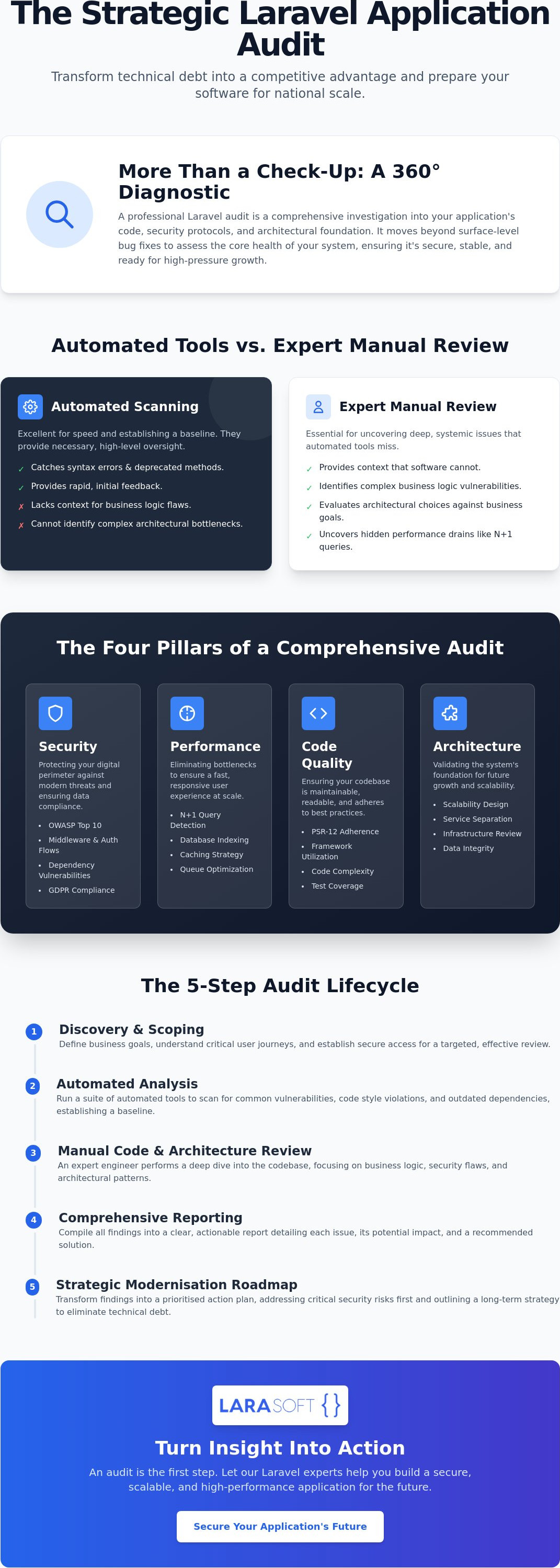
A professional laravel application audit follows a meticulous, structured process. It isn't a one-off scan but a phased investigation designed to uncover systemic issues. This lifecycle ensures that every layer of the application, from the server configuration to the final line of code, is validated against modern standards. By following a repeatable framework, we ensure that no corner of your digital asset is left unexamined, providing a clear path from diagnostic discovery to stable growth.
We begin by establishing secure access to your repository and staging environments. This phase involves a rigorous review of your server infrastructure and deployment pipelines. We analyze your database schema to identify missing foreign keys or inefficient indexing that could lead to data corruption or slow performance. Understanding your current team structure and development workflow helps us identify if process-related issues are contributing to the accumulation of technical debt. This contextual knowledge is vital for making recommendations that your team can actually implement.
Following discovery, we execute an automated deep scan. This identifies low-hanging fruit such as deprecated functions, missing return types, or basic syntax errors. However, the core of the laravel application audit lies in the manual code review. Our senior architects perform a deep dive into your business logic and sensitive controllers. We look for authorization flaws, complex race conditions, and architectural inconsistencies that automated software cannot detect. This manual oversight ensures your most critical business rules are properly enforced at the code level.
The audit concludes with a comprehensive report that categorises findings by severity. It's vital to distinguish between "Critical Security Risks" and "Technical Debt." A critical risk, like an exposed configuration file or a SQL injection vulnerability, requires immediate intervention to protect your data. Conversely, technical debt, such as non-standard naming conventions or bloated controllers, is a long-term maintenance concern that affects developer velocity. We translate these technical findings into business-centric action points, allowing stakeholders to set realistic timelines for remediation based on the actual risk to operations.
Finally, we provide a remediation roadmap. This document prioritises fixes based on their potential business impact. It ensures your resources are focused on the most significant threats first, rather than wasting time on trivial cosmetic changes. If you need a partner to guide you through this diagnostic journey, our team specialises in high-integrity Laravel web development and architectural oversight. We help you turn these insights into a stable, scalable foundation for your future features.
Completing a laravel application audit provides you with a comprehensive map of your system's vulnerabilities and inefficiencies. However, the audit itself is merely the diagnostic phase. The real business value is realized when those findings are translated into a structured modernisation strategy. Without execution, the report is just a document; with it, it becomes the foundation for a high-performance digital asset. We help you move from identification to intervention, ensuring your technical improvements align with your commercial objectives.
Success requires a rigorous approach to prioritisation. We recommend a "Security First" hierarchy. Critical vulnerabilities that expose user data or system integrity must be addressed immediately. Once the perimeter is secure, the focus shifts to performance. Eliminating database bottlenecks and optimizing queries directly improves user retention and conversion rates. Finally, we address technical debt. While less urgent than a security patch, reducing debt is essential for restoring developer velocity and lowering long-term maintenance costs. This tiered approach ensures your budget is always allocated to the areas of highest impact.
Integrating these findings into your existing development cycles prevents the audit from becoming an overwhelming burden. Rather than halting all feature development, we often recommend blending remediation tasks into your standard two-week sprints. This maintains momentum while steadily improving system health. For UK businesses grappling with aging systems, Larasoft acts as a deeply invested ally in legacy code modernisation. We don't just point out what's wrong; we provide the architectural expertise to rebuild your core components for future scale.
Managing debt requires a balance between "Refactor as You Go" and dedicated maintenance sprints. For minor improvements, updating code as you touch it for new features is efficient. For systemic issues, such as migrating to a new service layer, a dedicated sprint is often more effective. We also focus on establishing new coding standards. This prevents the return of technical debt by ensuring your team follows the same high-level patterns identified in the laravel application audit. Training your internal developers on these findings turns the audit into a long-term educational asset, improving the quality of every line of code written hereafter.
The agency that performed your audit is often best positioned to execute the fixes. They already possess a deep, granular understanding of your codebase's idiosyncrasies. This continuity reduces the "onboarding tax" and ensures that remediation is handled with the same architectural precision used during the diagnostic phase. Beyond the initial fixes, long-term stability is best achieved through proactive software maintenance. This ongoing partnership ensures your application remains at the cutting edge of the Laravel ecosystem, preventing the gradual accumulation of new risks. A successful audit concludes not with a document, but with a faster, more secure application ready for growth.
A professional laravel application audit provides more than just a list of bugs; it offers a strategic roadmap for your software's future. You've learned that while automated tools offer a necessary baseline, the true value lies in expert manual oversight that aligns complex code with your specific business logic. By addressing security risks first and systematically tackling technical debt, you transform your application into a scalable asset capable of supporting national growth.
Our expert UK-based Laravel development team is ready to help you navigate this transition. We specialize in legacy code modernisation and complex API integration, with a proven track record of building secure, bespoke applications that perform perfectly under pressure. Don't let architectural choices from the past limit your future innovation. It's time to gain total clarity on your system's health and performance.
Book a Professional Laravel Application Audit with Larasoft to validate your current architectural choices and prepare your platform for the next stage of its journey. We're here to ensure your technology remains your greatest competitive advantage.
A professional laravel application audit typically takes between one and three weeks to complete. The exact duration depends on the codebase's complexity, the number of third-party integrations, and the depth of the required manual review. A standard application might see a full report within five to ten business days, while large-scale enterprise platforms require more extensive architectural analysis to ensure every component is thoroughly validated.
No, an audit does not require your application to be taken offline. The process is conducted entirely on a cloned version of your repository or within a staging environment. This ensures your production system remains fully operational for your users while our team performs deep scans and manual code analysis in a siloed, secure environment. Your business continues as usual while we identify the necessary technical improvements.
A security audit focuses on identifying vulnerabilities like SQL injection, cross-site scripting, and broken authentication flows to protect your data integrity. In contrast, a performance audit targets system efficiency, identifying database bottlenecks, N+1 query issues, and caching failures. While security prevents breaches and ensures compliance, performance optimization ensures your system remains responsive and stable under heavy user load, preventing churn caused by latency.
Even new applications benefit from a laravel application audit to ensure the foundation is built to modern industry standards. Catching architectural flaws or code smells early prevents the accumulation of technical debt that becomes exponentially more expensive to fix as the system grows. An audit validates that your initial development team has followed best practices for security and scalability from the very first deployment.
UK businesses should ideally commission a technical audit annually or whenever a significant structural change occurs. If you're launching a major new feature set or preparing for a national marketing campaign, an audit provides the necessary validation that your system can handle the increased traffic. Regular oversight ensures that your digital assets remain compliant with evolving security standards and continue to perform at peak efficiency.
Yes, an audit frequently identifies opportunities to reduce monthly hosting and infrastructure costs. By finding and fixing inefficient database queries or redundant background processes, you reduce the load on your server's CPU and RAM. Highly optimized applications can often run on smaller, more cost-effective instances without any loss in performance, allowing you to scale your user base without a linear increase in overhead.
A development agency needs read-only access to your Git repository and a sanitized version of your environment configuration. Access to a staging or development database is also required to analyze indexing strategies and query performance. We prioritize security during this process, ensuring that sensitive production data is never exposed and that all access is managed through secure, encrypted channels to maintain total confidentiality.
Yes, a professional report includes an executive summary that translates technical findings into business risks and strategic opportunities. While the document contains granular technical data for your developers, it also uses a clear risk categorization system. This allows non-technical stakeholders to understand which issues impact security, which affect performance, and how each finding relates to the company's overall commercial growth and stability.
Here’s what we've been up to recently.
Certified Quality. Great Prices