Technical SEO for Laravel: CTO's Strategic Guide 2026


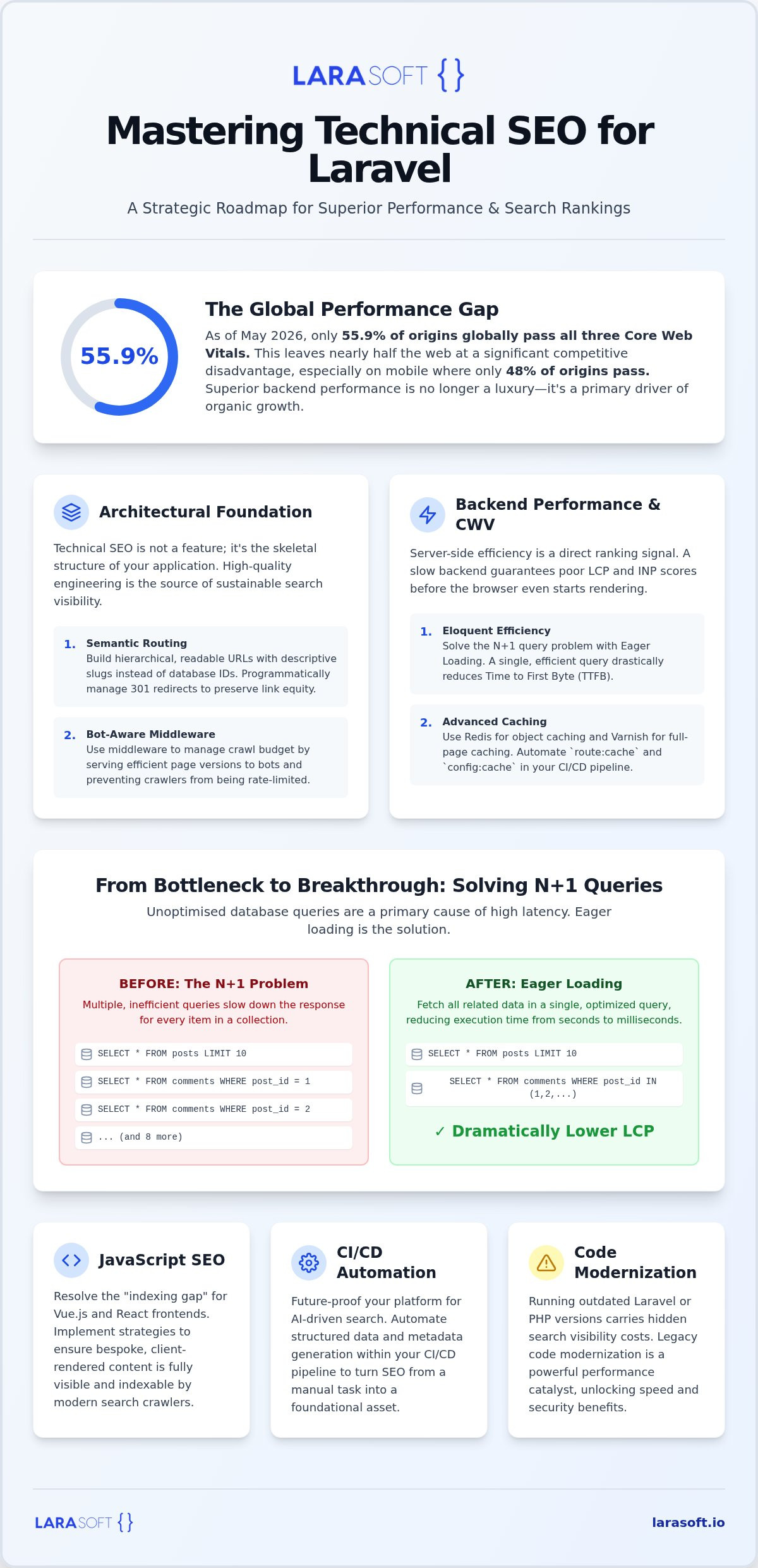
As of May 2026, only 55.9% of tracked origins globally pass all three Core Web Vitals, leaving nearly half of the web at a significant competitive disadvantage. Achieving technical seo for laravel applications requires more than basic metadata; it demands a rigorous focus on the underlying architecture. You recognize that a bespoke application's speed and crawlability are the primary drivers of organic growth, yet you're likely managing the friction of unoptimised Eloquent queries or indexing hurdles with Vue.js and React frontends.
This guide provides a strategic roadmap to master the backend optimisations and architectural requirements needed to ensure your platform dominates search rankings through superior performance. We'll show you how to transform SEO from a manual overhead into a foundational asset. We explore how to automate SEO workflows within your CI/CD pipeline, leverage Laravel Octane for sub-second response times, and ensure full indexability for AI-driven crawlers that bypass client-side scripts. By aligning your development cycle with modern search requirements, you'll build a system that performs perfectly under pressure while securing long-term scalability.
Technical SEO isn't a layer added at the end of a project; it's the skeletal structure of the code itself. For bespoke platforms, Search engine optimization (SEO) is a direct byproduct of high-quality engineering. When we implement technical seo for laravel applications, we focus on how the framework handles the request lifecycle and response headers. Clean controller logic is vital here. If your controllers are bloated with complex database logic, your Time to First Byte (TTFB) suffers. We ensure controllers remain lean by offloading heavy tasks to dedicated service classes or background jobs. This keeps the initial server response snappy for both users and crawlers.
Laravel’s routing engine allows us to build deep, hierarchical URL structures that mirror your site's logical architecture. Instead of exposing database IDs, we use Route Model Binding to inject descriptive slugs directly into the URL path. This makes the URL readable for users and highly contextual for search engines. For legacy migrations, we manage 301 redirects programmatically within the route files. This prevents the loss of link equity during a system overhaul. Semantic URLs provide a clear map of your site's hierarchy, which significantly enhances both user experience and crawlability.
Middleware acts as a sophisticated gatekeeper for every incoming request. It's a powerful tool for managing your crawl budget. We can use middleware to identify bot user agents and ensure they receive the most efficient version of a page. This isn't about cloaking; it's about ensuring bots aren't bogged down by heavy client-side assets intended for human interaction. Rate limiting is another critical factor. We configure throttle middleware to be "bot-aware," ensuring that search engine crawlers aren't inadvertently blocked during a deep crawl of a large-scale application.
We also implement dynamic robots.txt files. By generating this file via a controller, we can adjust crawl instructions based on the environment or real-time database flags. This level of control ensures that technical seo for laravel applications is a proactive discipline, protecting your index from low-value pages while prioritizing high-conversion assets.
Server-side performance is the first hurdle in the search discovery process. If your backend fails to deliver the initial HTML payload quickly, the browser cannot begin rendering the Largest Contentful Paint (LCP). For technical seo for laravel applications, this means database efficiency is a direct ranking signal rather than a luxury. Mobile search rankings are particularly sensitive to high latency; 2026 data shows that only 48% of mobile origins pass all Core Web Vitals. When your server response lags, it creates a compounding cost that pushes your LCP and Interaction to Next Paint (INP) scores into the "poor" category before the user even sees a pixel.
Eloquent is a powerful ORM, but it's often the source of hidden performance bottlenecks. The most common culprit is the N+1 query problem, where the application executes a new database query for every item in a collection. You can identify these bottlenecks using tools like Laravel Telescope or the Laravel Debugbar during development. To resolve this, we implement Eager Loading, which uses the with() method to fetch all related data in a single, efficient query. Properly configured database indexing reduces query execution time from seconds to milliseconds, which directly lowers the LCP score by accelerating the initial HTML response. This structural cleanliness ensures that search engine bots can crawl more pages within their allotted budget.
Caching is the most effective way to maintain "Good" Core Web Vitals scores under heavy load. We use Redis for object caching to store frequently accessed data in memory, while Varnish can be deployed for full-page caching of static-heavy views. During your deployment pipeline, running route:cache and config:cache is mandatory for maximum production speed. These commands flatten your application's configuration into a single file, reducing the overhead of every request. While JavaScript SEO focuses heavily on how crawlers render content, the speed of the initial data delivery remains the foundation of a successful crawl.
Effective cache invalidation is equally critical. We use model observers to purge specific cache keys whenever content is updated, ensuring search engines always see the most recent version of your data without sacrificing speed. Maintaining this level of performance often requires ongoing software maintenance to ensure that as your database grows, your query efficiency doesn't decline. By prioritising these backend optimisations, you create a stable environment where search engines can easily discover and index your bespoke content.
Decoupled architectures using Vue.js or React provide exceptional user experiences, but they introduce a significant "indexing gap" that can cripple your search visibility. Standard client-side rendering relies on the browser to execute JavaScript before content is visible. While Googlebot eventually processes these scripts, many AI-powered crawlers and search bots don't execute client-side code at all. This means critical content often remains "hidden" in the initial HTML response. Building a bespoke application without a robust rendering strategy is a business risk that can lead to poor indexing and lost organic traffic.
When implementing technical seo for laravel applications, the choice between Server-Side Rendering (SSR) and Static Site Generation (SSG) is pivotal. SSR allows the server to pre-render the page, delivering a complete HTML document to the crawler instantly. This ensures that your application is fully indexable from the first byte. SSG is an alternative for less dynamic sites, but for complex, bespoke platforms, SSR provides the flexibility needed to handle real-time data while maintaining search parity. This approach eliminates the delay between crawling and indexing, which is vital for time-sensitive content.
Inertia.js has become the gold standard for bridging the gap between Laravel backends and modern frontends. It allows you to build single-page applications (SPAs) while keeping the routing and controller logic within Laravel. By configuring the Laravel SSR engine, you ensure that every page is fully rendered on the server before being sent to the client. This architectural choice is explored further in The Strategic Guide to Vue.js Frontend Development for Modern Businesses, which details how to balance high-performance frontends with technical integrity.
Managing SEO metadata becomes more complex in a decoupled stack. You can't simply rely on static Blade templates when your frontend is dynamic. We use robust packages like Spatie Laravel-SEO to centralise metadata management within the backend. This allows you to dynamically inject Open Graph tags, Twitter Card data, and meta descriptions based on the model data. It's also essential to ensure that canonical tags are correctly rendered within the SPA context. Without a centralised strategy, you risk duplicate content issues where the same page is indexed under multiple URL patterns, diluting your ranking potential.
Manual SEO updates represent a significant bottleneck for scaling bespoke platforms. When your team has to manually update metadata or sitemaps for every new product or article, human error becomes a liability. For technical seo for laravel applications, automation is the only way to ensure compliance across thousands of pages. By integrating SEO checks into your CI/CD pipeline, you treat search visibility as a core requirement of the build process. This shift ensures that no unoptimised code reaches production, protecting your architectural integrity and search rankings simultaneously.
Preparing for AI search, such as Google's Search Generative Experience (SGE), requires a shift in how we present data. AI bots prioritise structured, machine-readable information over traditional keyword density. Automated workflows allow us to feed these bots exactly what they need without manual intervention. This proactive approach transforms your application from a collection of pages into a structured knowledge base that AI engines can easily digest and cite. It ensures your platform remains relevant as search transitions from a list of links to a series of synthesised answers.
Managing the crawl budget for large-scale sites is a complex task. We implement automated sitemap updates using packages like Spatie’s Laravel Sitemap. Instead of a static file, the sitemap is generated dynamically, prioritising high-value pages while excluding administrative routes or low-value search results. We also automate the submission process via the Google Search Console API. This ensures that new content is indexed within minutes of publication, rather than waiting for a scheduled crawl. This level of precision is essential for maintaining a competitive edge in fast-moving markets.
Structured data is no longer optional; it's the primary way search engines understand the context of your bespoke content. We build JSON-LD generators that pull data directly from your Eloquent models to create rich schemas for Organizations, Products, and Articles. This programmatic approach ensures that every page on your site includes valid, up-to-date schema markup without developer input. Structured data acts as a translator for AI-driven search engines, providing the explicit context they need to generate accurate summaries and answers. If your current platform lacks this level of automation, our SEO services can help you modernise your schema architecture to meet 2026 standards.
Search visibility is a moving target. What qualifies as a high-performing application today may be considered legacy by next quarter. For technical seo for laravel applications, the cost of technical debt is measured in declining search rankings and increased server latency. As of late 2026, PHP 8.2 is reaching its end of life on December 31, which means applications still running on this version face significant security risks and performance degradation. Modernising to PHP 8.4 or 8.5 isn't just a maintenance task; it's a strategic SEO intervention that ensures your server-side execution remains fast enough to meet Google's 2026 Core Web Vitals thresholds.
Software maintenance and search visibility share a deep synergy. A modern tech stack, such as Laravel 13, provides the underlying efficiency needed to compete in high-difficulty niches. Without regular updates, your platform's Time to First Byte (TTFB) will naturally climb as the codebase grows more complex and database tables expand. This performance decay is often invisible to marketing teams but is immediately penalised by search engine algorithms that prioritise efficiency and reliability. Maintaining a modern environment is a prerequisite for any bespoke platform that intends to dominate its category.
Legacy architectures often lack the flexibility required to implement 2026 SEO standards. For instance, attempting to retrofit Server-Side Rendering (SSR) onto a poorly structured legacy frontend is often more expensive than a full modernisation. Old PHP versions directly impact your site's ability to handle concurrent requests, leading to spikes in TTFB during deep crawls. We view software maintenance as a prerequisite for organic growth. If your foundation is brittle, no amount of keyword optimisation can compensate for a failing Largest Contentful Paint (LCP) score. Choosing the right partner for this journey is critical, and we recommend reviewing The Strategic Guide to Choosing a Laravel Development Agency in 2026 to ensure your technical ally understands the nuances of modern search requirements.
Maintaining search health requires a proactive approach to performance monitoring. We integrate automated Lighthouse audits directly into the CI/CD pipeline to catch performance regressions before they reach the production environment. This ensures that every deployment is benchmarked against the 2026 Core Web Vitals thresholds: LCP under 2.5 seconds and Interaction to Next Paint (INP) under 200 milliseconds. Setting up automated alerts for these metrics allows your development team to respond to regressions in real-time, preventing long-term ranking losses. A dedicated Laravel partner ensures that your application remains at the cutting edge, transforming technical seo for laravel applications from a one-off project into a sustainable competitive advantage.
Mastering technical seo for laravel applications requires a shift from superficial marketing tweaks to deep architectural discipline. We've detailed how backend efficiency, strategic middleware, and server-side rendering form the essential foundation needed to pass 2026 Core Web Vitals. By automating sitemaps and structured data within your CI/CD pipeline, you ensure your platform remains visible to both traditional crawlers and emerging AI search engines. These structural optimisations aren't just technical checkboxes; they're the primary drivers of long-term organic growth and scalability.
Our UK-based team of Laravel experts specialises in high-performance bespoke builds and complex legacy code modernisation. We bring a proven track record of transforming technical debt into a foundational asset for business growth. Request a Technical SEO Audit for Your Laravel Application to ensure your system is fully optimised for maximum crawlability and speed. The transition to a high-performance, search-ready platform is a manageable journey when backed by specialised expertise. Your bespoke application has the potential to dominate search rankings; it's simply a matter of aligning your code with the rigorous standards of modern search.
Laravel provides a robust architectural foundation but does not offer automatic SEO solutions out of the box. While features like clean routing and Blade templates are beneficial, you must manually implement image optimisation, sitemap generation, and structured data. For bespoke applications, we rely on specialized packages or custom logic to ensure full search visibility. It's the developer's responsibility to configure these elements to meet modern search engine requirements.
The N+1 query problem forces your application to execute excessive database requests, which significantly increases server response times. This latency directly impacts your Largest Contentful Paint (LCP) score, a key ranking factor in 2026. Slow backend execution can cause search engines to reduce your crawl budget; this means fewer pages are indexed. Resolving these bottlenecks through eager loading is essential for maintaining the high performance required for competitive search rankings.
JavaScript frameworks aren't inherently bad for SEO, but client-side rendering often hides content from crawlers that don't execute scripts. This creates an indexing gap where search engines only see an empty shell. To ensure technical seo for laravel applications remains effective, you must use a rendering strategy like Server-Side Rendering (SSR). This ensures that bots receive fully rendered HTML, allowing your bespoke frontend content to be properly crawled and indexed.
Implementing SSR typically involves using Inertia.js alongside a Node.js server to pre-render your Vue or React components. By configuring the Laravel SSR engine, your server generates the initial HTML payload before it reaches the browser. This approach provides crawlers with immediate access to your content while maintaining the fluid user experience of a single-page application. It's a critical architectural choice for any high-performance platform seeking to maximize its organic reach.
Mobile performance issues often stem from high JavaScript execution times rather than server speed. While your server might respond quickly, the mobile device struggles to process complex scripts, negatively impacting your Interaction to Next Paint (INP) score. In 2026, the mobile pass rate for Core Web Vitals is only 48%. Optimising your application requires reducing the main-thread workload and ensuring that your frontend assets are as lean and efficient as possible.
Legacy code modernisation is a direct catalyst for improved search performance. Outdated PHP versions and bloated codebases create significant latency that no plugin can fix. Upgrading to a modern tech stack like Laravel 13 allows you to leverage features like Laravel Octane, which can double your application's throughput. This reduction in server response time improves your Core Web Vitals, signaling to search engines that your platform is reliable and high-performing.
For large-scale platforms, we recommend using the Spatie Laravel Sitemap package to automate the generation process. This tool allows you to crawl your application programmatically and include only high-value routes in your XML sitemap. You can also integrate this with the Google Search Console API to notify search engines immediately when new content is published. This ensures your crawl budget is used efficiently, prioritizing your most important pages for indexing.
Interaction to Next Paint (INP) has become a critical metric for technical seo for laravel applications in 2026. It measures the latency of all user interactions, which is heavily influenced by how your Laravel backend delivers data to your JavaScript frontend. While LCP remains vital for the initial load, a poor INP score indicates that your application feels sluggish to users. Maintaining an INP under 200 milliseconds is essential for securing a "good" status.
Here’s what we've been up to recently.
Certified Quality. Great Prices