Secure Laravel Development: A Strategic Guide to Hardening Enterprise Applications

Recent data from StackShield reveals that the most frequent vector for information disclosure in enterprise systems isn't a complex hack, but simply leaving debug mode enabled in production. When you combine this with the fact that 64% of applications still lack a basic Content-Security-Policy, it's clear that even sophisticated platforms are often built on fragile foundations. For UK business leaders, the stakes for secure laravel development have never been higher, as the threat of data breaches and the complexity of modern API integrations continue to grow.
We understand the uncertainty that comes with managing legacy code and the pressure to maintain compliance with evolving data protection standards. This guide promises to help you master the technical and strategic frameworks required to build, modernize, and maintain bulletproof Laravel 13 applications in 2026. You'll gain a clear roadmap for hardening your architecture, from securing autonomous AI agents to ensuring your third-party integrations are airtight. We'll move beyond basic patches to establish a disciplined, scalable security posture that protects your users and your reputation.
The digital landscape for UK enterprises in 2026 is no longer defined by simple perimeter defense. As autonomous AI agents and complex API ecosystems become standard, the surface area for potential attacks has expanded. Adopting a strategy for secure laravel development isn't just a technical preference; it's a fundamental business requirement for maintaining operational integrity. When 64% of web applications still fail basic security header checks, relying on default settings is a gamble that high-growth organizations can't afford to take. Security is not a checkbox; it's a continuous discipline.
Financial and reputational costs associated with data breaches have reached a tipping point. Beyond the immediate sting of UK GDPR penalties, a single vulnerability in custom software can erode years of built-up user trust. We view secure laravel development as the bedrock of scalability. A system that isn't hardened at its core will eventually buckle under the pressure of growth or malicious intent. Transitioning from reactive patching to proactive hardening ensures that your platform remains a foundational asset rather than a liability.
Bespoke Laravel builds provide a level of structural integrity that off-the-shelf platforms simply can't match. By eliminating unnecessary features and focusing on a lean, custom-built codebase, we reduce the attack surface significantly. This approach aligns perfectly with UK data protection standards, ensuring that compliance is baked into the architecture rather than added as an afterthought. Protecting your intellectual property requires more than a firewall; it demands a rigorous set of architectural standards that govern how data flows through your entire ecosystem.
Many decision-makers believe the Laravel framework is "secure by default." While the framework provides excellent built-in tools like CSRF protection and Eloquent ORM to prevent SQL injection, these features only work if they're implemented correctly. Developer expertise remains the deciding factor in whether these tools are utilized effectively. Over-reliance on third-party packages without thorough auditing is another common pitfall that introduces hidden vulnerabilities into otherwise stable systems. The Shared Responsibility Model in software development dictates that while the framework provider secures the core engine, the developer is responsible for the secure implementation of the application logic and configuration.
Building a resilient application requires moving beyond basic syntax to a deep configuration of the framework's internal mechanisms. True secure laravel development starts at the server level, where the interaction between PHP and the web server creates the first layer of defense. Laravel 13 requires a minimum of PHP 8.3, which includes critical security patches and performance improvements that act as a prerequisite for any enterprise-grade build. We focus on hardening the runtime environment by strictly following PHP security best practices, ensuring that the underlying engine is as robust as the code itself.
The application's perimeter is defined by its configuration files and its handling of incoming requests. Securing the .env file is a non-negotiable step; these files must never be web-accessible or committed to version control. Beyond this, we implement Cross-Site Request Forgery (CSRF) protection using Laravel's built-in middleware for all state-changing requests. To combat Cross-Site Scripting (XSS), we utilize Blade's automatic escaping while carefully auditing any use of raw HTML tags. Implementing sophisticated rate limiting is also essential to prevent brute force attacks and resource exhaustion, especially on sensitive endpoints like authentication and password resets.
Authentication is often the most targeted component of any enterprise system. We go beyond simple login forms by implementing multi-factor authentication and granular authorization using Laravel’s Gates and Policies. This ensures that users only access the data they are specifically permitted to see. For businesses managing complex systems, professional software maintenance ensures these configurations remain optimal as new threats emerge.
Database integrity is maintained through the strict use of Eloquent ORM and prepared statements, which effectively neutralize SQL injection risks. We follow the principle of least privilege for database user accounts, ensuring the application only has the permissions necessary for its specific tasks. When handling sensitive user data, we employ Laravel’s built-in encryption services to protect data at rest. This involves using the AES-256 and AES-128 encryption standards, managed through the application's unique encryption key. By validating and sanitizing every piece of incoming data through dedicated Request classes, we create a multi-layered defense that catches malicious input before it ever reaches the database layer.
Modern enterprise applications are rarely monolithic. The transition to headless architectures requires a specialized approach to secure laravel development, where the backend serves as a hardened data provider for dynamic frontends and autonomous agents. When your Laravel application acts as an API for Vue.js or React, the security perimeter shifts from traditional page reloads to stateless token exchanges. This architectural change demands a rigorous focus on how data is exposed and consumed across different layers of the stack.
Managing third-party API risks is equally critical. Every external integration is a potential vector for data leakage. We implement strict outbound data policies and use Laravel’s HTTP client features to audit every external request. By adhering to the principles found in the NIST Guide to Secure Web Services, we ensure that your distributed architecture maintains high standards for message integrity and confidentiality. This proactive stance prevents your application from becoming a bridge for malicious actors to access sensitive partner data.
Implementing OAuth2 and OpenID Connect via Laravel Passport or Sanctum is the industry standard for protecting distributed systems. We use Sanctum for lightweight SPA authentication and Passport when a full-scale OAuth2 server is required. Securing these endpoints involves more than just checking a token; it requires robust rate limiting to prevent data scraping and automated attacks. JWT Security is a protocol for creating compact, URL-safe tokens that claim ownership of an identity, allowing for stateless authentication where the server doesn't need to store session data. This is essential for maintaining performance in high-traffic environments while ensuring that every request is cryptographically verified.
Integrating AI into a Laravel stack creates a new frontier of risk. The OWASP Top 10 for Agentic Applications 2026 highlights that autonomous systems are uniquely vulnerable to prompt injection, where maliciously crafted inputs hijack the model's logic to execute unauthorized commands. Protecting user data during secure laravel development involves ensuring that sensitive information isn't leaked to external LLMs or used for model training without consent. We prioritize a "Human-in-the-Loop" architecture for sensitive operations, such as financial approvals or data deletions. This ensures that while AI provides the momentum, human oversight maintains the guardrails. Maintaining the integrity of AI output is paramount to prevent the application from making automated decisions based on hallucinated or manipulated data.
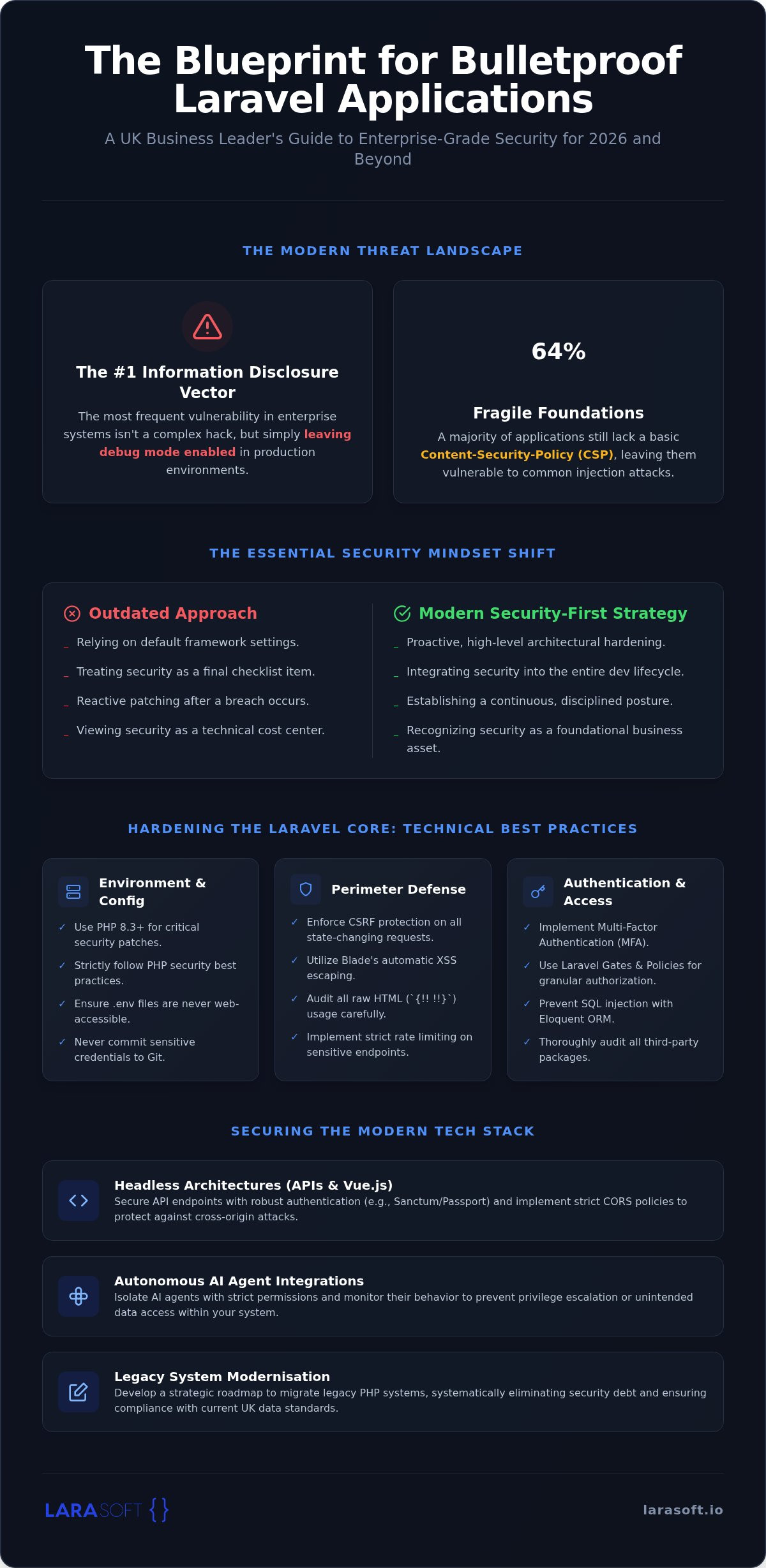
Many UK enterprises operate on systems built years ago. These "black box" applications often harbour deep-seated security debt that grows more dangerous every day. It's a common mistake to view modernisation as a purely aesthetic or performance-based task. In reality, secure laravel development for legacy systems is about identifying and neutralising structural rot before it's exploited. Running outdated versions is a significant risk. For instance, Laravel 12 will stop receiving security fixes in February 2027. If your stack still relies on PHP versions below 8.3, you're missing critical engine-level protections that modern frameworks take for granted. This technical obsolescence makes your application an easy target for automated scripts scanning for known vulnerabilities.
We start the process with a dual-layered audit. Automated tools are excellent for catching known CVEs and identifying deprecated functions across thousands of lines of code quickly. However, manual reviews remain essential for spotting logical flaws and insecure business logic that automated scanners simply miss. We prioritise patches based on a matrix of business risk and exploitability. This ensures we address high-impact vulnerabilities first, protecting your most sensitive data assets while we prepare for a deeper architectural shift. This structured approach prevents the "patchwork" security that often leads to more problems down the line.
Migration doesn't have to be a disruptive "big bang" event. We prefer an incremental approach that preserves data integrity while gradually hardening the system. This involves refactoring raw SQL queries into Eloquent. Raw queries are often the primary source of SQL injection in older systems, while Eloquent uses prepared statements by default. We also wrap modern authentication layers around legacy user tables, providing immediate MFA support without requiring a full database migration. This strategy allows for zero-downtime security upgrades. Your business stays online while the underlying architecture undergoes a transformation.
Professional legacy code modernisation eliminates the structural vulnerabilities that hackers target most. It transforms a technical liability into a foundational asset for your future growth. If you're concerned about the integrity of your current system, our team can provide a comprehensive legacy code audit to map out your path to a modern, hardened stack. We focus on clean execution and business returns, ensuring your transition is as smooth as it is secure.
Security isn't a destination; it's a continuous state of vigilance. At Larasoft, we've moved past the "set and forget" mentality that leaves so many enterprise systems vulnerable. True secure laravel development requires a lifecycle approach where protection is integrated into every stage of the development process. From the first line of code to the final deployment, we treat security as a primary feature rather than an optional layer. This ensures that as your application evolves, its defenses grow alongside it, preventing the accumulation of technical debt that leads to catastrophic failures.
Automated testing and CI/CD pipelines serve as our digital guardrails. We don't just hope the code is secure; we prove it through rigorous automated suites that check for regressions and configuration errors before any change goes live. By automating security checks within our deployment cycle, we eliminate human error and ensure every release maintains the integrity of your platform. This disciplined execution allows your business to innovate at pace without sacrificing the safety of user data. We view these pipelines as a critical component of secure laravel development, providing the transparency needed for stakeholders to trust the stability of their digital infrastructure.
Real-time visibility is essential for stopping threats before they escalate. We implement comprehensive security event monitoring and error logging to identify unusual patterns the moment they occur. Using tools like Composer Audit, we perform automated dependency checks to catch vulnerabilities in third-party packages as soon as they're reported. Staying ahead of the curve requires a dedicated software maintenance plan that prioritizes these updates. Ongoing care is the only way to ensure your application remains resilient against the zero-day threats of tomorrow. It's about maintaining a proactive posture where we solve problems before they impact your users.
Choosing a development partner is about more than just hiring coders; it's about finding an ally who understands your business risks. We combine deep technical expertise with a sense of business reassurance, acting as a specialized extension of your own team. Our "Quiet Competence" model means we focus on building clean, efficient systems that perform perfectly under the high pressure of enterprise demand. We take immense pride in the structural integrity of our work, ensuring your platform is a foundational asset for long-term scalability. Ready to secure your application? Contact Larasoft for a technical audit and let's build something bulletproof together.
Transitioning to a hardened digital environment requires a shift from reactive patching to a disciplined, long-term architectural strategy. We've explored how secure laravel development bridges the gap between clean code and business longevity, particularly when navigating the inherent risks of legacy debt and the complexities of agentic AI. Building a resilient system isn't just about the initial launch; it's about maintaining a lifecycle of vigilance that protects your user trust and operational integrity against an evolving threat landscape.
Larasoft brings quiet competence to every partnership, focusing on bespoke high-performance applications that perform perfectly under pressure. As specialists in UK legacy code modernisation and leaders with an expert Laravel AI integration team, we ensure your transition to a modern stack is both fluid and airtight. We treat your software not as a one-off product, but as a foundational asset for your company's future growth. Don't leave your structural integrity to chance. Secure your business future with a bespoke Laravel audit from Larasoft and turn your technical liabilities into a hardened, scalable advantage. Your journey toward a bulletproof application starts with a single strategic assessment.
Laravel isn't inherently "bulletproof," but it offers a more robust security baseline than most PHP frameworks. It provides built-in protections against SQL injection, Cross-Site Request Forgery (CSRF), and Cross-Site Scripting (XSS). While these defaults are powerful, true secure laravel development depends on how a developer configures these tools. Misconfigurations or poor implementation of custom logic remain the most common causes of vulnerabilities in enterprise systems.
The most significant risks in 2026 include prompt injection in AI-integrated features and misconfigured production environments. Research indicates that leaving debug mode enabled remains a top information disclosure vector for enterprise platforms. Additionally, many applications still lack critical security headers like Content-Security-Policy (CSP). As architectures become more distributed, securing headless APIs and managing third-party integration risks have become primary concerns for high-growth organisations.
Bespoke development significantly improves security by reducing the total attack surface. Unlike off-the-shelf software, which includes generic features and bloat that can harbour hidden vulnerabilities, a custom build only contains the code your business actually needs. This lean approach makes it easier to audit and maintain. It also allows for the implementation of specific security protocols tailored to your unique data handling requirements and compliance standards.
Legacy Laravel applications can be hardened without a full rewrite through a process of incremental modernisation. This involves updating the underlying PHP version to 8.3, refactoring raw SQL into Eloquent, and wrapping modern authentication layers around old database tables. While a full rebuild might be ideal for performance, these targeted interventions eliminate the most critical structural vulnerabilities. It allows businesses to maintain operations while systematically reducing their security debt.
GDPR is the regulatory framework that mandates data protection by design and by default for all UK businesses. In the context of secure laravel development, this means implementing rigorous encryption for data at rest and in transit. It also requires granular access controls and detailed logging to ensure you can track how personal data is processed. Compliance isn't just about avoiding fines; it's about building a system that users can trust with their information.
Enterprise Laravel applications should undergo a comprehensive security audit at least once a year. However, you should also trigger an audit after any major architectural change, such as a new API integration or a significant framework upgrade. For high-traffic systems, we recommend quarterly automated vulnerability scans combined with an annual manual review. This dual approach ensures that both known vulnerabilities and complex logical flaws are identified and neutralised before they can be exploited.
Laravel AI integration does pose risks, particularly regarding prompt injection and data leakage to external models. If user data is sent to a third-party LLM without proper sanitisation or consent, it could lead to significant privacy breaches. We mitigate this by implementing strict outbound data policies and "Human-in-the-Loop" validation for sensitive operations. Ensuring that AI models only process anonymised or strictly necessary data is critical for maintaining user privacy and regulatory compliance.
The primary difference lies in the complexity of the authentication requirements. Laravel Sanctum is a lightweight system designed for SPAs, mobile apps, and simple token-based APIs. It's easier to implement and perfect for most internal projects. Laravel Passport is a full OAuth2 server implementation. It's the better choice for enterprise applications that need to support complex scopes, third-party logins, or act as an identity provider for other services across a distributed ecosystem.
Here’s what we've been up to recently.
Certified Quality. Great Prices