Native vs Cross-Platform Apps: Strategic Guide 2026

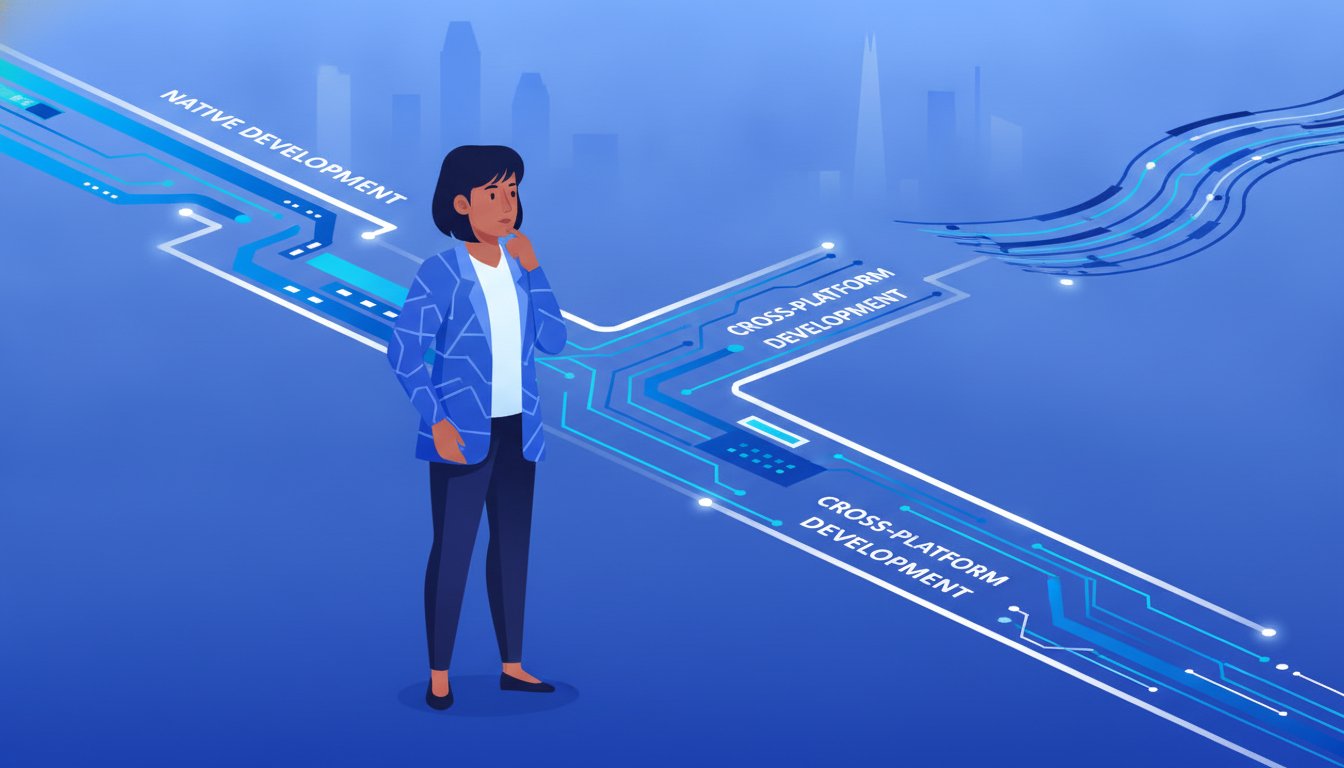
Selecting the wrong mobile tech stack in 2026 is no longer just a minor technical debt; it's a structural liability that can consume up to 20% of your initial investment in annual maintenance alone. You likely feel the pressure to launch quickly while fearing that a cross-platform compromise might alienate your iOS power users or leave you locked into an obsolete framework. The decision regarding native vs cross-platform app development shouldn't be a gamble on future compatibility or a source of inconsistent user experiences across devices.
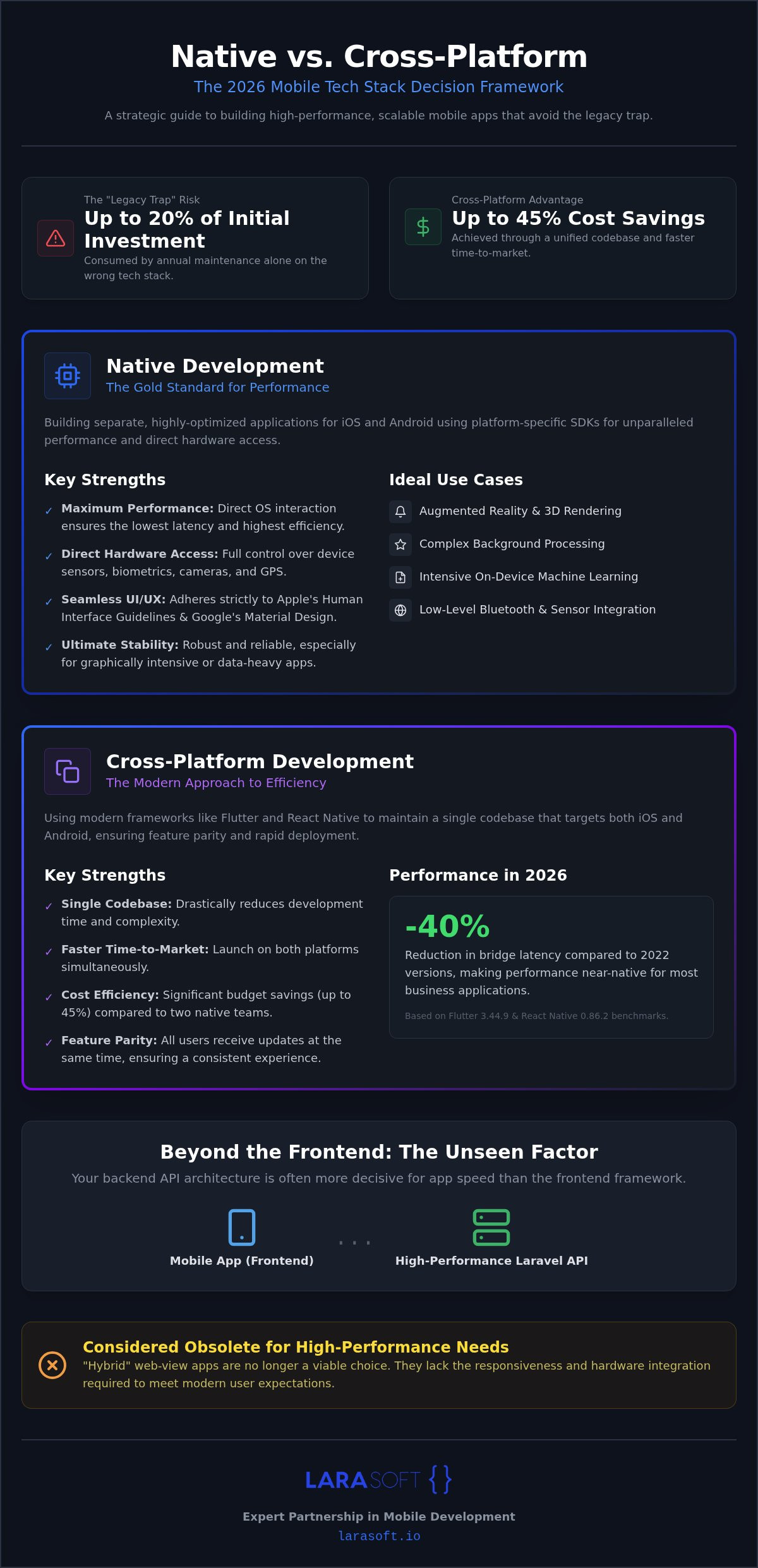
This guide offers a rigorous technical and commercial framework to help you build a high-performance mobile asset that scales without falling into the legacy trap. We will analyse the latest performance benchmarks for Flutter 3.44.9 and React Native's New Architecture, alongside the growing adoption of Kotlin Multiplatform. You'll gain a clear understanding of how cross-platform solutions can offer cost savings of up to 45% without sacrificing the fluid transitions your users expect. By the end, you'll have the confidence to select a development path that aligns with your long-term growth and architectural integrity.
The evolution of mobile app development has reached a critical pivot point. Choosing a tech stack is no longer a simple binary choice between speed and cost; it's a strategic decision regarding the architectural integrity of your digital assets. This choice represents the most significant technical milestone in your mobile roadmap. Getting it wrong often leads to expensive re-platforming or a "legacy trap" that stifles innovation as your business scales.
In 2026, the industry has largely abandoned "hybrid" web-view apps. These wrappers, which essentially displayed mobile websites inside an app container, are obsolete for high-performance needs. They lack the responsiveness and hardware integration required to meet modern user expectations. Today, the choice regarding native vs cross-platform app development focuses on frameworks that compile to machine code or offer high-performance abstraction layers.
Native development involves building separate applications for iOS and Android using their respective platform SDKs. By using Swift for Apple devices and Kotlin for Android, developers gain direct access to the device's hardware. This is essential for applications requiring advanced sensors, biometric security, or complex augmented reality features. It ensures the software runs with maximum efficiency by interacting directly with the operating system.
Performance remains the primary advantage of a native stack. Apps built this way adhere strictly to platform-specific design languages, such as Apple's Human Interface Guidelines or Google's Material Design. This creates a seamless UI/UX that feels intuitive to the user. For data-heavy or graphically intensive applications, native code provides the stability and responsiveness that abstraction layers sometimes struggle to match.
Cross-platform development has matured into a robust alternative for enterprise-grade applications. Modern frameworks like Flutter and React Native allow businesses to maintain a single codebase that targets both major operating systems. This approach ensures feature parity. A new update reaches all your users simultaneously, rather than in staggered releases that frustrate one segment of your audience.
By August 2026, the performance gap has narrowed significantly. With the release of React Native 0.86.2 and Flutter 3.44.9, these tools now offer near-native execution speeds for the vast majority of business use cases. This efficiency allows for a more specialised development process and a faster time-to-market. It's a compelling path for UK businesses looking to maximise their digital investment while maintaining high standards of quality. The decision of native vs cross-platform app development now rests on specific functional requirements rather than basic performance limitations.
The technical debate surrounding native vs cross-platform app development often centres on execution speed. Native code interacts directly with the operating system, providing the lowest possible latency for high-performance tasks. In contrast, cross-platform frameworks rely on abstraction layers or "bridges" to communicate with native APIs. While these bridges once created noticeable bottlenecks, modern development tools have transformed the performance profile of shared codebases.
Native development remains the non-negotiable choice for applications requiring deep hardware integration. If your project involves low-level Bluetooth communication, complex background tasks, or real-time sensor processing, the direct access provided by Swift or Kotlin is essential. These scenarios require the high-performance local processing that only native SDKs can guarantee. Native environments also provide superior stability for third-party libraries that interact with specialised device features.
By 2026, cross-platform bridges have reduced latency by over 40% compared to 2022 versions. This advancement makes frameworks like Flutter or React Native viable for almost any business application that doesn't rely on heavy 3D rendering or intensive on-device machine learning. For a deeper look at these architectural trade-offs, Kotlin's cross-platform guide offers an excellent breakdown of how logic sharing impacts execution across different environments.
A common oversight in mobile strategy is over-prioritising the frontend stack while neglecting the backend architecture. The responsiveness of your application depends more on the efficiency of your Laravel backend than the language used to build the UI. A poorly optimised API will cause lag and timeouts regardless of whether you've chosen a native or cross-platform path. The backend is the engine; the mobile app is simply the dashboard.
Building a unified, Laravel-powered core allows you to decouple the frontend from the backend logic. This structural integrity ensures data consistency across iOS and Android while providing the flexibility to migrate your frontend stack in the future without rebuilding your entire business logic. If you are planning a complex rollout, our team can help you design a bespoke API integration that serves as a high-performance foundation for your mobile asset.
On-device AI and ML processing still favour native environments. While third-party plugins are increasingly stable for cross-platform frameworks, native development provides superior access to specialised hardware like Apple's Neural Engine. This makes native the preferred choice for apps that perform heavy local data processing without relying on cloud-based computation, ensuring that performance remains perfect even under pressure.
The commercial viability of a mobile asset depends on balancing speed with structural integrity. The decision regarding native vs cross-platform app development determines your burn rate and your ability to respond to market shifts. For UK businesses, this choice is often a matter of prioritising either the depth of the user experience or the breadth of market reach within a specific budget.
Building for both platforms natively effectively doubles your engineering requirements. You must recruit, manage, and pay for two distinct skill sets: Swift for iOS and Kotlin for Android. In the UK's competitive tech market, senior native developers command a premium. Opting for cross-platform development instead allows a single team to manage a unified codebase. This approach often reduces initial development expenditure by 30% to 45%, allowing you to reallocate capital toward user acquisition or backend scaling.
A common mistake is viewing development costs as a one-off transaction. Total Cost of Ownership includes the long-term burden of updates and bug fixes. Native apps require separate maintenance cycles for every iOS and Android update. If a new feature is added, it must be coded, tested, and deployed twice. This can lead to a fragmented product where one platform lags behind the other, frustrating your user base.
Cross-platform frameworks offer a more streamlined maintenance path, but they aren't immune to hidden costs. If your application requires extensive customisation to access specific device hardware, your team may spend significant time writing "native bridges." In these cases, the cost of making a cross-platform app behave like a native one can erode the initial savings. We believe a bespoke architecture, planned correctly from the start, prevents these expensive mid-project corrections.
Time-to-market is often the deciding factor for startups and companies launching a Minimum Viable Product (MVP). Cross-platform development accelerates this phase by allowing simultaneous deployment to the App Store and Google Play. This rapid iteration cycle provides faster access to user feedback, which is vital for refining your product-market fit. It ensures your features reach all users at the same time, maintaining brand consistency.
However, native development remains a powerful competitive differentiator in high-end consumer markets. If your brand relies on a "pixel-perfect" interface or ultra-low latency, the investment in native code can reduce user churn. Some UK firms employ a dual-track approach, launching natively on a single platform to prove the concept before expanding. This disciplined strategy ensures that you aren't over-investing in a tech stack before your business model is validated by real-world data.
The decision between native vs cross-platform app development isn't just a launch-day milestone. It's a long-term commitment to a multi-year maintenance cycle that can either support your growth or stifle it. If you select a tech stack without considering its five-year viability, you risk falling into a "Legacy Trap." This is the specific point where the cumulative cost of maintaining an obsolete system exceeds the cost of a complete rebuild.
Many UK businesses opt for the lowest initial development quote only to find themselves requiring legacy code modernisation within twenty four months. Technical debt accumulates quickly when code is written to meet a launch deadline rather than to support future scaling. This debt is often more complex in cross-platform environments where your application is tethered to the stability of a third-party framework like Flutter or React Native.
Operating system updates present another scaling challenge. Native development provides immediate access to new iOS and Android features. When Apple or Google release an update, native developers can implement new APIs on day one. Cross-platform frameworks usually require a waiting period while the community or parent company updates the core engine. For businesses that rely on being at the cutting edge of mobile technology, this delay can become a significant competitive disadvantage.
Bespoke software requires a dedicated maintenance plan to remain secure and performant. Cross-platform environments are particularly susceptible to "dependency hell," where updating one third-party plugin can break multiple other integrations. This creates a fragile ecosystem that demands constant attention to prevent software rot. Native stacks are generally more stable over the long term because they rely on the platform's own first-party SDKs, which are designed for backward compatibility.
Recognising the signs that your current mobile app needs a structural overhaul is vital for survival. Common indicators include slow load times, frequent crashes following OS updates, and a ballooning budget for simple bug fixes. Migrating from a cross-platform stack to a native one, or vice versa, is a delicate operation. It requires a technical partner who understands how to preserve data integrity while re-architecting the frontend. Clean code and rigorous documentation are your only true defences against the eventual obsolescence of any tech stack.
Handling user growth over a five-year horizon requires an architecture that scales horizontally. While native apps benefit from the hardware optimisations of the device, cross-platform apps often require more aggressive refactoring to maintain performance as feature complexity increases. If your current mobile asset is struggling to keep pace with your business, our team can provide the legacy code modernisation expertise needed to rebuild your platform on a more sustainable foundation.
Larasoft operates as a technical ally rather than a mere service provider. Our objective approach to the native vs cross-platform app development debate ensures that your choice is driven by business logic rather than developer preference. We evaluate your specific performance requirements, budget constraints, and long-term scaling goals to recommend the architecture that offers the highest return on investment. Our goal is to build a system that performs perfectly under pressure while remaining manageable as your team grows.
Our bespoke development philosophy rejects off-the-shelf shortcuts that lead to technical debt. Instead, we focus on structural integrity and custom-built excellence. This commitment extends to the core of your mobile asset: the backend architecture. By building high-performance Laravel backends, we provide your mobile frontend with industrial-strength APIs that ensure data integrity and rapid response times. This strategic decoupling of the frontend and backend is a deliberate move that prevents the "Legacy Trap" and allows your platform to evolve as new technologies emerge.
Reliability and technical authority are the cornerstones of our work. UK businesses partner with us because they gain direct access to senior developers who understand the intricate nuances of both native and cross-platform ecosystems. We don't use junior-level teams for critical architectural decisions. We have a proven track record in technical modernisation, helping clients rescue failing projects and transform them into scalable foundations for future growth. Our software maintenance services ensure that your application remains secure, performant, and compatible with every new iOS and Android release long after the initial launch.
Every partnership begins with a rigorous technical discovery phase. We don't start coding until we've aligned your mobile strategy with your broader digital ecosystem. This ensures that your app isn't a siloed product but an integrated component of your business operations that communicates perfectly with your existing CRM or ERP systems. Whether you're building a new MVP or modernising a complex enterprise platform, we provide the end-to-end support necessary to build a high-performance mobile asset. Contact Larasoft today to discuss your mobile application roadmap.
Navigating the complexities of native vs cross-platform app development requires a shift from short-term budgeting to long-term asset management. The decision you make today dictates your ability to scale, your vulnerability to technical debt, and the responsiveness of your digital platform. Success in the 2026 mobile landscape depends on aligning your tech stack with specific commercial goals while ensuring your backend architecture can support rapid growth.
Larasoft provides the technical authority needed to build reliable, high-performance mobile assets. As specialists in bespoke Laravel and mobile development, our UK-based team focuses on preventing technical debt through clean architecture. We don't just deliver a product; we provide the long-term software maintenance required to ensure your platform remains a foundational asset for your business.
Building a high-quality mobile application is a structured journey toward growth. We're ready to act as your technical ally, helping you navigate these trade-offs with precision and discipline. Book a Technical Discovery Session with Larasoft to define your mobile application roadmap and secure your competitive edge.
Native development usually requires a higher initial investment because it involves building two separate applications. You'll need specialists for both Swift and Kotlin to target iOS and Android users. However, cross-platform costs can escalate if your project requires extensive custom native bridges for hardware access. A well-planned architecture from the start is the best way to manage these long-term costs effectively.
Cross-platform frameworks like Flutter and React Native can handle AR and biometrics using third-party plugins or native modules. While these tools have matured significantly by 2026, native development remains the superior choice for high-performance hardware interfacing. If your app relies heavily on real-time sensor data or complex 3D rendering, a native stack provides more direct access to the device's processing power.
Cross-platform development is typically the faster route for startups aiming to launch a Minimum Viable Product. Maintaining a single codebase allows for simultaneous deployment to the App Store and Google Play, accelerating the user feedback loop. This efficiency is vital for rapid iteration. If your business model requires instant market reach across both major platforms, a shared stack is the most pragmatic choice.
Native applications benefit from the immediate security patches and first-party encryption tools provided directly by Apple and Google. Cross-platform apps rely on the framework maintainers to implement these updates, which can sometimes cause a slight delay. Regardless of the stack, the security of your mobile asset depends heavily on the integrity of your API integration and robust backend data handling protocols.
Modern frameworks have narrowed the gap so significantly that most users cannot distinguish between the two. However, native apps still offer the most fluid transitions and perfect adherence to platform-specific design languages. If your brand identity is built on a pixel-perfect, high-end consumer experience, the subtle performance advantages of native code can help reduce user churn and improve overall engagement.
This is a common concern regarding native vs cross-platform app development. If a framework is discontinued, your application becomes a legacy asset that is difficult to update for new OS versions. Choosing widely adopted frameworks like React Native or Flutter mitigates this risk. We focus on building clean, documented codebases that allow for easier migration if a specific tech stack ever becomes obsolete.
The tech stack doesn't directly impact your ranking in search results, but it does affect the performance metrics that influence App Store Optimization. Factors like app size, load speed, and crash rates are critical for visibility. A native app might have a slight edge in raw performance, but a well-optimised cross-platform app can rank just as highly if the user experience remains seamless.
Yes, we specialise in legacy code modernisation and complex migrations for UK businesses. Whether you're moving from a hybrid wrapper to a native stack or consolidating two native apps into a single cross-platform codebase, our team ensures data integrity throughout the process. We conduct a thorough technical discovery to ensure your new architecture is scalable and free from the structural debt of your previous system.
Here’s what we've been up to recently.
Certified Quality. Great Prices