Mobile App Maintenance: 2026 Strategic Guide for UK

What if the software that powers your business is slowly becoming its biggest liability? In a market where 90% of UK smartphone time is spent within apps, failing to invest in high-quality mobile app maintenance services can devalue your digital investment overnight. You've likely realised that launching an app is just the start, but the pressure of managing legacy code while trying to scale for new business features often feels like an expensive, uphill battle after an iOS 27 update or a surprise privacy manifest rejection.
This guide will show you how to transform your maintenance strategy, moving from reactive bug-fixing to a proactive performance architecture approach. By prioritising structural integrity and OS compatibility, you'll ensure zero downtime during transitions and maintain predictable monthly support costs. We'll explore the technical requirements for iOS 26.6.1 and the Android 17 ecosystem, the latest UK GDPR compliance standards, and how to modernise your architecture to support future AI integration and long-term user retention.
For many UK organisations, the release of an app is viewed as the finish line. In reality, it's the starting point of a complex lifecycle. Professional mobile app maintenance services act as a proactive strategy to protect the structural integrity of your digital assets. This isn't just about fixing bugs. It's about ensuring your software remains relevant as the ecosystem around it evolves. By treating maintenance as a core business function, you shift from a mindset of "repair" to one of "performance architecture."
Stakeholders often encounter the "Iceberg Effect," where the initial build represents only the visible 20% of the total effort. Approximately 80% of software costs occur after the launch phase. These costs stem from the constant need to adapt to new security protocols, evolving user behaviours, and the complexities of Mobile application management (MAM) within enterprise environments. Without a structured plan, these invisible requirements quickly erode the ROI of your original investment. In the competitive UK market, where app stability is directly tied to user retention, neglecting this lifecycle can lead to a rapid decline in market share.
Choosing to "fix it when it breaks" is a high-risk financial gamble. Industry data indicates that reactive repairs often cost three times more than scheduled updates. This discrepancy exists because emergency fixes require immediate resource relocation, often disrupting other critical development cycles. More importantly, frequent crashes or downtime following an OS update like iOS 27 can permanently damage brand reputation. Technical debt is the interest paid on delayed software updates. When you defer maintenance, you aren't saving money; you're simply accumulating a larger bill for the future that will eventually demand payment through system failure or total rebuilds.
A well-maintained codebase is a prerequisite for growth. By keeping dependencies current and refactoring code regularly, you create a stable foundation for legacy code modernisation. This process ensures that when you're ready to integrate 2026 hardware innovations or new AI agents, your app is architecturally prepared to handle the transition. Mobile app maintenance services keep your codebase clean and reduce friction for future feature additions. This disciplined approach allows your application to perform perfectly under pressure while supporting the long-term scalability of your business operations.
Effective mobile app maintenance services go beyond superficial fixes. They require a rigorous, multi-layered approach to preserve the software's structural integrity. In 2026, this means synchronising frontend performance with backend stability while navigating the strict requirements of the Apple and Google ecosystems. High-performance apps require continuous monitoring of API latency and crash reports to identify bottlenecks before they impact the user experience. Strategic mobile app maintenance services ensure that every component, from the UI to the API, remains optimised for the latest hardware.
Maintaining visibility on performance metrics is essential. We track load times and SDK health to ensure the app remains responsive under varying network conditions. Following expert tips for app maintenance, a focused effort on user feedback and performance data allows for iterative improvements. This disciplined monitoring prevents the gradual degradation of the user experience that often plagues unmanaged applications.
Dependency drift is the silent killer of modern mobile applications. Modern apps rely on dozens of third-party libraries and frameworks. When these aren't updated in tandem with the core OS, the entire system becomes brittle. For organisations using cross-platform solutions like React Native or Vue-based frameworks, this synchronisation is even more critical. With iOS 27 in public beta and Android 17 already shaping user expectations, testing protocols must account for new hardware features. This includes managing revised payment "steering" rules and ensuring compatibility with the latest system updates like iOS 26.6.1.
Security isn't a one-time setup. It's a continuous process of hardening the application against emerging threats. Regular audits of custom-built software are mandatory for maintaining UK GDPR and Data Protection Act 2018 compliance. If your app relies on a complex backend, ensuring your laravel development agency maintains strict security protocols is vital. This includes patching vulnerabilities in the API layer and ensuring that privacy manifests meet the latest App Store requirements. Failure to address these can lead to sudden rejections or costly data breaches.
Managing these moving parts requires a partner who understands the deep technical interplay between mobile frontends and secure backends. You can explore our specialised maintenance frameworks to see how we provide the architectural stability your business needs to scale.
Selecting the right financial structure for your mobile app maintenance services is a strategic decision that impacts both operational stability and long-term valuation. Most organisations choose between a predictable monthly retainer or a reactive, on-demand support model. While "pay-as-you-go" offers lower upfront costs for smaller, low-traffic applications, it often introduces significant risk. Without priority access, your business is left waiting in a queue during critical OS transitions or security emergencies. Retainers, by contrast, ensure that a dedicated team is always familiar with your codebase, allowing for immediate action when platform updates occur.
When evaluating a UK-based SLA, it's vital to distinguish between response times and resolution times. A rapid response is meaningless if the technical resolution takes days due to communication gaps or a lack of deep system knowledge. This is a frequent issue with offshore maintenance; time-zone delays and linguistic barriers often result in hidden costs that far outweigh any initial savings on hourly rates. A UK-based partner provides the immediate, high-fidelity communication required for complex technical handovers and emergency troubleshooting, ensuring your internal teams aren't left managing a technical crisis alone. For those weighing their global options, Founders Workshop offers a comprehensive look at why choosing a nearshore model can often be superior to traditional offshore development.
A retainer isn't just a fee for availability. It's an investment that prevents the expensive "re-learning" cost associated with developers frequently opening and closing your code for the first time. Proactive monitoring identifies revenue-killing outages before they affect the end-user. Continuous refactoring also extends the shelf life of a mobile app. This disciplined approach ensures you don't face a mandatory, six-figure rebuild every few years due to accumulated technical debt. By allocating a consistent budget to maintenance, you preserve the app as a foundational asset rather than a depreciating one.
Before committing, you must verify the technical discipline of your provider. Ask specifically about their version control protocols and how they document architectural changes. If your system relies on a complex backend, confirm their expertise in specific environments like Laravel. You should also inquire about their emergency procedures for critical failures. A partner who takes pride in the cleanliness of their work will have clear, structured answers regarding their deployment pipelines and regression testing frameworks. This transparency is the hallmark of a technical ally who values high-quality execution over quick fixes.
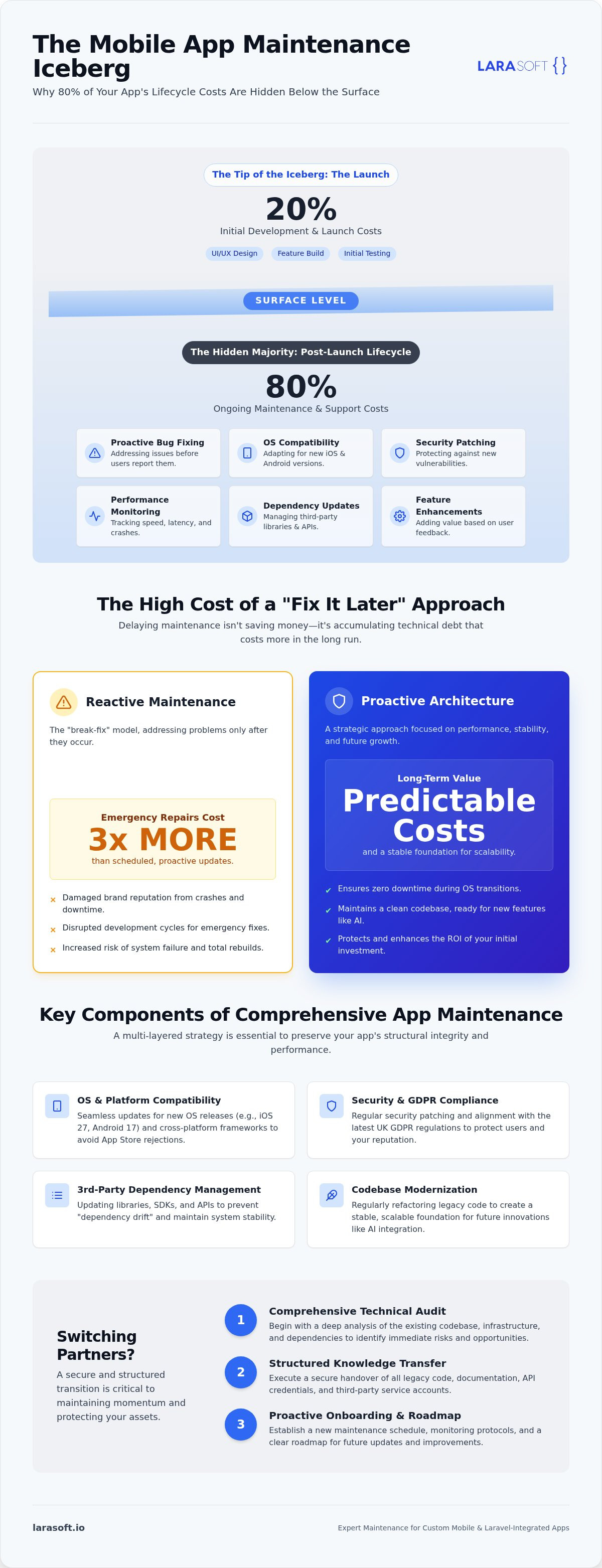
Transitioning to new mobile app maintenance services is often the most stressful period for a business leader. It typically occurs when a previous relationship has fractured or a freelancer has reached their technical limit. A successful handover isn't a leap of faith; it's a structured journey that secures your digital investment. This process requires a deep technical immersion to ensure the new team understands every architectural nuance and dependency within your application. By treating this transition as a performance audit, you move from a state of uncertainty to a position of technical control.
The handover concludes by securing your digital estate. This includes centralising credentials for repositories, app store accounts, and third-party API keys. Once access is established, we enter a "Stabilisation Phase." During this time, we identify and fix immediate critical issues discovered during the audit. This proactive approach ensures your app is stable and ready for the 2026 hardware innovations mentioned in previous sections. If you're struggling with a partner who has become unresponsive, request a technical audit to begin your transition to a reliable maintenance framework.
A professional agency must review your code quality before committing to an SLA. We look past the UI to evaluate the structural integrity of the codebase. This involves scanning for "spaghetti code," identifying deprecated libraries, and assessing the hosting environment. If your app relies on third-party APIs or a Laravel backend, we verify that these integrations are secure and performant. This audit identifies potential points of failure that could lead to crashes after an OS update, allowing us to address them before they become emergency tickets.
The biggest risk occurs when the original developer leaves behind zero documentation. In these cases, we perform code archaeology to reconstruct the app's logic and business rules. We create a living document that serves as the blueprint for all future work. This phase also involves setting up local development environments that mirror your production setup. This ensures that every update is tested in a controlled environment before deployment, preventing the "it works on my machine" syndrome that often causes downtime during partner transitions.
At Larasoft, we don't view maintenance as a reactive burden. We see it as a disciplined process of performance architecture. Our team provides specialised support for high-performance Native and Cross-Platform applications, ensuring every line of code contributes to your business goals. Unlike generic providers, we focus on the structural integrity of custom-built solutions. Our technical artisans take immense pride in the cleanliness and efficiency of their work. This commitment to quality allows us to maintain applications for five to ten years, transforming a one-off product into a foundational asset for your future growth.
A critical advantage of our mobile app maintenance services is our deep expertise in Laravel. Most mobile applications rely on complex backends for data processing and user management. If your frontend and backend drift out of sync, performance suffers and security risks increase. We ensure your mobile frontend and Laravel backend stay in perfect alignment. This full-stack perspective allows for precise performance tuning in high-traffic environments. It also prepares your system for the integration of AI capabilities, ensuring your maintenance plan is forward-thinking rather than just retrospective.
Whether you're running a Native iOS app or a React-based cross-platform solution, we apply the same rigorous standards of code hygiene. This meticulous attention to detail prevents the accumulation of technical debt and simplifies future feature additions. By choosing a partner that understands the deep technical interplay of your entire stack, you're not just buying support; you're securing a manageable, structured journey toward long-term scalability. We focus on ensuring your infrastructure handles 2026 hardware demands while maintaining the fluid transitions users expect from premium digital products.
We move beyond the traditional "ticket" system to act as your strategic technical ally. Our UK-based project management team prioritises transparent, jargon-free communication, ensuring you always understand the strategic purpose behind technical interventions. We conduct regular strategic reviews to align your technical roadmap with emerging market opportunities. This collaborative approach ensures that every update supports your broader commercial objectives and drives long-term user retention. To ensure your digital investment remains performant and secure, you can contact Larasoft for a comprehensive mobile app health check today.
Maintaining a mobile application in 2026 requires more than occasional bug fixes; it demands a disciplined approach to performance architecture. By prioritising structural integrity and proactive monitoring, you protect your digital investment from the "Iceberg Effect" and ensure seamless compatibility with evolving operating systems. Professional mobile app maintenance services transform your software from a depreciating liability into a foundational business asset ready for future AI scaling. Whether you're modernising legacy code or synchronising complex Laravel backends, the right technical ally ensures your platform remains performant under pressure.
Larasoft provides the specialised expertise needed to navigate these technical complexities. As UK-based Laravel and mobile experts, we offer a strategic partnership approach that prioritises high-quality execution and legacy code recovery. Don't let technical debt devalue your hard-earned market position. Secure Your App’s Future with Professional Maintenance and build a resilient foundation for your organisation’s next phase of growth. Your application’s journey toward long-term scalability starts with a single, structured step today.
Maintenance costs in the UK vary based on the complexity of the application, the size of the user base, and the frequency of required updates. Typically, a percentage of the initial development cost is allocated annually to ensure the software remains secure and compatible with new operating systems. Factors such as the need for proactive monitoring or complex third-party API integrations will influence the total investment. We recommend a strategic review to determine a predictable budget that aligns with your specific technical requirements.
Yes, we specialise in taking over the maintenance of native and cross-platform applications originally built by other agencies or freelancers. Our transition framework begins with a comprehensive technical audit to assess code quality and infrastructure health. We focus on stabilising legacy code and modernising the architecture to support future scaling. This process ensures that your digital asset remains performant even if the original documentation is incomplete or the previous developer is no longer available to provide support.
Failing to update an app for six months significantly increases the risk of critical failure and app store removal. The rapid release cycles of iOS 27 and Android 17 mean that unmanaged apps often crash due to deprecated APIs or changed system permissions. Additionally, your app becomes vulnerable to security threats and may be rejected for privacy manifest violations. Routine mobile app maintenance services prevent these issues, ensuring your software remains functional and compliant with the latest platform policies.
Traditional maintenance focuses on stability, security, and compatibility, but strategic partnerships often include perfective maintenance for feature enhancements. While routine updates keep the app running on new hardware, adding entirely new business logic is typically managed as a separate development phase. However, a clean codebase maintained through professional mobile app maintenance services makes adding these features significantly faster and more cost-effective. We align our technical roadmap with your business goals to ensure seamless feature integration without compromising system integrity.
We manage security through regular audits and proactive patching of both the mobile frontend and the backend, particularly for Laravel-integrated systems. Our process ensures compliance with the UK Data Protection Act 2018 and current GDPR standards. In 2026, this includes updating privacy manifests to meet Apple's strict requirements and securing API integrations against emerging threats. By identifying vulnerabilities before they are exploited, we protect your user data and maintain the commercial reputation of your digital platform.
Bug fixing is a reactive process that addresses existing errors, whereas ongoing maintenance is a proactive strategy designed to prevent issues before they occur. Maintenance includes monitoring performance, managing dependency updates, and ensuring compatibility with new OS versions like iOS 26.6.1. While bug fixing resolves a specific failure, maintenance preserves the overall structural integrity of the application. This disciplined approach reduces long-term technical debt and ensures that the software remains a scalable foundation for your business operations.
We provide comprehensive maintenance for both iOS and Android platforms, covering native builds and cross-platform frameworks like React Native. Our team monitors the latest system updates, including the August 2026 Google Play services v26.32 and the public beta of iOS 27. We ensure that your application performs perfectly across a wide range of devices and operating system versions. This multi-platform approach is essential for maintaining high user retention rates in the competitive UK mobile market.
Your app likely needs legacy code modernisation if simple updates frequently cause unexpected crashes or if it's becoming difficult to find developers willing to touch the existing codebase. While routine maintenance keeps a system running, modernisation involves refactoring outdated architecture to support new technologies like AI agents. If the cost of maintaining your current app exceeds the value it provides, or if technical debt prevents you from adding essential business features, a strategic modernisation plan is necessary for long-term viability.
Here’s what we've been up to recently.
Certified Quality. Great Prices