Laravel API Integration with Third Party Services: The 2026 Enterprise Guide

A single fragile connection to a third-party service can now trigger UK regulatory fines of up to £17.5 million following the Data (Use and Access) Act 2025 reforms. You've likely felt the frustration of an integration breaking during a silent vendor update or watched your application latency spike because of a sluggish external endpoint. It's a common pain point for technical leaders who need to maintain structural integrity while scaling. Mastering laravel api integration with third party services isn't just about making a successful HTTP call; it's about building a resilient, AI-ready architecture that protects your data and your reputation.
We understand that enterprise systems require more than just a working connection. They need to perform under pressure. This guide provides the blueprint for building modular, sub-second integrations using Laravel 13 and Laravel Octane, ensuring your systems remain secure and compliant with the latest UK standards. We'll explore strategic architectural patterns, the new Laravel AI SDK, and the rigorous security protocols required to safeguard sensitive data transfers in a modern enterprise environment.
Laravel 13 has redefined the role of a web framework, moving beyond simple server-side rendering to become a high-performance orchestrator for disparate digital services. For UK enterprises, the challenge isn't just connecting to a provider; it's managing the complexity of dozens of different Application Programming Interface (API) endpoints simultaneously. Successful laravel api integration with third party services requires a shift in perspective. You're no longer building a monolith. You're building a "headless" brain that directs data between CRM systems, payment gateways, and AI models with precision.
This architectural shift promotes developer velocity. Laravel’s built-in HTTP client provides a fluent, expressive syntax that significantly reduces the boilerplate code typically required to handle requests. It allows your team to focus on business logic rather than low-level networking concerns. By centralising these connections within Laravel, you create a "Single Source of Truth." This ensures that data remains consistent across your mobile app, web platform, and internal dashboards. It's a critical factor for maintaining structural integrity when your system is under high traffic.
Decoupling your core application logic from external dependencies is a survival tactic in a fast-moving market. If a third-party service suffers an outage or pushes a breaking update, a well-abstracted Laravel layer prevents your entire system from failing. This modularity facilitates future-proof scaling. Whether you're expanding into new IoT devices or upgrading your mobile frontend, your core backend remains stable. It also reduces vendor lock-in. You can swap one service for another without the need to rewrite your entire codebase, protecting your long-term investment.
The framework provides a robust toolkit for enterprise-grade connectivity. Service Providers act as the central hub for registering third-party clients, ensuring that dependencies are injected cleanly and tested easily. For secure internal-to-external communication, Laravel Sanctum offers a lightweight yet powerful authentication layer that handles token-based security without the overhead of complex OAuth servers. UK businesses rely on this stability to act as reliable middleware. In an era where data privacy is paramount, Laravel’s disciplined approach to laravel api integration with third party services ensures that every packet of data is accounted for and compliant with the Data (Use and Access) Act 2025.
Building a high-performance bridge requires more than just a successful handshake. You need a structural framework that treats every external request as a potential point of failure. Implementing the Gateway Pattern allows you to wrap complex third-party logic inside a predictable interface. This abstraction ensures that your application remains agnostic to the specific quirks of a vendor's implementation. Whether you choose RESTful architecture for its universality or GraphQL for precise data orchestration, the goal remains the same: total control over the data flow.
Strict versioning is your primary defence against the "breaking change" phenomenon. By locking your laravel api integration with third party services to specific vendor versions, you prevent unexpected updates from crashing your production environment. For businesses requiring high availability, designing for offline-first resilience is vital. This involves smart data syncing where Laravel queues background jobs to reconcile local state with external servers once a connection is stable. Aligning these technical choices with a secure API-driven enterprise blueprint ensures that your architecture supports long-term growth rather than just immediate functionality.
Service classes are the workhorses of a clean integration. By isolating external API logic within dedicated classes, you keep your controllers slim and focused. We recommend implementing Interfaces for these services. This makes it trivial to swap providers if a vendor’s pricing or reliability changes. Security is equally paramount. You shouldn't hardcode credentials; instead, use encrypted environment variables to manage your API keys. If your current codebase feels cluttered with inline API calls, our team specialises in legacy code modernisation to restore structural integrity and performance.
Transparency is the hallmark of a professional development cycle. Tools like Scribe or Swagger generate live, interactive documentation that bridges the gap between technical artisans and business stakeholders. This allows non-technical team members to understand the data flow without reading PHP. Standardising error responses is another critical step. When a third-party service returns a 422 or 500 error, your Laravel bridge should translate that into a consistent format for your Vue.js or React frontend. This creates a predictable experience for the end-user and simplifies debugging for your engineers.
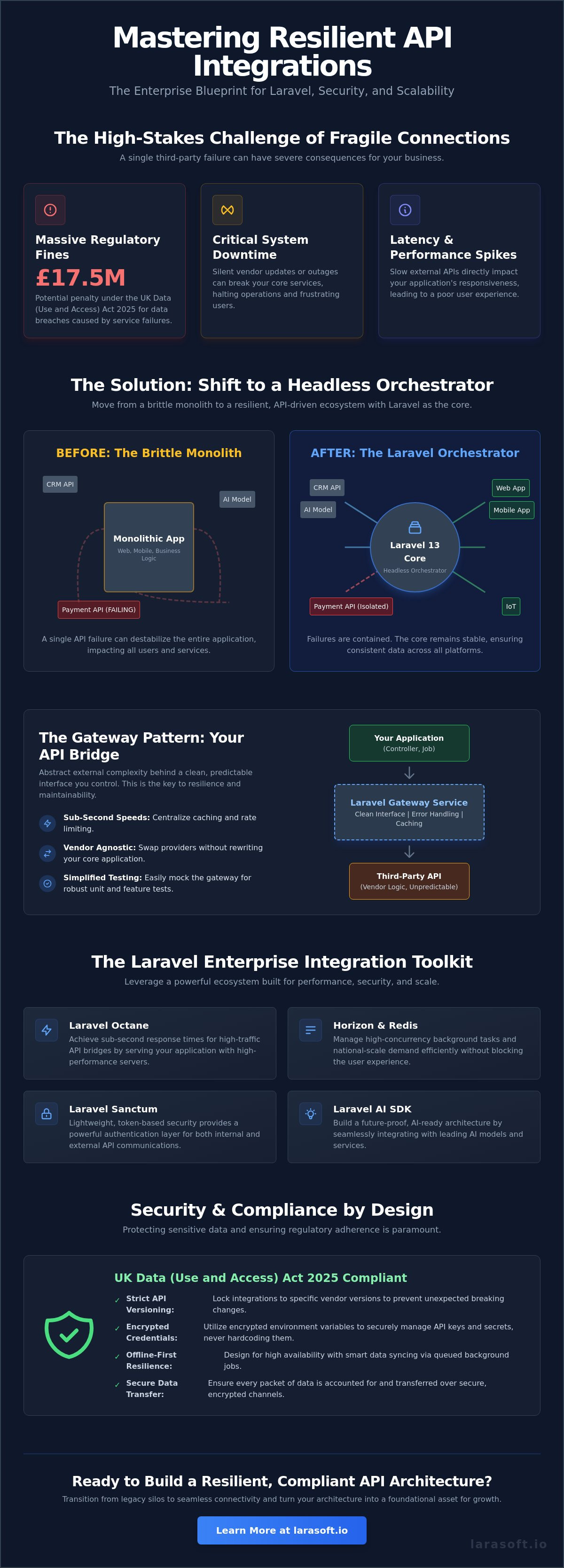
Security is no longer a secondary consideration in software architecture; it's the foundation of business continuity. For UK enterprises, the stakes have never been higher. Following the reforms in the Data (Use and Access) Act 2025, maximum fines for PECR breaches have increased to £17.5 million or 4% of global annual turnover, aligning them with UK GDPR levels. A poorly managed laravel api integration with third party services can expose your organisation to these liabilities if sensitive data is mishandled during transit or storage. Protecting the transport layer with TLS 1.3 is your first line of defence. For high-security environments, we implement certificate pinning to ensure your application only communicates with verified, legitimate servers.
Resilience is a core component of security. If a third-party service fails or suffers a latency spike, it shouldn't trigger a cascading failure across your entire platform. We utilise circuit breaker patterns to monitor the health of external endpoints. When a service becomes unresponsive, the circuit "trips," allowing your application to fail gracefully or serve cached data instead of hanging indefinitely. Rate limiting is equally vital. By strictly controlling the frequency of outgoing requests, you protect your own system resources and prevent vendor-side throttling that could disrupt your core operations.
Enterprise-grade security requires more than simple API tokens. While Laravel Sanctum is excellent for lightweight needs, we deploy Laravel Passport for full OAuth2 implementation when complex, scoped permissions are required. This allows you to grant specific, time-limited access to third-party providers without exposing your entire database. For clients invested in native mobile app development, we integrate biometric hooks. This ensures that high-stakes API calls, such as financial transfers or PII access, require a physical authentication factor on the user's device before the request is signed and sent.
Compliance is a moving target that requires constant vigilance. Every third-party integration must be backed by a robust Data Processing Agreement (DPA) that aligns with current UK standards. We implement automated audit logging to track every data exchange, providing a clear trail for the Information Commission in the event of an inquiry. Managing the "Right to be Forgotten" is another critical technical hurdle. Our architectures include automated triggers that cascade deletion requests to all integrated external services when a user closes their account. This ensures your laravel api integration with third party services remains fully compliant with the new "right to complain" regulations coming into force in June 2026.
Scaling an application for national demand requires more than just functional code; it demands an architecture that thrives under pressure. Every external request adds latency that can degrade the user experience if left unmanaged. We utilise Redis caching to store frequently accessed data from external endpoints, significantly reducing the need for repetitive network calls. This strategy is a cornerstone of effective laravel api integration with third party services, allowing your platform to maintain peak performance even during traffic surges. By serving data from memory rather than waiting for a distant server, we ensure your application feels instantaneous.
High-concurrency background tasks require a robust management system to prevent process bottlenecks. Laravel Horizon provides this by offering deep visibility into your queue workers, allowing us to balance workloads across multiple servers with precision. We also focus on database optimization to ensure that external data feeds are indexed rapidly, preventing the "lock-up" scenarios often seen in less mature architectures. For national asset delivery, we integrate Content Delivery Networks (CDNs) that cache static content and API responses closer to your users, ensuring a snappy interface for customers across the country.
The introduction of the Laravel AI SDK in version 13 has opened new avenues for intelligent data handling. We can now implement predictive pre-fetching, where AI models analyse user behaviour to anticipate which third-party data will be needed next. This effectively eliminates wait times for the end-user. We also use Natural Language Processing (NLP) at the API layer to automate complex data transformation and mapping, reducing the manual overhead of synchronising disparate systems. These same logic layers power intelligent mobile chatbots that can interact with your APIs in real-time. If you're looking to lead your industry with these technologies, our experts in Laravel AI integration can help you architect a future-proof solution.
Maintaining a healthy laravel api integration with third party services requires constant vigilance and proactive maintenance. We deploy Laravel Pulse to track the health of external connections in real-time, allowing us to identify and resolve latency issues before they impact your customers. Query optimization is another priority, ensuring that large-scale data syncs don't cause the application to "hang" or become unresponsive during peak hours. In the enterprise landscape of 2026, sub-second latency has become the non-negotiable benchmark for all third-party interactions.
At Larasoft, we view every project as a strategic partnership. Our process begins with a rigorous discovery phase where we map out your existing data silos and identify the technical specifications needed for a bespoke solution. This isn't just about writing code; it's about understanding the business returns of a successful laravel api integration with third party services. We provide a clear roadmap that moves your organisation away from brittle, manual processes toward a streamlined, automated ecosystem. By defining clear success metrics early, we ensure that the resulting architecture delivers both technical excellence and tangible commercial value.
Transitioning from fragmented systems to a unified, API-first architecture requires a disciplined approach. We focus on structural integrity, ensuring that each new bridge we build is documented, secure, and ready for high-concurrency demands. By choosing a dedicated technical ally, you gain access to artisans who take pride in the cleanliness and efficiency of their work. We don't just deliver a one-off product; we provide a foundational asset that scales with your national ambitions. Our commitment is to build systems that perform perfectly under pressure, protecting your reputation and your data.
Many UK firms struggle with outdated software that hinders growth and prevents mobile expansion. We specialise in transforming these legacy systems into mobile-ready API backends, allowing you to leverage modern frontends like Vue.js or React. This process often involves Legacy code modernisation for UK firms, where we strip away inefficient logic and replace it with clean, manageable endpoints. We've successfully helped clients consolidate disparate silos into single, high-performance Laravel bridges, significantly reducing the maintenance overhead associated with technical debt.
The API landscape is constantly shifting as vendors update their protocols and UK regulations like the Data (Use and Access) Act 2025 evolve. This is why Larasoft is the preferred laravel development agency for national projects. We offer ongoing software maintenance to ensure your integrations remain stable and secure against emerging threats. A build-and-forget mindset leads to fragility; our commitment to long-term reliability means we're there to monitor, tune, and optimise your systems as they grow. Contact us today to discuss your bespoke laravel api integration with third party services and start your journey toward a more connected, resilient future.
Success in the modern enterprise landscape depends on the resilience and speed of your external connections. We've examined how a modular architecture prevents third-party failures from disrupting your core operations, and why adhering to the Data (Use and Access) Act 2025 is vital for avoiding substantial UK regulatory fines. Mastering laravel api integration with third party services isn't just a technical task; it's a strategic investment in your organisation's future scalability and security. By utilising Laravel 13 and AI-driven optimisation, you can achieve the sub-second response times your users expect.
Our team of expert UK-based technical artisans is ready to guide you through this transition. We specialise in custom vue.js frontend development and offer dedicated legacy code modernisation to ensure your systems remain cutting-edge. We don't just provide services; we act as a committed technical ally for your long-term growth. Architect Your Scalable API Ecosystem with Larasoft today. Let's build a robust foundation that performs perfectly under pressure.
Laravel is exceptionally fast when paired with Laravel Octane and PHP 8.3. By keeping the application in memory, Octane allows Laravel to handle thousands of concurrent requests with sub-second response times. This makes it a premier choice for high-frequency trading platforms or real-time data feeds where every millisecond of latency impact business performance. It's the standard for modern enterprise middleware in the UK.
Laravel Sanctum provides a lightweight token-based authentication system perfect for single-page applications and mobile apps. In contrast, Laravel Passport is a full OAuth2 server implementation designed for complex enterprise environments where you need to manage granular scopes for multiple third-party clients. We typically recommend Sanctum for internal service-to-service communication and Passport when you're building a public-facing API ecosystem with strict authorization requirements.
Compliance requires a combination of technical safeguards and legal documentation. You must ensure all data transfers utilize TLS 1.3 encryption and that sensitive PII is encrypted at rest. Under the Data (Use and Access) Act 2025, you're also required to provide a clear audit trail of data processing. We implement automated logging and "right to be forgotten" triggers to ensure your systems remain aligned with the Information Commission's latest standards.
A single Laravel backend can act as a headless orchestrator for all your frontends. By using API Resources to standardize JSON responses, you ensure that your Vue.js web app and your native mobile apps receive identical, predictable data. This "Single Source of Truth" approach significantly reduces maintenance costs and ensures that business logic remains consistent across every digital touchpoint in your organisation.
Interactive documentation is now the industry benchmark. We use tools like Scribe or Swagger to generate live API docs directly from your route files and controller annotations. This ensures that your documentation never falls out of sync with your actual codebase. Clear, versioned documentation allows your internal teams and external partners to test endpoints in real-time, which accelerates the development cycle and reduces integration errors.
Versioning is typically managed through URL prefixes like /api/v1/ or through custom request headers. This is a critical step in managing laravel api integration with third party services because it allows you to push updates without breaking existing connections. By maintaining legacy versions alongside new releases, you provide a stable transition period for your users and ensure that your core business operations remain uninterrupted during major upgrades.
The first-party Laravel AI SDK released in 2026 makes AI integration straightforward. You can use it to automate data transformation, power intelligent chatbots, or implement predictive pre-fetching for your laravel api integration with third party services. By treating AI as a service layer within your existing API, you can add sophisticated text analysis or generation features without needing to rebuild your entire technical infrastructure from scratch.
The total investment for custom API development depends on the complexity of the data mapping, the number of external endpoints, and your specific security requirements. UK businesses should seek a detailed technical specification that accounts for architectural design, testing, and long-term maintenance. While costs vary between projects, focusing on a bespoke, modular build ensures you avoid the long-term expenses associated with technical debt and fragile, off-the-shelf connectors.
Here’s what we've been up to recently.
Certified Quality. Great Prices