Bespoke Web Application Development in the UK: A Business Guide


What if the right software isn’t another standard tool, but an application shaped around the way your business works? A search for “bespoke web application development uk” often starts when off-the-shelf platforms can’t support a critical workflow or connect cleanly with existing systems. A custom build can address that gap, but it makes sense only when the problem, scope and long-term ownership are clear.
A bespoke application can bring processes and systems together. To judge whether it’s the right investment, identify the workarounds it will replace, the users it will support and the outcomes you expect. This guide explains how to define the scope, compare technical approaches, plan integrations and security, and prepare for ongoing maintenance.
A requirements-led approach keeps technical choices tied to business needs. Laravel can provide the application backend, with a Vue.js or React frontend where the user experience calls for it. API integration can connect the application with existing systems. From scoping through to ownership, a structured development plan makes decisions and risks easier to manage.
A bespoke web application is software designed around specific users, workflows and business rules, rather than a general-purpose product configured to fit. A content-led website mainly presents information; an application lets users complete tasks, such as submitting requests, managing records or completing transactions. A configurable software-as-a-service (SaaS) product may support similar tasks, but only within the options its supplier has built. For a general overview, see What is a Web Application?
The case for custom development depends on the gap between how your business needs to work and what available tools can support. Repeated manual steps, disconnected systems, complex permissions or workflows that don’t follow a standard pattern can signal a mismatch. The key question isn’t whether bespoke software can be built. It’s whether resolving the mismatch will improve an important process enough to justify creating and maintaining an application.
Start with the operational problem and the people affected by it, not a preferred framework or feature list. For example, a multi-step approval process may need different reviewers depending on request type, value or department. A customer portal might show users relevant records and let them submit or track requests. A specialised booking workflow may need to coordinate availability, eligibility and follow-up tasks in a way standard booking tools don’t accommodate.
Look for recurring workarounds. If staff copy data between systems, maintain spreadsheets to track status or use email to fill gaps in a process, document what they do and why. Then note the consequences: duplicated effort, delays, inconsistent records or a poor experience for customers and staff. These details turn a broad request for “a custom system” into a defined business need. They also help establish which users and tasks the application must support.
A standard tool can be the sensible choice when the process is common, stable and well served by its existing features. In industry workflows like project tracking and daily reporting, dedicated solutions such as GoBuid already offer structured tools that eliminate manual paperwork. If configuration handles the essential workflow and the system connects adequately with the tools already in use, a bespoke build may add complexity without enough business value to justify it. Custom software also requires ongoing ownership, so building around a minor inconvenience alone is rarely a strong case.
Compare the effort of configuring a tool with the workarounds it would leave behind. A few manageable adjustments may be simpler than building and maintaining a separate application. But if exceptions keep multiplying, staff duplicate work or critical business rules can’t be represented reliably, the balance may shift. The decision behind bespoke web application development uk is whether a tailored workflow can solve a meaningful operational problem that configuration cannot address cleanly. The planned custom-versus-off-the-shelf comparison explores that trade-off in more detail.
A clear scope translates day-to-day work into requirements that users and developers can understand, prioritise and test. A good application scope defines its users, their actions and the measurable outcomes the application must support. This gives technical decisions a business reference point and prevents a feature list from growing without a clear purpose.
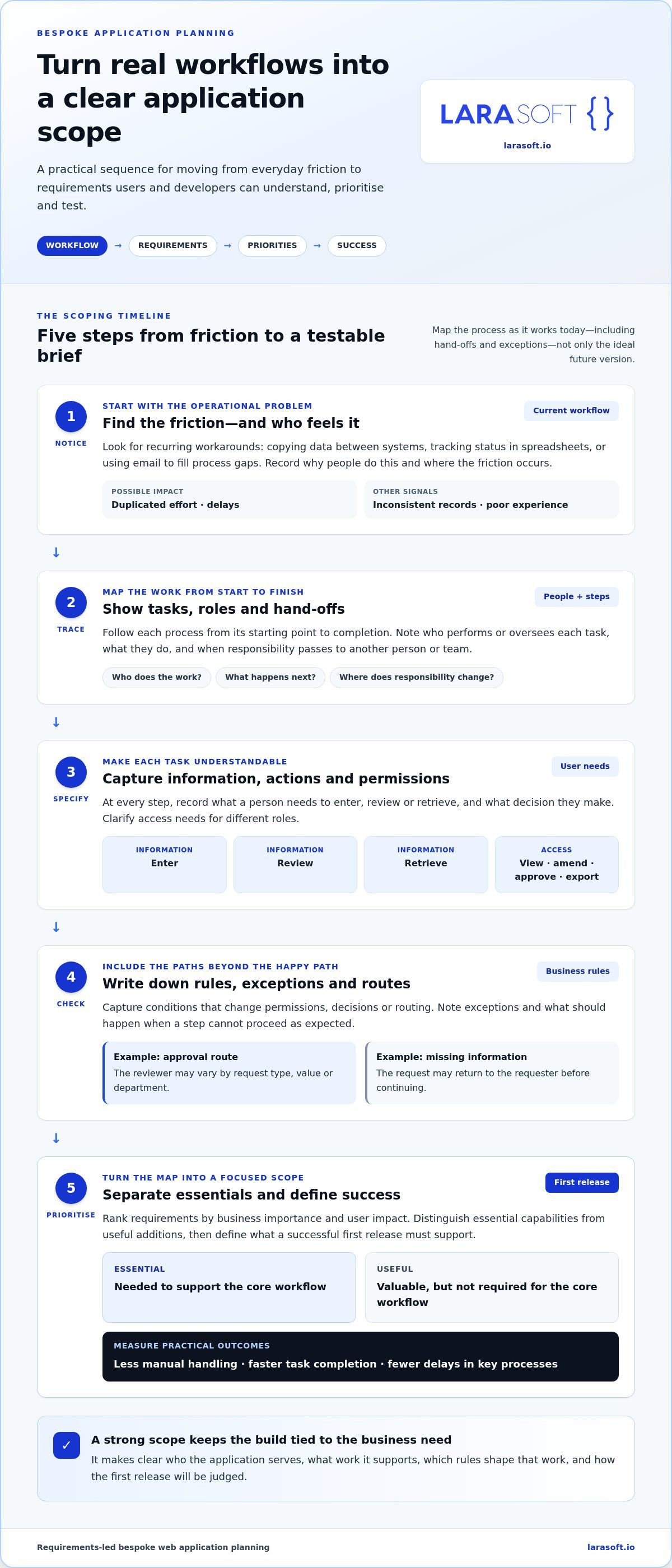
For bespoke web application development uk, map the workflow as it operates now, including exceptions and hand-offs, rather than describing only an ideal future system. A process map can show where information is entered twice, decisions stall or responsibility changes between teams. Those details help distinguish an application that fits real operations from one that simply digitises an incomplete process.
List each user role and follow the process from its starting point to completion. At each step, note what the person needs to enter, review or retrieve, what decision they make, and what happens next. Record permissions too: different users may need to view, amend, approve or export different information.
Then capture hand-offs and exceptions. In an approval workflow, for example, a request might go to a manager, return to the requester if information is missing, or follow a different route under a specific business rule. Mapping these paths exposes requirements before they become late changes.
Rank requirements by business importance and user impact. Separate essential capabilities from useful improvements, and note dependencies such as an existing system that must supply or receive data. This gives the team a reasoned basis for setting scope instead of treating every requested feature as equally urgent.
A first release should complete a meaningful workflow, not attempt to contain every future idea. Include the capabilities users need to carry out the core process safely and reliably. Defer enhancements that can be assessed after people have used the application, but keep essential business rules, permissions and data needs in scope.
Write user stories from each role’s perspective, then add acceptance criteria that describe observable behaviour. “Add approval functionality” is too broad. A testable criterion could specify that an authorised reviewer can approve or return a submitted request, and that the requester can see its resulting status. Set criteria to reflect the organisation’s actual rules.
Agree how success will be assessed before development begins. Measures might include time to complete a task, the number of manual hand-offs or how often requests need correction. Clear criteria also make review and sign-off more objective. For deeper lifecycle detail, a web application development process can help connect scoping with design, build and release planning.
Bring workflow knowledge and technical planning together early. A defined scope gives the team a practical basis for choosing an architecture, estimating effort and managing changes as the application develops.
Architecture determines how an application’s parts work together, how it exchanges information with other systems and how easily it can change. These decisions should follow the requirements, not a trend or technology preference. For bespoke web application development uk, a sound design balances the workflow the application must support with the practicalities of maintaining it over time.
A monolithic application keeps much of its core functionality in one coordinated system. That can suit an application with a focused purpose and a single main interface. An API-oriented approach separates functions behind defined interfaces, which can help when several applications or services need to exchange data. It also introduces more components and integration points to manage, so separation isn’t automatically an advantage.
Laravel can provide the backend, the part that applies business rules, manages data and handles requests. Vue.js or React can support a more interactive frontend when the user experience calls for it. A simpler interface may not need that additional layer. Consider workflow complexity, integration requirements, the skills available to maintain the code and the likelihood of future changes before selecting the stack. A strategic guide to choosing a Laravel development agency can help clarify the technical and delivery considerations involved.
For each proposed integration, map what information moves, in which direction, and which system owns the authoritative record. For example, an application might send approved information to another business system while reading selected records from it. Define what should happen if a service is unavailable, data is incomplete or an update fails. Clear boundaries reduce the risk of conflicting records and make errors easier to trace.
Security should shape the design. Plan how users authenticate, then give each role only the access its tasks require. Consider sensitive data throughout its journey: what the application collects, where it is stored, who can view it and how it is transferred. Test important permissions and failure paths, not only the expected user journey. Operational monitoring should help the team spot errors and integration failures so they can investigate and address them.
Assess UK GDPR requirements in the context of the personal data and processes involved in the application. Treat this as a design input, not a claim that a particular framework makes a system compliant. Give accessibility the same early attention: consider relevant WCAG guidance when defining interface behaviour, content structure, keyboard use and visual presentation, then include accessibility checks in testing. Leaving these considerations until launch can mean reworking core interactions.
Architecture, integrations and safeguards are connected decisions. Planning them together helps the application support its business purpose and gives the team a clearer foundation for testing, operation and future change.
A successful release is more than software that runs. It should meet the agreed requirements, be ready for its intended users and have a clear ownership plan. Assess delivery against evidence, not just demonstrations: can the team show how requirements were implemented, what has been tested and what your business needs to operate and maintain the application?
Use this checklist before release:
For bespoke web application development uk, making these checks part of delivery connects technical completion with practical business readiness. It also gives stakeholders a clearer basis for accepting the work and planning what comes next.
Before development, capture a baseline where practical. If the goal is to reduce manual handling, record how many steps or hand-offs the current process involves. If delays are the problem, track how long a task typically takes or where it waits. Choose a small set of measures tied directly to the business need. Collecting data without a decision in mind adds effort without clarifying value.
After launch, review the same measures alongside feedback from the people using the application. A process may involve fewer manual steps but still frustrate users at a particular point. Use that feedback to prioritise improvements. Avoid adding features simply because they’re possible; focus on changes that address observed friction or support a clear operational outcome.
Agree who is responsible for the code, deployments, dependency updates, monitoring and ongoing improvements. These responsibilities matter after launch, when software needs maintenance and the business may change its processes. An understandable architecture and maintainable code can make future adjustments easier to assess and deliver.
Documentation should explain important design decisions and how key parts of the application relate to one another. That context reduces the effort needed to investigate issues or make changes, particularly if the people working on the system change over time. For businesses dealing with older systems or difficult-to-change code, a legacy code modernisation strategic guide offers further perspective on planning for long-term change.
A structured technical assessment can clarify whether your scope, delivery evidence and ownership plan align with business priorities. Discuss your bespoke application requirements with Larasoft to explore the technical considerations and next steps.
Larasoft develops bespoke Laravel web applications for businesses across the UK, aligning the technical plan with defined operational requirements. The application is shaped around the workflows, users and business rules established during scoping, rather than treating a generic product as a fit for every process. This keeps decisions about the backend, interface and integrations tied to the job the application needs to do.
For organisations considering bespoke web application development uk, this joined-up approach connects requirements with delivery and long-term ownership. Laravel is the core web development capability, supported by Vue.js or React frontend development, API integration and software maintenance for the wider application.
Laravel provides the application backend: the part responsible for business logic, rules, data handling and the responses users see when they take an action. The frontend is planned around the experience the product requires. Vue.js or React can support interactive interfaces where users need responsive screens and dynamic interactions. The choice should follow the application’s needs rather than a technology trend.
Integration planning connects the application to relevant business systems. Larasoft’s API integration service can support defined data flows between a custom application and existing tools. Establish what information is exchanged, which system is responsible for it and how the application should behave if an exchange fails. These boundaries make integration part of the design rather than an afterthought.
Bringing these elements into one plan helps business and technical stakeholders understand how each part contributes to the intended workflow. A strategic guide to Vue.js frontend development can offer further context on how frontend choices relate to a modern application experience.
A custom build needs to be considered beyond the point where its features are complete. Testing should cover expected user journeys and important edge cases, while deployment readiness means preparing the application for release in a controlled, understandable way. Maintainable code and useful documentation give the organisation a foundation for future work as processes and requirements evolve.
Larasoft provides software maintenance to support applications after launch through ongoing technical care and planned changes. Dependency updates, issue investigation and improvements can help keep the system aligned with its purpose as the business develops. Ongoing ownership should be part of the delivery plan, not left as an undefined task for later.
Larasoft brings Laravel development, frontend capability, API integration and software maintenance together around your application requirements. To discuss your workflow, integration needs or next steps, talk with Larasoft about your application.
Start by making the challenge concrete. Identify the workflow that needs to change, who it affects and what a better outcome would look like. That gives your team a practical basis for evaluating bespoke web application development uk and deciding whether a tailored build supports your priorities.
From there, the technical plan can connect the application’s logic with the experience users need. Larasoft’s Laravel web application development can form the foundation, with Vue.js or React frontend development, API integration and software maintenance considered as parts of the wider solution. The right combination depends on your requirements and how you expect the application to evolve.
You don’t need every technical decision settled before taking the next step. A focused conversation about your workflow, existing systems and goals can help clarify which questions to resolve first and shape a sensible direction for the work.
Explore your application’s next steps with Larasoft to discuss a custom application built around your business needs.
It’s the design and development of software tailored to an organisation’s users, processes and rules. Unlike a standard website that mainly publishes information, a web application lets people complete tasks through a browser, such as submitting requests or managing records. The scope might include a staff workspace, a customer-facing portal or both. Its features and behaviour are shaped by the problem it needs to solve, rather than a fixed set of product options.
Choose a custom application when an important process can’t be handled cleanly by configuring existing tools, and the resulting workarounds create real operational friction. The case for bespoke web application development uk is stronger if that workflow supports a distinctive service or involves rules, roles or data exchanges that standard products don’t accommodate well. Before committing, compare the ongoing effort of workarounds with the effort of building, operating and evolving software designed for that process.
The cost depends on what the application must do and how it needs to fit into your organisation. A focused internal tool has different requirements from a multi-role platform with several integrations, complex data handling or a highly interactive interface. To make estimates meaningful, document the intended users, essential workflows, integration needs and launch priorities. Also consider ownership costs, including maintenance and future changes, rather than assessing the initial build in isolation.
There’s no reliable single timeframe without understanding the requirements. Delivery is affected by the number of workflows, how clearly decisions can be made, integration complexity, and the testing and review needed before release. A useful plan identifies dependencies early, such as access to existing systems or decisions about data. Prioritising a first release around a complete, valuable user journey can help the team focus without promising a date before the work is understood.
The stack depends on the application’s behaviour, interfaces and integration needs. Laravel is used for backend development, where application rules and data operations are handled. Vue.js or React can support interactive frontend experiences where the interface calls for them. Other technical choices may depend on existing systems and how the application will be maintained. Select technologies for their fit with the requirements and long-term ownership, rather than choosing a framework simply because it’s fashionable.
Build security into design, development and release practices. Use appropriate authentication and role-based access, protect sensitive information, test permissions and failure cases, and monitor for operational issues. Assess UK GDPR considerations against the personal data and processes involved, and include relevant accessibility needs in interface design and testing. Compliance depends on the application and its use, so technical safeguards should support a wider assessment rather than be treated as a guarantee of compliance.
Yes, an application can exchange information with existing systems through APIs when those systems support an appropriate connection. First establish which system owns each record, what data needs to move and what should happen if an exchange fails. For instance, an application may retrieve selected account information while sending completed transactions to another platform. Clear integration boundaries help avoid conflicting data and make errors easier to investigate. Integration requirements should shape the design from the start.
Here’s what we've been up to recently.
Certified Quality. Great Prices