Bespoke Mobile App Development London: A Strategic Guide


Most off-the-shelf software isn't an investment; it's a technical debt trap that limits your operational agility from day one. You've likely felt the friction of rigid platforms or perhaps you're anxious that poor-quality legacy code is quietly inflating your future costs. It's a common frustration for London's business leaders who need systems that adapt as quickly as the market does. This guide clarifies the strategic landscape of bespoke mobile app development London, providing a roadmap to transform mobile engineering into a high-yield business asset.
You'll discover how bespoke mobile engineering transforms business operations and learn the exact framework for choosing the right tech stack and development partner in 2026. We'll break down the nuances of native and cross-platform development while identifying the architectural decisions that ensure your application remains secure and scalable. We'll also examine how to identify a technical ally who prioritizes structural integrity and long-term ROI over quick, temporary fixes, ensuring your digital platform performs perfectly under pressure.
Bespoke development describes the process of engineering custom software from the ground up to align with specific business logic. It isn't just about applying a unique visual skin to an existing platform; it's about building structural integrity into every line of code. In 2026, the UK market is witnessing a decisive shift. Many organisations are pivoting away from the SaaS-heavy models that dominated the last decade, seeking instead the autonomy that comes with owned IP. By investing in bespoke mobile app development London, businesses are creating foundational assets that support long-term digital growth rather than renting temporary solutions.
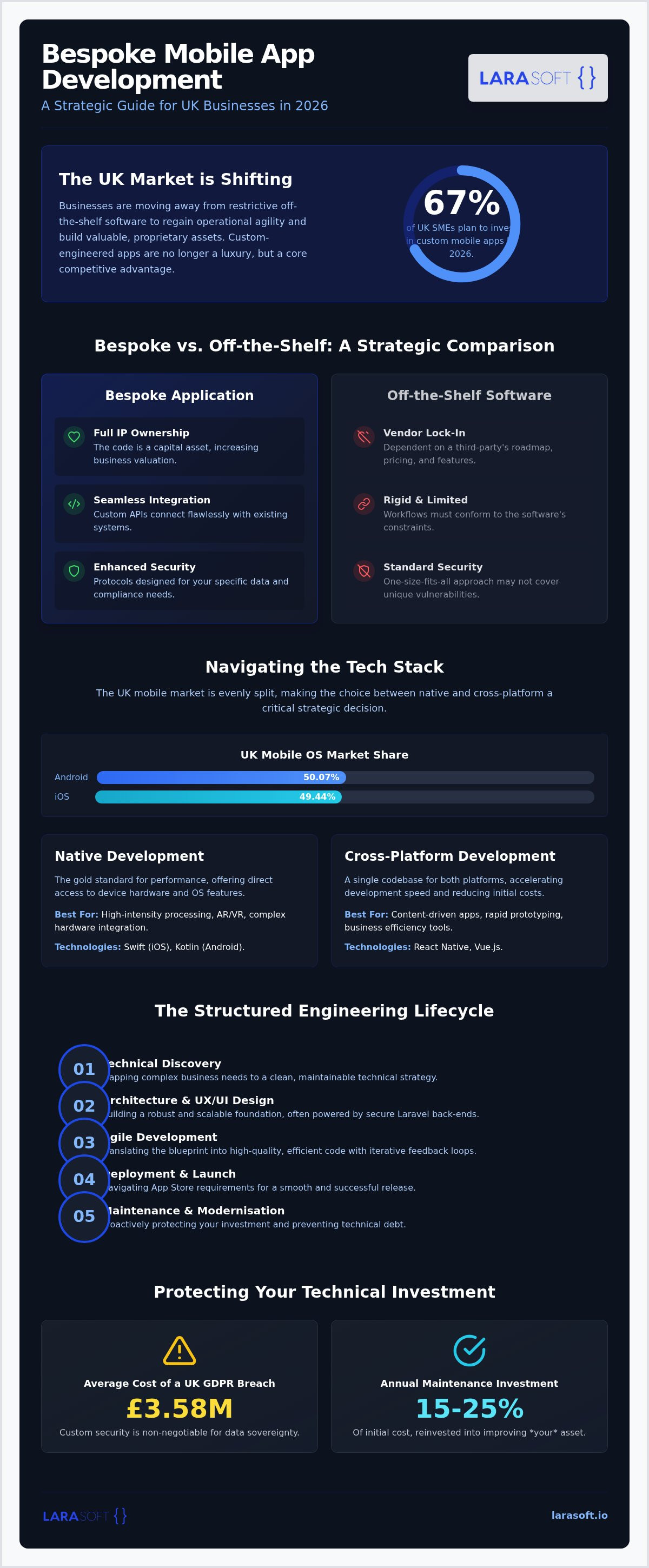
Custom mobile solutions act as a central pillar for operational efficiency. When software is built to match your exact internal processes, you eliminate the friction caused by trying to bend your workflows to fit a vendor's rigid framework. This shift toward high-performance, custom-engineered systems is reflected in the fact that 67% of UK SMEs plan to invest in mobile apps by 2026. They aren't just looking for an interface; they're looking for a scalable engine for their business.
The primary driver for custom engineering is the removal of recurring licensing fees and the trap of vendor lock-in. SaaS platforms often seem cost-effective initially, but as your user base grows or your requirements become more complex, those monthly costs scale aggressively. Bespoke development turns that expenditure into a capital asset. You own the code, you control the roadmap, and you decide when and how to scale.
Security and data sovereignty are also paramount. With the average cost of a UK GDPR breach reaching £3.58 million in 2024, controlling your data architecture isn't optional. Custom builds allow for the implementation of enhanced security protocols that are specifically designed for your data handling needs. This ensures full compliance with the UK Data Protection Act 2018 and the Online Safety Act 2023 from the very first deployment.
When comparing bespoke mobile app development London to off-the-shelf alternatives, you must evaluate the total cost of ownership over a five-year horizon. While off-the-shelf software has a lower entry price, it lacks the flexibility to integrate deeply with existing UK business systems or legacy databases. This often leads to "shadow IT" or manual workarounds that drain productivity.
Ultimately, an off-the-shelf product is a shared utility. A bespoke application is a competitive advantage. It allows you to tailor user journeys to match unique operational workflows that your competitors simply cannot replicate with a standard license.
Deciding on a technical architecture is the most critical pivot point in bespoke mobile app development London. With the UK market split almost evenly between Android (50.07%) and iOS (49.44%), your choice dictates both user experience and long-term maintenance overhead. It isn't just a matter of preference; it's a strategic calculation based on your specific business logic and performance requirements.
When an application requires deep integration with device hardware or handles high-intensity processing, native development remains the gold standard. By using Swift for iOS and Kotlin for Android, engineers gain direct access to platform-specific features without the abstraction layers that can occasionally introduce latency. This approach ensures your software can fully leverage the latest OS capabilities, such as those found in iOS 26.6 or Android 17.
Native code is often non-negotiable for enterprise apps that rely on complex biometric data, real-time sensor monitoring, or extensive AR/VR capabilities. These builds offer the highest level of long-term stability. They receive direct support from Apple and Google, ensuring that your application remains functional through major system updates. While the initial investment is higher, the structural integrity of a native app provides a reliable foundation for businesses with high-performance demands.
For many business use cases, cross-platform frameworks like React Native and Flutter have evolved to provide near-native performance. These tools allow for a "single codebase" approach, which can reduce development and maintenance costs by 30% to 40% compared to building two separate native apps. This efficiency doesn't require a compromise on quality; modern frameworks now offer fluid transitions and high-fidelity interfaces that are indistinguishable from native apps for most users.
The role of React and Vue.js in this ecosystem is significant. These frontend technologies allow for a unified development experience across web and mobile platforms. When paired with an API-first architecture, your mobile front-end communicates seamlessly with a robust back-end. This synergy ensures that your data remains consistent across all touchpoints, whether a user is on a desktop or a smartphone. If you're looking to balance speed to market with high-quality execution, exploring bespoke mobile engineering with a technical ally can provide the clarity needed to choose the right path.
Ultimately, the tech stack should serve the business goal. A well-architected API allows your mobile application to act as a lightweight, high-performance portal into your core business logic. Whether you choose the raw power of native code or the streamlined efficiency of a cross-platform solution, the focus must remain on building a secure, scalable platform that delivers a clear ROI through improved operational efficiency.
Engineering a mobile platform requires more than just coding; it demands a disciplined lifecycle that bridges the gap between business objectives and technical execution. At the heart of successful bespoke mobile app development London is a methodology designed to mitigate project risk through transparency and rigorous validation. By treating the development process as a structured journey, you ensure that the final product isn't just functional but is also built on a maintainable, high-performance foundation. This lifecycle transforms an abstract concept into a reliable business asset that can scale alongside your organisation.
A structured approach prevents the common pitfalls of feature creep and architectural debt. It ensures that every technical decision, from database schema design to frontend state management, serves a specific operational requirement. This level of precision is what separates a professional engineering project from a generic software build.
The journey begins with technical discovery, where we map your specific business logic to a scalable architecture. This phase defines the Minimum Viable Product (MVP), a strategy that 67% of UK SMEs are adopting in 2026 to accelerate time-to-market. By focusing on core features first, you validate your concept with real users before committing to a full-scale enterprise build. We create wireframes that strictly adhere to UK user accessibility standards, ensuring the interface is intuitive for a British audience that spends an average of 4-5 hours daily on mobile devices. Crucially, this stage establishes the API architecture, creating a secure conduit for data flow between your mobile front-end and back-end systems, often powered by robust Laravel frameworks.
Once the architecture is set, we move into iterative development using Agile methodology. This approach allows for continuous feedback and ensures the project remains aligned with your evolving needs. Our engineers write clean code using modern frameworks, supported by Continuous Integration (CI) and Deployment (CD) pipelines. This automation ensures that every code change is tested and verified before it reaches your users, maintaining the structural integrity of the application throughout the build.
Quality assurance is exhaustive, testing stability across diverse mobile hardware running iOS 26.6 and Android 17. We also navigate the increasingly complex regulatory environment, ensuring compliance with the Online Safety Act 2023 and the latest CMA guidelines for app store submissions. Successfully launching on the Apple App Store and Google Play Store requires more than just a finished file; it requires a deep understanding of store-specific steering conduct requirements to ensure a smooth approval process and long-term availability.
Launching your application is a milestone, not the finish line. In the context of bespoke mobile app development London, the most resilient projects are those that treat software as a living asset rather than a static product. Technical debt accumulates when codebases aren't updated to match evolving security standards or OS requirements. Proactive management ensures your platform remains performant and secure against modern threats, preventing the software rot that can quietly devalue your technical investment over time.
A strategic approach to maintenance involves more than just reactive bug fixes. It requires a deep understanding of how your mobile front-end interacts with your core business logic. By establishing a long-term technical partnership, you ensure that your application evolves alongside your business, rather than becoming a rigid constraint that limits your growth.
Maintenance is a vital component of a healthy digital lifecycle. Annual app maintenance typically requires an investment of 15% to 25% of the initial development cost. This covers critical security patching and OS compatibility updates for the latest versions, such as iOS 26.6 and Android 17. We focus on performance monitoring and database query optimisation to ensure your application remains fast even as user demand scales. This steady rhythm of updates ensures that your infrastructure is always ready to support growing traffic and new feature deployments.
A major barrier to mobile innovation is often the existing infrastructure. Many UK enterprises rely on aging ERP or CRM systems that weren't designed for modern, API-first architectures. Through legacy code modernisation, we refactor these old codebases to support high-performance mobile front-ends. This process often includes implementing Laravel AI solutions to automate legacy workflows, turning a technical burden into a competitive advantage.
Ignoring technical debt in a mobile-first economy is a significant risk. Systems that aren't modernised become increasingly expensive to support and difficult to secure. By integrating your mobile app with legacy databases through custom API layers, you create fluid transitions between old data and new user experiences. If you're ready to secure your technical future, you can partner with our engineering team to audit your current architecture and ensure your bespoke mobile app development London investment remains a foundational asset for years to come.
The true measure of a successful mobile project isn't the launch date; it's the application's performance eighteen months later. Realising a genuine return on investment requires a partner who understands that code is a foundational business asset, not a disposable product. Choosing a Laravel development agency provides the architectural backbone your mobile front-end needs to handle complex data and high user volumes. This back-end stability ensures that as your user base grows, your system remains responsive and secure.
Our approach to bespoke mobile app development London focuses on creating a unified digital ecosystem where technical authority meets business partnership. We don't just build apps in isolation. We look at the synergy between your custom web applications and your mobile solutions, ensuring data flows effortlessly between platforms. To drive organic growth and ensure your investment reaches its target audience, we also integrate specialized SEO services directly into the broader app ecosystem.
This focus on digital presence extends to the professionals driving these projects; many use LYNKP to build a career identity that is as polished and performant as the bespoke software they help create.
We provide direct access to senior UK developers and technical architects who take pride in the cleanliness and efficiency of their work. This isn't a factory model; it's a collaborative engineering process. You'll benefit from transparent project management and results-oriented communication that keeps you informed at every sprint. We prioritise long-term scalability over quick-fix products, building systems that are designed to perform perfectly under pressure. This commitment to structural integrity means your software won't just work today; it'll be ready for the hardware and regulatory shifts of 2027 and beyond.
Moving from a vision to a functional platform starts with a clear understanding of your current technical landscape. If you're managing aging software, we can initiate a comprehensive technical audit to identify bottlenecks and security risks. This audit forms the basis of your mobile roadmap for the upcoming fiscal year, allowing you to plan your investment with precision. We help you map out every phase of bespoke mobile app development London, from initial discovery to final deployment and ongoing maintenance.
Ready to transform your operational efficiency with a custom-engineered solution? Our team is prepared to help you navigate the complexities of modern mobile architecture and build a platform that drives measurable business growth. Request a consultation for your bespoke mobile project today and secure a technical ally for your long-term success.
Building a mobile platform represents a fundamental shift from renting software to owning a high-value competitive asset. Success in the current landscape requires more than just a functional interface; it demands structural integrity, a robust back-end, and a clear lifecycle strategy for maintenance. We've explored how a disciplined engineering process turns complex business logic into scalable, secure code.
Investing in bespoke mobile app development London ensures your organisation isn't held back by rigid SaaS models or decaying legacy systems. Larasoft provides a UK-based senior engineering team specializing in Laravel and modern front-end frameworks. With a proven track record in legacy code modernisation, we act as a dedicated technical ally rather than a one-off vendor. We're committed to building systems that perform perfectly under pressure and scale with your vision.
Partner with Larasoft for Expert Bespoke Mobile Development
Your journey toward a more agile and performant digital future starts with a strategic architectural decision. We're ready to help you turn that vision into a lasting foundational asset.
The total investment for bespoke mobile app development London depends on the complexity of your business logic and the required integrations. Factors such as whether you choose a native or cross-platform architecture and the need for legacy system connectivity influence the final budget. We focus on providing a transparent breakdown during the discovery phase to ensure your technical roadmap aligns with your expected business returns.
Project timelines generally span between three and nine months, influenced by the scope of the discovery phase and technical complexity. An initial MVP can often be launched more quickly to gather user feedback. More extensive enterprise platforms requiring deep database refactoring or complex AI features naturally take longer to ensure every component meets our standards for structural integrity and performance.
Select native development for high-intensity apps requiring direct hardware access, or choose cross-platform frameworks like React Native for improved development efficiency. React Native allows for a single codebase that serves both iOS and Android platforms. This often results in a 30% to 40% reduction in maintenance costs while delivering a user experience that remains indistinguishable from platform-specific native applications.
We frequently integrate new mobile solutions with existing legacy software by refactoring old codebases and implementing custom API layers. This modernization process ensures that your aging ERP or CRM systems can communicate securely with modern mobile interfaces. It prevents your existing infrastructure from becoming a bottleneck, allowing you to unlock new operational efficiencies without a total system replacement.
Mobile applications are platform-specific software installed on a device, whereas web applications are accessed via a browser. Mobile apps offer better performance, offline access, and deeper integration with device features like the camera or biometrics. The decision depends on your specific use case and whether your target audience requires the high-fidelity experience and hardware access that only an app provides.
Our team handles the entire deployment process, ensuring your app meets all regulatory and technical requirements for the Apple App Store and Google Play Store. We navigate complex guidelines, including the Online Safety Act 2023 and CMA conduct requirements. By managing these technical hurdles, we ensure your application reaches your users without unnecessary delays or rejections during the review phase.
Maintenance includes essential security patches, performance optimizations, and compatibility updates for the latest operating systems like iOS 26.6 and Android 17. It's a continuous process that prevents technical debt and software rot. By treating your application as a living asset, you ensure it remains secure and performant as user demands grow and mobile hardware continues to evolve.
Laravel is a premier choice for mobile back-ends because it offers a secure, expressive framework for building robust APIs. It handles complex data structures and user authentication with high efficiency. Many organisations choose this path for their bespoke mobile app development London projects to ensure long-term scalability and fluid integration with other web-based business systems.
Here’s what we've been up to recently.
Certified Quality. Great Prices