The Ultimate Software Maintenance Agreement Checklist for 2026

Did you know that software maintenance can account for as much as 90% of your total application expenses over its lifetime? It's a staggering figure that highlights why a robust software maintenance agreement checklist is no longer a luxury for 2026. Most decision-makers view the initial build as the finish line; however, the reality is that your custom software is a living asset that requires disciplined governance. Without a clear framework, you're likely facing unpredictable downtime and the constant friction of distinguishing a critical bug from a standard feature request.
We understand the frustration of watching support costs climb while security vulnerabilities linger in your legacy code. This article provides a comprehensive framework to safeguard your technical investments, ensuring your systems remain resilient under the pressure of modern regulations like DORA and NIST CSF 2.0. You'll learn how to define precise service standards, secure guaranteed response times, and establish a roadmap for long-term stability. We'll break down the essential clauses that turn a standard contract into a strategic partnership, providing the predictability and high-quality execution your business requires to scale.
A software maintenance agreement is a formal contract between your business and a technical partner that ensures your application remains functional, secure, and compatible. It's the structural foundation for any custom-built platform. While many decision-makers view the launch of a product as the final milestone, it's actually the beginning of a long-term operational journey. Without a structured agreement, your software is left to age in a rapidly evolving digital environment, leading to performance degradation and security risks.
It's vital to distinguish this service from managed IT infrastructure support. Managed IT typically handles hardware, server uptime, and network connectivity. In contrast, software maintenance focuses exclusively on the health of the application's codebase. For businesses relying on bespoke applications built with frameworks like Laravel or React, this distinction is crucial. Off-the-shelf software receives global updates from a vendor; your custom code requires a dedicated software maintenance agreement checklist to ensure unique business logic and third-party integrations don't break as the web changes.
Neglect leads to technical debt. This isn't just a technical nuisance; it's a financial liability. As code becomes outdated, the cost to implement new features or fix vulnerabilities increases exponentially. A well-defined maintenance plan prevents this accumulation, transforming your software from a depreciating asset into a scalable engine for growth.
Effective maintenance isn't a singular task. It's a multi-faceted discipline that addresses different aspects of system health:
Many organizations mistakenly believe that a development warranty provides sufficient protection. A standard warranty typically covers "bugs" for a short period after launch, ensuring the product works exactly as specified on the day it was delivered. However, a warranty doesn't account for the external changes that occur six months later. It won't cover a security patch for a newly discovered vulnerability or an update required by a change in UK privacy laws.
The transition from the build phase to the support phase marks a shift in priorities. You move from rapid innovation to disciplined stability. A comprehensive software maintenance agreement checklist bridges this gap by defining exactly how the partnership evolves once the initial project concludes. Maintenance is a proactive commitment to future-proofing your system, whereas a warranty is a reactive fix for past errors.
A robust software maintenance agreement checklist serves as the blueprint for your application’s operational integrity. It begins with a granular definition of the scope of services. You must clearly delineate between maintenance tasks, which keep the platform running, and new feature development. For instance, updating a Laravel dependency to patch a security flaw is maintenance; adding a new reporting dashboard is a separate project. Without this distinction, your support budget will quickly vanish into scope creep.
Security management is the next non-negotiable item. In 2026, a "best efforts" approach is insufficient for protecting custom code. Your agreement should specify the frequency of vulnerability scanning and the timeline for deploying critical patches. When managing custom codebases, error correction must be categorized by severity. Critical issues affecting core business functions require immediate intervention, while low priority aesthetic bugs follow a standard release cycle. Clear documentation through maintenance logs ensures that every change is tracked, providing a transparent audit trail for your internal stakeholders. Finally, ensure your contract explicitly states that you retain ownership of all custom code updates and patches. Intellectual Property (IP) rights must remain with the client to protect the value of the asset.
Bespoke applications demand deeper technical oversight than generic software. This includes mandatory framework updates for environments like Laravel or React to mitigate security risks and leverage performance improvements. Regular database optimization is equally vital; query tuning prevents the slow-motion performance degradation that often plagues aging systems. Proactive API integration monitoring ensures that third-party connections don't fail silently. This level of detail is a hallmark of a comprehensive software contract checklist, ensuring all technical bases are covered.
Beyond the code, your agreement must protect your business interests. Termination clauses should outline a clear transition path, ensuring you aren't "locked in" and can migrate to a new provider without losing access to your codebase. Regarding payment, consider whether a retainer-based model or ad-hoc billing better suits your risk profile. Retainers often guarantee availability for mission-critical systems. If you're looking for a partner to manage these complexities, our team provides tailored software maintenance services designed for long-term scalability.
The success of any software maintenance agreement checklist hinges on how you define performance. It isn't enough to promise that a developer will "fix bugs." You need measurable, enforceable benchmarks that align with your operational needs. A Service Level Agreement (SLA) acts as the heartbeat of your contract, providing the transparency required to manage a long-term technical partnership. With software renewal costs increasing by an average of 11.4% since 2024, ensuring you receive high-quality, timely support is essential for maintaining a positive return on investment.
A common point of friction is the confusion between response time and resolution time. Response time is merely the period in which a developer acknowledges your ticket and assigns a resource. Resolution time, however, is the window in which the actual fix is deployed. Your agreement must specify both. While a response might happen within two hours, the resolution for a complex logic error in a custom Laravel application may take significantly longer. Defining these separately prevents the frustration of receiving a quick "we're looking at it" without a clear timeline for a solution.
To enforce these times effectively, you must establish clear severity levels. We typically categorize issues into three tiers:
Consequences for SLA breaches are equally important. Service credits, where a percentage of the monthly fee is refunded if targets are missed, provide a financial incentive for the provider to maintain high standards. These credits should be paired with clear escalation paths that allow you to move the issue up the chain of command if a resolution stalls.
Instant fixes are often a myth in complex custom software environments. Unlike off-the-shelf products, a change in one area of a bespoke codebase can have ripple effects across the entire system. Every patch requires rigorous regression testing to ensure stability. Align your SLA tiers with your core business hours and critical operations to ensure support is available when your traffic is at its peak. Automated monitoring tools play a vital role here, providing objective data to verify whether your partner is meeting their contractual obligations.
When a critical failure occurs, you cannot afford to wait in a generic support queue. A well-structured agreement defines a clear chain of command, starting with the lead developer and moving up to technical directors if necessary. A dedicated account manager acts as your strategic ally, translating technical progress into business-centric updates. Establishing a clear escalation path reduces business anxiety during downtime by ensuring you always know exactly who is accountable for your system's recovery.
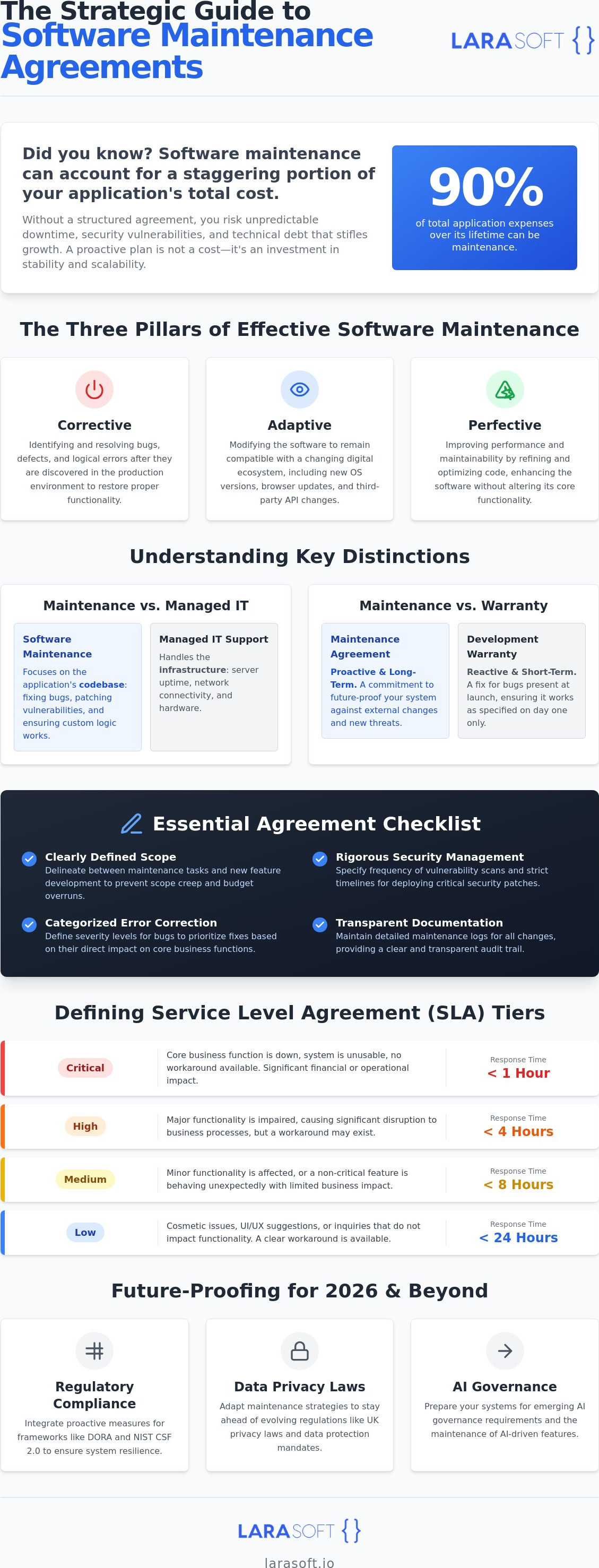
By 2026, the technical environment has shifted toward greater regulatory scrutiny and the ubiquity of intelligent systems. Your software maintenance agreement checklist must evolve to address these modern complexities. It's no longer sufficient to focus on uptime alone. You must now ensure that maintenance activities strictly comply with UK privacy laws and the latest GDPR requirements. This involves more than just secure data handling; it requires a proactive approach to how developers access production environments and manage sensitive information during routine updates.
The rise of artificial intelligence introduces a new maintenance category: AI Integrity. If your platform utilizes Laravel AI integrations, your agreement should include provisions for monitoring model drift and performance decay. AI models require regular tuning to ensure they remain accurate and unbiased as new data enters the system. Neglecting this leads to a gradual loss of utility and potential business risk. Similarly, your agreement must define a specific protocol for zero-day exploit responses. When a critical vulnerability is discovered in a common library, your technical partner needs a pre-approved mandate to act immediately, bypassing the usual ticket queues.
Reliability also depends on your backup and disaster recovery strategy. Effective maintenance doesn't just involve creating backups; it requires regular, documented restore tests. Verifying that a backup actually works is the only way to guarantee business continuity during a catastrophic failure. If you need a partner who understands these high-stakes requirements, explore our software maintenance solutions to protect your digital infrastructure.
Custom-built applications face unique risks in the software supply chain. Regular security audits are essential to identify vulnerabilities within third-party dependencies before they are exploited. This is particularly critical during legacy code modernisation, where older systems are integrated with modern frameworks. Every update must be handled with precision to maintain the structural integrity of the codebase. Managing these dependencies requires a disciplined approach to versioning and a deep understanding of the underlying architecture.
Your frontend must remain accessible to all users to comply with evolving WCAG standards. Maintenance plans should include periodic accessibility audits and updates to ensure your interface remains inclusive. Beyond accessibility, stay ahead of regulatory changes in UK software laws that may dictate how data is processed or stored. Finally, consider sustainability. Optimizing code performance isn't just about speed; it reduces server energy consumption, aligning your technical operations with modern corporate social responsibility goals.
At Larasoft, we view every line of code as a foundational asset for your business's future. We don't just react to failures; we provide a proactive framework that ensures your digital platforms perform perfectly under pressure. While a software maintenance agreement checklist provides the necessary structure, the value of the partnership lies in the execution. Our team operates as a deeply invested technical ally, applying a disciplined approach to system health that transforms complex development processes into a manageable journey toward growth.
Our specialized expertise anchors our identity as technical artisans. We focus on high-performance environments, providing dedicated support for Laravel Web Development, Vue.js, and React frontends. This deep architectural knowledge allows us to handle more than just routine patches. We excel at Legacy Code Modernisation, bridging the gap between aging systems and modern performance standards. By prioritizing structural integrity and clean code, we ensure your software remains scalable and secure as your business evolves.
Generic support desks often struggle with the nuances of custom-built applications. They lack the specialized insight required to understand how a change in a specific API integration might affect your entire ecosystem. We provide a different level of service. Our team integrates SEO Services and performance monitoring directly into our maintenance workflows. This ensures that your site isn't just "up," but is also optimized for search visibility and user experience. We take immense pride in the efficiency of our work, delivering transparent reporting from our UK-based technical team so you're always informed of your system's status.
Protecting your software assets requires immediate, strategic action. The first step is often a comprehensive technical audit of your current codebase to identify hidden vulnerabilities or performance bottlenecks. From there, we work with you to draft a software maintenance agreement checklist that aligns specifically with your commercial goals and risk profile. Whether you need to maintain a complex Laravel application or modernize a legacy mobile platform, we're ready to help. Contact us today to discuss a bespoke maintenance plan that secures your technology for 2026 and beyond.
Your custom software is the engine of your business operations. A robust software maintenance agreement checklist is the difference between a system that degrades and one that scales. By establishing clear SLAs and addressing modern security requirements like AI integrity and zero-day response protocols, you transform your codebase into a resilient, long-term asset. This proactive approach eliminates the friction of unpredictable downtime and provides the cost predictability necessary for strategic planning.
Larasoft provides the high-quality execution your business requires to thrive in 2026. As specialists in Laravel and bespoke web applications, our UK-based technical team understands the nuances of custom code management. We offer the specialized expertise needed for both high-performance modern platforms and complex legacy code modernisation. Our goal is to ensure your systems perform perfectly under pressure while maintaining the highest standards of security and compliance.
Secure your software’s future with a Larasoft maintenance plan. We're ready to act as your dedicated technical ally, ensuring your systems remain a foundational asset for years to come.
A warranty is a reactive guarantee that the software functions as specified at launch, typically lasting between three and twelve months. In contrast, software maintenance is a proactive service that keeps the application compatible with evolving browsers and security standards. While a warranty covers past development errors, maintenance ensures the system's longevity by adapting to future technical changes and environmental shifts.
Industry benchmarks indicate that annual maintenance costs typically range between 15% and 25% of the initial development expenditure. Systems in high-compliance environments or those relying on legacy code often sit at the higher end of this scale. With software renewal costs increasing by an average of 11.4% since 2024, budgeting for these structured services is essential for predictable financial planning and long-term stability.
Standard maintenance agreements focus on stability and security rather than new functionality. A professional software maintenance agreement checklist usually categorizes new features as separate development projects with their own scope and budget. Maintenance is intended to preserve the existing value of the asset through bug fixes, security patches, and minor performance optimizations that don't alter the core business logic.
Legacy systems require a specialized approach focused on modernisation and technical debt reduction. Maintenance for an older Laravel version involves patching known vulnerabilities and ensuring compatibility with modern server environments until a full framework upgrade is feasible. We specialize in legacy code modernisation, helping businesses transition older platforms into secure, modern architectures without disrupting daily operations or losing critical data.
There is no universal law requiring these agreements, but specific regulations like GDPR and the Digital Operational Resilience Act (DORA) make them a practical necessity. These laws require businesses to maintain high levels of data security and operational resilience. Failing to have a structured maintenance plan can lead to compliance failures and significant fines if a security breach occurs due to unpatched software vulnerabilities.
Success is measured through objective technical metrics and strict adherence to Service Level Agreements (SLAs). Key indicators include system uptime, average resolution times for critical bugs, and the frequency of successful security deployments. A successful plan results in a stable environment where technical debt remains low and the application continues to perform perfectly under the pressure of increasing user traffic and evolving search engine requirements.
You can transition to a different provider if your agreement includes clear termination and code handover clauses. Ensuring you retain full Intellectual Property (IP) rights to all custom code updates is vital for a smooth transition. A professional partner should provide a structured exit path, ensuring your new agency has the documentation and access needed to maintain the system's structural integrity without service interruption.
Regular maintenance directly supports your SEO strategy by optimizing core web vitals and ensuring technical health. It addresses performance bottlenecks that slow down page speeds and ensures the frontend remains compatible with the latest mobile devices. By keeping the codebase clean and the security protocols current, maintenance helps prevent the ranking drops associated with slow, insecure, or functionally broken web applications.
Here’s what we've been up to recently.
Certified Quality. Great Prices