Downsides of Using AI with Laravel: What to Watch For

Did you know that 92% of AI-generated codebases analyzed by Sherlock Forensics in early 2026 contained at least one critical security vulnerability? As Laravel 13 pushes the boundaries of PHP 8.3, the temptation to automate complex logic with tools like LaraCopilot is at an all-time high. However, the downsides of using AI with laravel often manifest as "vibe coding" debt, where rapid output masks deep-seated architectural erosion. You aren't just looking for a faster way to write syntax. You're looking to build a foundational asset that performs perfectly under pressure.
We understand the pressure to deliver features at the speed of an LLM prompt, yet we also recognize the valid fear of inheriting a "spaghetti" codebase that no human developer can safely maintain. This article reveals the hidden structural and security risks of over-relying on AI agents in your development workflow. You'll discover how to balance automated efficiency with human expertise. We will provide a clear framework for safe integration, ensuring your application remains compliant with the EU AI Act and the NIS2 Directive while maintaining the clean, elegant architecture your business demands.
The release of Laravel 13.x has solidified a new era where AI-assisted software development is no longer an experiment but a baseline expectation. Tools like Laravel Boost and specialized assistants are designed to accelerate the repetitive aspects of coding, such as generating migrations, basic controllers, and boilerplate tests. This promise of instant output is seductive for businesses aiming for rapid growth. Yet, we are witnessing the emergence of a "Productivity Paradox." While initial development speed might skyrocket, the cumulative time spent debugging AI-generated logic often outweighs those early gains. The downsides of using AI with laravel become apparent when the framework's opinionated structure meets the generic, context-free suggestions of a large language model.
Laravel is built on the concept of "Artisan" craftsmanship. Every line of code serves a specific architectural purpose, adhering to strict conventions that ensure long-term maintainability. AI agents often prioritize functional correctness over these framework standards. They might provide a working solution that bypasses Laravel's built-in security features or ignores the Service Layer entirely, leading to bloated models. This tension shifts the developer's role from a creator of logic to a supervisor of automated agents. It's a transition that requires high-level seniority to manage effectively, as the risk of "vibe coding" can quickly turn a clean installation into a legacy system before it even launches.
The workflow has evolved significantly with the introduction of the Model Context Protocol (MCP) and tools like Claude Code. We've moved past simple "Copilots" that suggest the next line of code toward "Agents" that can execute entire tasks across a codebase. In the UK market, this has led to a surge in AI-driven legacy modernisation projects. Companies are using these agents to refactor ancient PHP systems into modern Laravel 13 environments. While efficient, this process often lacks the nuance required for high-stakes business logic. Without a human-first architectural blueprint, these agents can introduce structural integrity issues that are difficult to untangle later.
AI struggles with the "invisible" parts of your business. It doesn't understand the specific domain context that isn't explicitly defined in your current file. This leads to the "Hallucination" risk, particularly within complex Eloquent relationships. An agent might confidently suggest a relationship that doesn't exist or ignore custom global scopes that protect sensitive data. The downsides of using AI with laravel are most visible here; the "magic" of automation fails to account for the unique, bespoke requirements of a custom-built enterprise platform. True architectural longevity still requires the human intentionality that algorithms cannot replicate.
Laravel is an opinionated framework for a reason. Its conventions provide a roadmap for scalability, security, and developer happiness. When teams rely too heavily on automated prompts, they often fall into the "Copy-Paste" anti-pattern. Instead of abstracting logic into reusable traits, components, or classes, AI typically duplicates code blocks across multiple files. It prioritizes immediate function over structural health. This is one of the significant downsides of using AI with laravel; you trade long-term maintainability for a few minutes of saved typing. When an AI completes a task, it doesn't look back to see if it could have refactored existing code. It simply writes what is requested in the moment, leading to a fragmented codebase where the same logic exists in various places with slight, AI-introduced variations.
Laravel's expressive syntax is its hallmark, making code feel like a conversation between developers. AI-generated code often lacks this nuance. It produces functional blocks that look correct but feel robotic and difficult for human teams to scan quickly. This lack of readability becomes a liability during code reviews and future updates. Similarly, AI-generated tests often provide a dangerous false sense of security. They typically test the "happy path" the AI just wrote, ignoring the complex edge cases that lead to production failures. Recent research on AI code security highlights how these automated shortcuts frequently miss underlying vulnerabilities in the application's structure, leaving your platform exposed despite a "green" test suite.
AI agents naturally gravitate toward "fat controllers" and bloated models. Because an LLM processes context in a linear fashion, it's simpler for the tool to dump business logic directly into the entry point rather than architecting a clean service abstraction. This blurring of boundaries makes scaling nearly impossible. When your architectural boundaries erode, even a routine legacy code modernisation becomes a nightmare of untangling interdependent logic. Maintaining a separate service layer requires a level of foresight that current agents don't possess. If your project is suffering from architectural drift, our experts in Laravel Web Development can help restore structural integrity.
AI builds the "mathematical average" of the internet's code. This leads to a risk of "Genericism," where every application looks and performs like a basic template. While standardisation is helpful for boilerplate, it can stifle unique technical solutions that give your platform a competitive edge. The downsides of using AI with laravel include this subtle loss of the "Artisan" spirit. The framework's elegant helpers and syntactic sugar are often bypassed for more generic PHP patterns that the AI is more familiar with from its broader training data. True innovation comes from solving problems that haven't been solved a million times before, a task that still requires a human developer's creative intuition and deep framework knowledge.
Laravel’s built-in security features, such as CSRF protection and Eloquent’s parameter binding, provide a robust foundation. However, AI often bypasses logic-level security. A common failure is the introduction of Insecure Direct Object References (IDOR) in API endpoints. An AI agent might generate a route that fetches a record by ID without verifying if the authenticated user has permission to access that specific resource. This is one of the most critical downsides of using AI with laravel; the code looks functional and passes basic tests, but it creates a massive data leak in production. The AI understands the syntax of a query, but it lacks the context of your specific authorization policies.
Data privacy is equally concerning. Developers often inadvertently include sensitive environment variables, API keys, or proprietary business logic in prompts sent to external LLMs. If these models aren't hosted within UK or EU data jurisdictions, you risk violating UK GDPR requirements regarding data sovereignty. The liability for any resulting breach rests solely with the business, not the AI provider. This creates an "Obscurity" problem where vulnerabilities are buried deep within thousands of lines of rapidly generated code that no human has fully audited. When code is produced at a rate that exceeds a team's ability to review it, security debt accumulates faster than it can be managed.
As we integrate AI agents directly into Laravel applications via tools like the Model Context Protocol (MCP), new attack vectors emerge. A malicious user could potentially use prompt injection to trick an integrated agent into performing unauthorized database actions or revealing system architecture. Securing these agents requires strict guardrails and a "Human-in-the-loop" approach. Every pull request containing AI-generated logic must undergo a rigorous security audit. You cannot assume that because an agent has access to your database schema, it will interact with it safely or follow the Principle of Least Privilege.
Operating within the UK regulatory environment means you must be certain where your application logic is being processed. Using non-UK hosted LLMs for processing sensitive application data can lead to significant compliance failures. We believe that proactive software maintenance must now include specialized security patching for AI-written code. It is no longer enough to update dependencies; you must also verify that the logic itself hasn't drifted into insecure patterns. Maintaining this level of oversight is essential for businesses that value long-term reliability and data integrity over short-term speed gains.
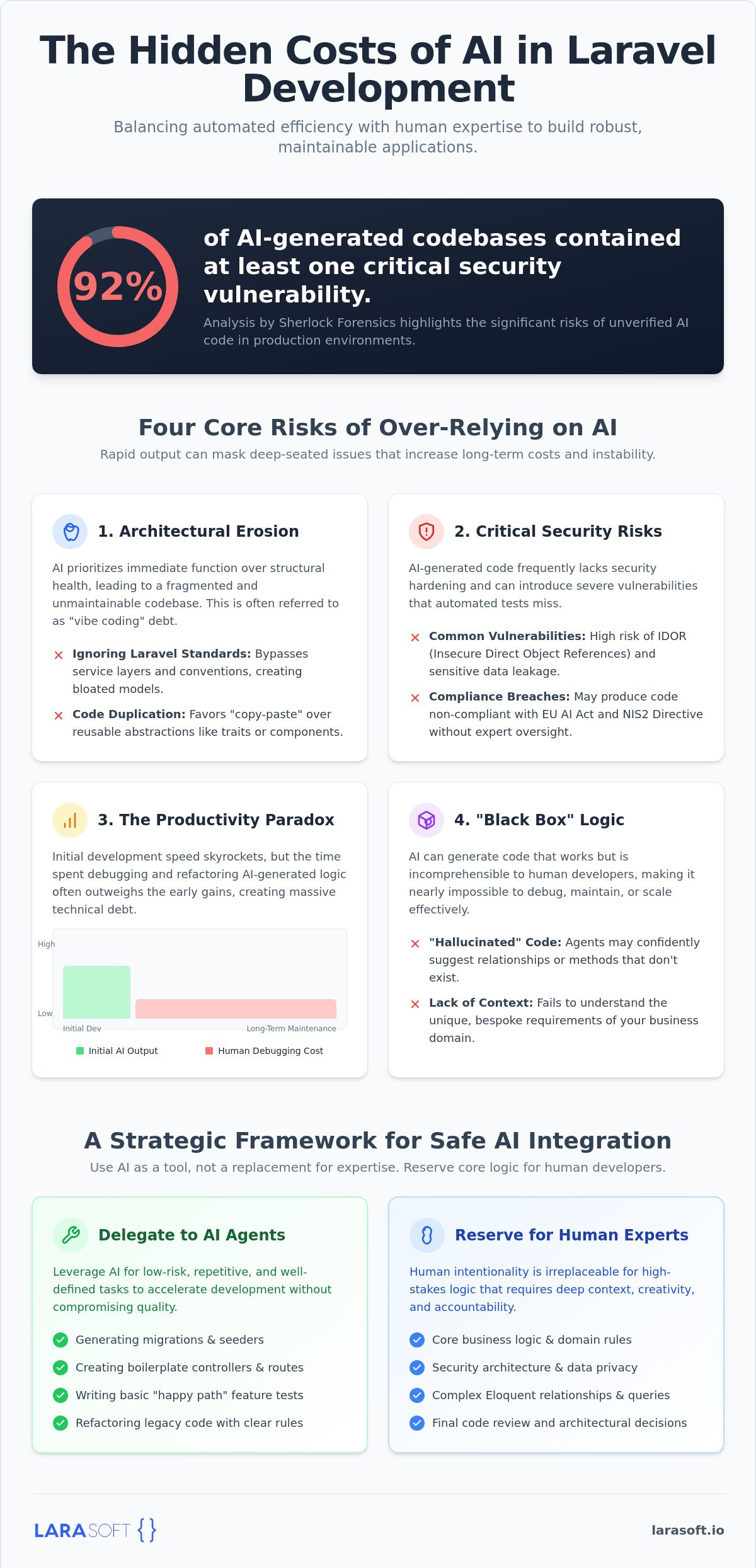
The allure of rapid deployment often masks a growing "Black Box" within your application. When an AI generates a complex block of logic, the developer tasked with implementing it may only have a surface-level understanding of its mechanics. If that code fails during a critical production event, the time required to deconstruct and fix it far exceeds the time saved during the initial prompt. This is one of the most persistent downsides of using AI with laravel; it creates a dependency on a tool that doesn't understand the long-term implications of its own output. We see this frequently when AI suggests outdated or incompatible Laravel packages, leading to "Dependency Hell" where your application becomes locked into a specific, fragile environment.
The hidden cost of "free" AI code eventually surfaces during refactoring. What felt like an efficiency gain at the start becomes a financial drain as senior engineers spend hours untangling algorithmic shortcuts to align them with business-critical requirements. This process also contributes to a steady loss of internal knowledge. If a team relies on agents to solve every architectural hurdle, they lose the muscle memory required to debug deep-seated issues without assistance. Maintaining structural integrity requires a level of intentionality that no current AI model can replicate. It demands a human understanding of how a specific feature will need to evolve over the next three to five years.
In 2026, the trend of "vibe coding" has led to a significant accumulation of security and structural debt. Research indicates that while AI-assisted developers commit code at a higher rate, they also introduce vulnerabilities and architectural inconsistencies at a proportionally faster pace. This acceleration means a system can reach a state of unmanageability in record time. It makes legacy code modernisation necessary for applications that are only six months old. To mitigate this, businesses must implement strict documentation standards that capture the "why" behind every AI-assisted decision, ensuring the logic remains transparent to future maintainers.
AI tools have a unique way of making junior developers look like seniors until the system hits a breaking point. An agent can generate a sophisticated-looking Eloquent query, but it won't understand the performance implications on a database with ten million rows. This gap in expertise is where the downsides of using AI with laravel become most dangerous for a growing business. Expert code reviews are no longer optional; they are the final line of defense against unmaintainable technical debt. We bridge this gap by combining automated speed with the disciplined oversight of technical artisans who take pride in clean, efficient code. If your current codebase feels like an unmanageable black box, explore our Laravel Web Development services to restore your platform's health.
To effectively mitigate the downsides of using AI with laravel, businesses must transition from blind automation to a human-led architectural framework. Successful integration begins with a "Human-First" blueprint. Before a single prompt is written, senior architects should define the database schema, service layer abstractions, and authorization policies. This ensures that the foundation remains sound and aligned with Laravel’s Artisan standards. AI should then be utilized as a tactical tool to fill in the gaps of that blueprint rather than being the primary architect of the system. This approach preserves the structural integrity of the application while still capturing the speed benefits of modern tooling.
We recommend a strict "Boilerplate vs. Value" distinction. AI excels at generating repetitive tasks such as migration files, factory definitions, and basic CRUD templates. However, core business value logic—the unique algorithms that give your platform a competitive edge—should never be outsourced to an LLM. This sensitive logic requires a deep understanding of your specific market context and long-term goals. Relying on a Laravel development agency that understands these nuances is the most reliable way to scale without sacrificing quality. They can help you identify exactly where automation adds value and where it introduces unacceptable risk.
Rigorous oversight is the final pillar of a safe AI strategy. Every pull request involving AI-generated code must undergo a mandatory manual peer review by a senior developer. This isn't just about checking if the code works; it's about verifying that it follows SOLID principles and doesn't introduce the security vulnerabilities discussed in previous sections. Automated testing suites should be expanded to include edge cases that AI typically overlooks. By treating AI as a junior contributor that requires constant guidance, you can harness its power without falling victim to the downsides of using AI with laravel.
Your team needs clear boundaries. Establish a formal AI policy that explicitly states which parts of the codebase are "no-go" zones for automated agents. This typically includes payment processing, authentication logic, and sensitive data handling. Mandate that all code, regardless of its origin, must meet your internal "Artisan" standards for readability and performance. For UK teams, fostering AI literacy is essential. Developers must understand how to audit LLM output for hallucinations and security flaws, turning them into sophisticated supervisors rather than passive observers.
If you notice that your development cycles are slowing down despite using AI, or if regression bugs are becoming a weekly occurrence, your project may be spiralling into technical debt. These are clear signs that the architectural erosion has reached a critical point. We provide specialized "AI Cleanup" and rescue services for businesses that have inherited unmanageable codebases. Our team of technical artisans can audit your system, restore its structural integrity, and implement a sustainable development workflow. Contact Larasoft for a technical audit of your Laravel application and ensure your platform remains a foundational asset for your future growth.
AI remains a powerful catalyst for accelerating development, yet it should never serve as the sole architect of your digital platform. We have explored how the downsides of using AI with laravel often manifest as unmaintainable code structures and logic-level security vulnerabilities that automated agents simply cannot detect. True technical excellence requires a strategic balance between modern automation and the disciplined oversight of human experts who understand the deep nuances of the Laravel ecosystem. High-quality execution isn't about speed alone; it's about the longevity and scalability of every class and component written.
By prioritizing architectural integrity and implementing rigorous human-in-the-loop audits, you can leverage agentic tools without compromising your application's long-term health. Our UK-based team has specialized in Laravel AI integration since 2023, bringing a proven track record in legacy code modernisation and structural rescue. We focus on building foundational assets that scale alongside your business returns. Secure your application's future with Larasoft's expert Laravel services. We are ready to help you transform complex technical challenges into a structured, manageable journey toward growth.
Yes, provided there is a rigorous human review process in place. Research from Sherlock Forensics in early 2026 suggests that 92% of AI-generated codebases contain at least one critical vulnerability. While tools like LaraCopilot accelerate output, they cannot replace the security intuition of a senior developer. Safe deployment in a Laravel 13 environment requires validating all AI logic against framework standards before it hits production.
AI-generated code does not guarantee compliance and often creates significant risks. One of the downsides of using AI with laravel is the potential for training data or sensitive keys to leak into public LLM prompts. With the EU AI Act's transparency obligations becoming effective on August 2, 2026, businesses must audit every automated script to ensure data sovereignty and prevent unauthorized processing of UK citizen data.
AI cannot replace the strategic partnership of a specialized agency. While agents handle syntax, they lack the business domain context required to build scalable, custom-built solutions. An agency provides the architectural integrity and long-term reliability that automated tools ignore. We act as a technical ally, ensuring your application performs perfectly under pressure while aligning with your specific commercial goals.
Technical debt is often hidden in "fat controllers" and duplicated logic blocks. You can identify this debt by checking if the AI has bypassed the Service Layer or ignored Laravel's built-in Eloquent relationships. If the code is functional but unreadable to your human team, it's a liability. We recommend using static analysis tools configured for PHP 8.3 to flag architectural drift early in the development cycle.
The most effective security strategy combines Laravel's native tools with specialized scanners. Ensure your environment uses Laravel Pint and PHPStan to enforce Artisan standards. Additionally, integrate security platforms like Veracode, which reported in Spring 2026 that 45% of AI-generated code still contains security flaws. These tools act as a necessary guardrail, preventing exploitable findings from reaching your production API endpoints.
Laravel Boost is excellent for generating boilerplate but should be restricted for enterprise-level core logic. Using it for high-stakes features can lead to the "Black Box" effect where your team doesn't fully understand the underlying system. For enterprise applications, maintain a human-first architectural blueprint. Use automation to handle repetitive migrations and factories while reserving complex business rules for your senior technical artisans.
AI often increases long-term maintenance costs despite lower initial development fees. This is a core part of the downsides of using AI with laravel; fixing "vibe coding" debt six months later is far more expensive than writing clean code initially. Maintenance must now include specialized security patching and refactoring of AI-written logic to ensure the application remains compatible with future framework updates.
AI is a useful assistant for refactoring syntax during legacy code modernisation, but it cannot manage the entire transition. It helps translate old PHP patterns into modern Laravel 13 conventions quickly. However, a human expert must verify that the logic remains intact and secure. We find that a hybrid approach ensures the modernisation process is a manageable journey toward growth rather than a series of breaking changes.
Here’s what we've been up to recently.
Certified Quality. Great Prices